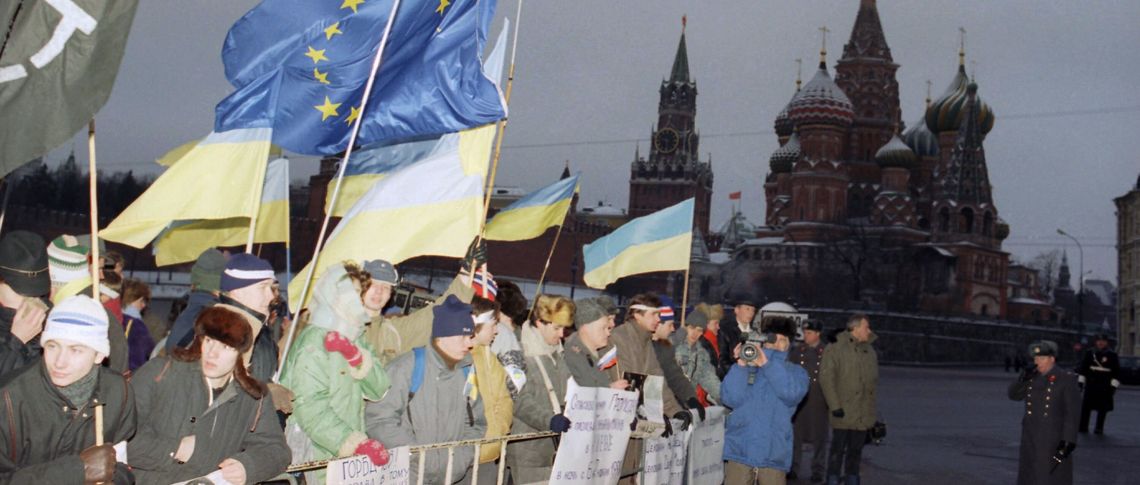
Europe has spent decades confronting the legacies of colonialism, slavery and racial hierarchy. This reckoning has been necessary and remains incomplete. Yet Russia’s war against Ukraine has exposed a major blind spot in Europe’s post-imperial imagination: the continent has learned to recognise some empires far more readily than others.
Russian domination of Ukraine is often described as aggression, revisionism or a security threat. It is all of these. But it is also imperial. The Kremlin does not simply seek territory or strategic depth. It denies Ukraine’s full historical and political subjecthood, treats Ukrainian culture as derivative and claims the right to determine whether the Ukrainian nation may exist independently.
Europe cannot credibly describe itself as post-imperial while recognising colonial domination in the West but treating Russian domination in the East as a separate matter of geopolitics. The answer is not to replace attention to Western colonialism with a new Eastern-centred hierarchy of suffering. It is to develop a more complete understanding of empire in Europe.
Ukraine has exposed a conceptual blind spot
Russia’s full-scale invasion has made the imperial character of its project difficult to ignore. Annexation has been accompanied by the suppression of Ukrainian education and public culture in occupied territories, the imposition of Russian citizenship and curricula, the appropriation of property and the deportation or forced transfer of Ukrainian children. According to data compiled by the Ukrainian government’s ‘Children of War’ portal and cited by the European Commission, more than 20500 children have been unlawfully deported or forcibly transferred since February 2022.
These are not incidental excesses of war. They are practices aimed at dissolving one political community into another. Imperial power operates not only by occupying land but by deciding which languages, memories and identities are permitted to endure.
Ukrainian intellectuals had described this relationship long before the full-scale invasion. Mykola Riabchuk has analysed Ukraine as a postcolonial society in which political independence did not automatically remove inherited cultural hierarchies or Russia’s assumption that Ukrainian identity was secondary and incomplete. Oksana Zabuzhko has explored the same domination through language, literature and memory: the culture of the imperial centre presents itself as universal, while the culture of the subordinated nation is reduced to something provincial or derivative.
The problem was therefore not that Europe lacked concepts for understanding Russian imperialism. It was that the voices articulating them were too often treated as regional, partisan or peripheral.
This matters as Ukraine’s relationship with the European Union becomes more concrete. Accession negotiations formally opened in June 2024, and in June 2026 the EU and Ukraine opened the first negotiating cluster, covering democratic institutions, the rule of law and fundamental rights. Enlargement is normally presented as a process in which a candidate adopts standards already defined by the Union.
Ukraine certainly has reforms to complete. But accession should not be imagined as a one-directional process in which a finished Europe teaches an incomplete Ukraine how to become European. Ukraine is also forcing the EU to reconsider its own historical categories, particularly its understanding of empire.
Hard to spot
One reason is that Western European discussions of colonialism were shaped mainly by overseas empires. This history established a familiar map: the imperial centre was European, while the colony was geographically distant and separated by the sea. Continental empires, overlapping populations and domination justified through claims of cultural kinship fitted this model less easily.
Alexander Etkind’s concept of Russia’s ‘internal colonisation’ helps explain this difference. Russian imperial expansion operated across adjacent territories, but colonial practices were also directed inward, towards populations that the state sought to control, modernise or culturally subordinate. The absence of an ocean between centre and periphery did not make these relations less imperial.
A second reason lies in the Soviet Union’s international identity. The USSR presented itself as an anti-imperial power and supported decolonisation movements in Africa and Asia. That support was materially important and cannot simply be dismissed. But external anti-colonialism coexisted with internal hierarchy, political coercion, Russification and Moscow’s control over the production of legitimate knowledge about Soviet republics and Eastern Europe.
Western analysts were more readily granted the authority to explain Russia than Russia’s neighbours were granted the authority to explain their own experience.
The Soviet system could therefore challenge Western colonialism globally while reproducing imperial relations within its own political space. This tension complicates any simple division between an imperial West and an anti-imperial socialist world.
A third reason is epistemic. Eastern Europe was often treated as an object of geopolitics rather than a producer of knowledge about empire. Ukrainian, Baltic, Polish, Georgian and other regional warnings about Russian power were frequently classified as nationalism, historical resentment or an inability to move beyond the Cold War. Western analysts were more readily granted the authority to explain Russia than Russia’s neighbours were granted the authority to explain their own experience.
Timothy Snyder brought the colonial interpretation of Russia’s war forcefully into the Western public debate after 2022. His influence helped make visible a perspective that Ukrainian thinkers had articulated for years: denying the existence of a nation and claiming the right to determine its political future are themselves imperial acts. The delayed reception of this argument reveals a hierarchy not only of power but also of whose knowledge Europe considers universal.
Recognition must not become competition
Correcting this imbalance creates another risk. Russian imperialism should not become an argument for minimising Western colonialism, and Eastern Europe should not present itself as an innocent region standing outside global histories of hierarchy, racism and domination.
A genuinely post-imperial Europe must recognise both overseas and continental empires without turning one history into an excuse for ignoring another. Western European states must integrate Russian and Soviet domination into their understanding of empire. Eastern European societies must also examine their own participation in imperial projects, treatment of minorities and tendency to regard colonial history as somebody else’s problem.
British rule in India, French rule in Algeria and Russian domination of Ukraine were not identical. Comparison is useful not because it erases differences, but because it identifies recurring mechanisms: denial of political agency, cultural hierarchy, control of knowledge, demographic engineering and the claim that the imperial centre understands the subordinated population better than that population understands itself.
A broader framework would also strengthen Europe’s relations with the wider world. European governments cannot credibly ask societies in Africa, Asia or Latin America to condemn Russian imperialism while appearing evasive about their own colonial pasts. Equally, opposition to Western hypocrisy should not require accepting Russia’s claim to represent anti-imperialism while denying Ukrainian sovereignty.
Enlargement should also transform the Union’s historical self-understanding.
The EU’s enlargement process is rightly described as geopolitical. Integrating Ukraine would anchor a country under attack within Europe’s political and legal order. But enlargement should also transform the Union’s historical self-understanding.
Ukraine is not merely returning to a Europe whose identity is already settled. It is exposing the incompleteness of the Europe it is expected to join. Its experience demonstrates that empire is not only something European powers once did overseas. It is also a recurring structure of domination within Europe and across its Eastern borderlands.
A post-imperial Europe cannot be built selectively. It must confront Western colonialism without treating Russian imperialism as an exception, and recognise Russian imperialism without using it to evade Western responsibility.
Europe will become genuinely post-imperial not when it declares the age of empire closed, but when it learns to recognise imperial domination wherever it occurs — including within its own contested geography.