


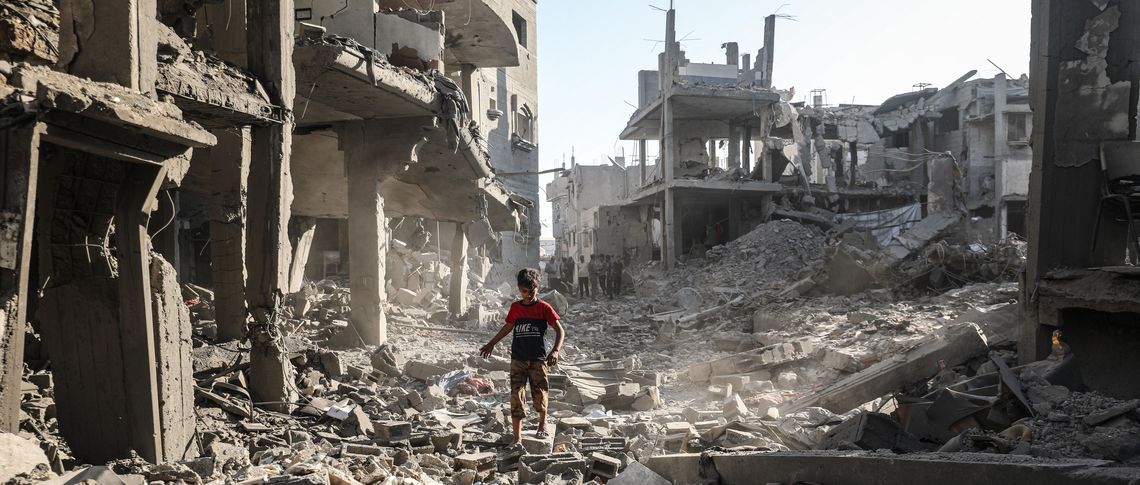
‘Ceasefire’ — the word sounds reassuring. And since Donald Trump succeeded in imposing this ceasefire with his 20-point plan, adopted by the United Nations as part of Resolution 2803, a little over nine months ago, the Gaza Strip has largely disappeared from the headlines. The war waged by Israel and the United States against Iran, as well as Israel’s devastating attacks in Lebanon, have further overshadowed public attention to the situation in Gaza.
Yet for the roughly two million people living in Gaza, the situation could hardly be more dramatic. First, there is no real ceasefire, despite the plan’s third point stating that ‘all military operations’ should come to an end. Air strikes continue almost daily, often carried out by drones. At times, attacks are also launched from warships stationed off the coast. More than 1 000 Palestinians have been killed in this way since the end of the war was announced in October 2025, almost a third of them children.
Second, virtually none of the other points of the arrangement – falsely described by Trump as a ‘peace plan’ – have been implemented, apart from the release of the Israeli hostages at the beginning of the process. The promised immediate and comprehensive assistance, the short-term ‘rehabilitation of infrastructure’, the ‘rehabilitation of hospitals and bakeries’ as well as the removal of rubble have all failed to materialise.
Extremist politicians in Israel openly state what their goals in Gaza are: permanent occupation and displacement.
The rationale behind the newly created structures – the Board of Peace, the Gaza Executive Board and the National Committee for the Administration of Gaza – was questioned from the outset, as their responsibilities could have been taken on by the United Nations and the Palestinian Authority. Instead, these new, dysfunctional parallel structures have contributed to the current political paralysis.
The National Committee, conceived as a transitional government, has still not even been able to enter Gaza after six months, as Israel has shown no interest in progress in the Gaza Strip or even in territorial unification with the West Bank. Nor has the plan for an international protection force linked to the disarmament of Hamas been able to move forward. Instead of pursuing negotiations, Israel continues its policy of targeted killings of Hamas leaders, despite Hamas recently announcing that it would formally relinquish its governing authority.
Meanwhile, extremist politicians in Israel openly state what their goals in Gaza are: permanent occupation and displacement. According to Finance Minister Bezalel Smotrich, plans for three Israeli settlements in northern Gaza – areas that Israel’s military has razed to the ground – already exist. Smotrich has also publicly spoken of settling the entire Gaza Strip.
A ceasefire without peace
The ‘yellow line’ established as part of the Trump plan, which is intended to mark the part of Gaza occupied by Israel, has gradually been pushed further in recent weeks. Contrary to the Trump plan, Israeli Prime Minister Benjamin Netanyahu has stated that Israel intends to permanently control 70 per cent of the territory. The population, already displaced several times internally, is living in the remaining, ever-shrinking area in tents or – at the risk of their lives – among the precarious ruins of their former homes.
Gaza also remains completely sealed off: Israel controls all border crossings and has imposed strict and opaque import regulations. Countless goods essential for humanitarian and medical care as well as reconstruction fall under a ‘dual-use’ classification. This means they cannot be imported because any potential military use must be ruled out. Numerous everyday items have been on the list since the beginning of the Gaza blockade in 2011, but since 7 October 2023 it has ultimately become an arbitrary instrument that amounts to collective punishment of the civilian population: wheelchairs, sleeping bags, tarpaulins and mobile toilets are all included. Vital medical equipment, such as ultrasound or dialysis machines, cannot be brought in. Thousands of seriously ill people cannot receive treatment, and otherwise harmless illnesses become life-threatening.
Finally, the Gaza Strip remains sealed off from the outside world as well: journalists are not permitted to enter. Aid organisations and the United Nations have withdrawn their international staff and are not being granted work permits. A coordinated disinformation campaign against the United Nations Relief and Works Agency for Palestine Refugees (UNRWA) has contributed to rendering what was once the most important provider of humanitarian aid, healthcare and education in Gaza incapable of operating.
The Israeli government, for its part, points out that around 600 lorries a day are crossing into the Gaza Strip. However, aid and human rights organisations make clear that only around 100 of these are carrying essential humanitarian supplies and basic foodstuffs. The remainder consists of consumer goods — and these are not determined by the needs of the population, but by the profit interests of (Israeli) importers. Even access to clean drinking water is not guaranteed in Gaza during peak summer temperatures of 40 degrees.
Europe’s failure to act
This inhumane situation is affecting an already severely weakened and traumatised population — more than half of whom are children. For two years now, they have been unable to attend regular classes, as all schools and universities have been completely destroyed. A study conducted during the war showed that, given the reality of death and destruction they face, children in Gaza almost universally expect to be killed in attacks. At that point, life expectancy in Gaza had fallen from more than 75 years to a shocking 35 years.
The unbearable conditions facing Gaza’s predominantly young population are well known, regardless of whether one describes the devastating consequences of war and destruction for Gaza’s population as genocide, as international and Israeli human rights organisations, the United Nations and the overwhelming majority of genocide scholars have done for some time. And yet the international community is failing to stop this suffering. Unlike many other conflicts with similarly disastrous consequences for civilians, however, the situation could be changed from one day to the next: through a controlled opening of the border and the import of everyday goods that could work towards restoring normality and make reconstruction possible.
The EU bears particular responsibility in this regard: it welcomed and supported the Trump plan and Resolution 2803; it is also present, at least in an advisory capacity, in the structures that were created, for example through the Civil-Military Coordination Centre (CMCC), which monitors the ceasefire. The EU knows exactly how dramatic the humanitarian situation in Gaza is — and they also know its cause.
If the German government and the EU continue to refuse to exert pressure on Israel to improve the situation of people in Gaza, the consequences will be disastrous.
Against this backdrop, Commission President Ursula von der Leyen’s recent celebration of the provision of aid funds for Gaza as a ‘heartwarming success’ is cynical. As long as no pressure is exerted on the Israeli government, the aid cannot reach those who need it. The establishment of a Team Gaza Initiative by 15 states, which Germany has also joined, is similarly futile in this respect. It states that the initiative aims to work ‘constructively’ with Israel. Yet the current Israeli government has made it abundantly clear on numerous occasions that it has no interest in doing so.
The debate over an import ban on settlement products has highlighted just how contradictory in particular Germany’s position is. Although settlements have for years been unequivocally condemned as illegal under international law, the German government is resisting concrete and effective measures at EU level, such as an import ban. While EU member states willing to take such action are calling for a majority decision, as is possible in the field of trade, German Foreign Minister Wadephul is blocking this by insisting on a unanimous decision. The Israeli government can only interpret this as a green light for its policy of settlement expansion and displacement, and it contributes significantly to further escalating the conflict.
As with the settlements in the West Bank, the EU and the German government have a legal obligation to take active steps against these violations of international law. Access to humanitarian aid must be guaranteed, and the International Court of Justice (ICJ) has already called on Israel to do so on several occasions. If the German government and the EU continue to refuse to exert pressure on Israel to sustainably improve the situation of people in Gaza, the consequences will be disastrous: continued attacks, a humanitarian crisis, the displacement of parts of the Palestinian population, permanent occupation and, most likely, the imminent inauguration of Israeli settlements in Gaza. European and German policymakers will condemn this once again — but it will be too late to act.


