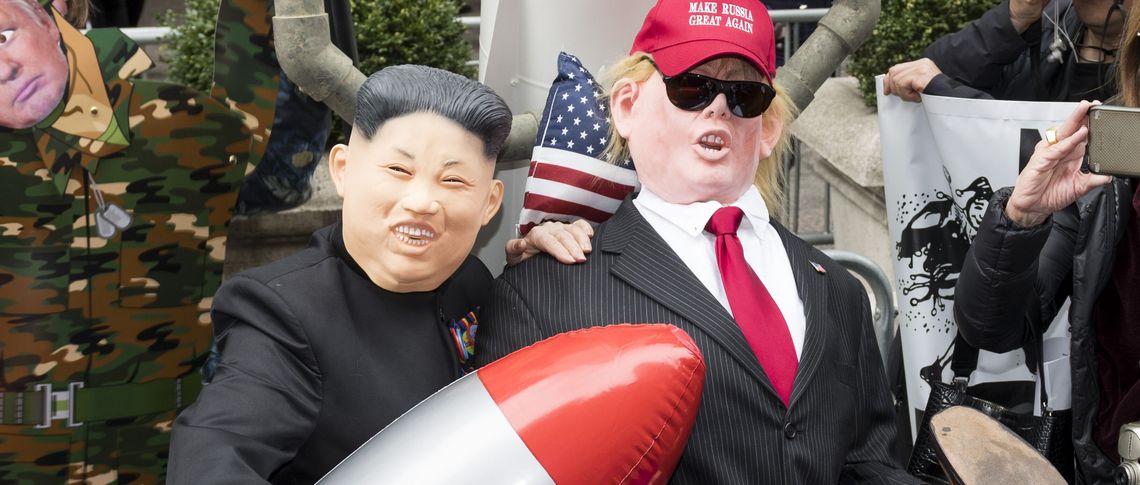
The supposed right of the stronger has become a weakness. Great military powers such as the United States, Russia and Israel have increasingly relied on military force in recent years as a means of advancing their interests. In their capitals, the conviction prevailed that international law was useless or even an annoying obstacle.
Before his appointment, US Secretary of Defence Pete Hegseth wrote in a book that American soldiers should ‘not fight according to rules that honourable men wrote in mahogany-panelled rooms eighty years ago.’ In a world order in which power is enforced through violence, there is no place for the laws of war embodied in the Geneva Conventions or for the prohibition on the use of force contained in the UN Charter.
The policies of recent months seemed to confirm this attitude. Russia’s war of aggression against Ukraine, the genocidal violence in Gaza, the military intervention in Venezuela, and the war against Iran are expressions of a blatant disregard for international law. These developments offer a glimpse into a dystopian future of permanent danger of war, immense suffering, and the threat of a global economic crisis: this is what a world without rules would look like. For precisely that reason, the most recent conflicts deserve closer examination. They show that military superiority may start wars, but it cannot replace political order.
Proving its relevance once more
By now, these conflicts have revealed that such a world order is itself harmful and unsustainable even for military great powers such as the United States, Russia and Israel. Although they possess greater resources and modern technology, they have not succeeded in prevailing over countries such as Ukraine or Iran. Israel cannot find a solution for the future of Gaza and the Middle East through military force alone, Russia may be compelled into negotiations that would ultimately result in an agreement, and even in Iran the United States had to return to the practice of international law because the conflict ultimately could not be resolved militarily.
Donald Trump, of all people, demonstrates how quickly even great powers run up against limits without rules, agreements, and international institutions. In January, the American president declared that he ‘did not need international law.’ In an interview with the New York Times, he explained that the only limitation on his power was his own moral principles. Trump prides himself on turning away from international law and multilateralism. He pointed to the abduction of Venezuelan President Nicolás Maduro, his plans to take over Greenland, and the airstrikes against Iran’s nuclear program last year. On his desk, while he spoke, stood a model of the dragon-like B-2 bomber used for those attacks.
International law was never merely an instrument of idealists; it has always also been an instrument of power.
Half a year later, however, it has become clear that even a politician like Trump ultimately cannot do without international law. In June, he signed an agreement with Iran intended to end the recent hostilities. Although many questions remain unresolved after its conclusion and parts of the agreement remain vague, for example, regarding future shipping through the Strait of Hormuz, the agreement did temporarily end the fighting, something that could not be achieved militarily. It establishes common objectives, agreements, and mechanisms for their enforcement — precisely the reasons why states have needed international law for centuries.
Why is that? Because historically international law did not emerge solely as a moral project, but also as an instrument for organising political power. Modern international law developed in the nineteenth century because it was easier and more efficient for countries to use the same units of measurement or to conclude agreements on the transmission of telegrams. Great powers used law to define their imperial territorial claims and consolidate their positions of power. As early as 1758, the French philosopher Jean-Jacques Rousseau recognised in his work The Social Contract that ‘the strongest is never strong enough to remain master forever unless he transforms his strength into right.’ International law was never merely an instrument of idealists; it has always also been an instrument of power.
Unlike a ‘treaty,’ the title ‘Memorandum of Understanding’ (MoU) between the United States and Iran implies a non-binding arrangement. However, the International Court of Justice in The Hague, the highest UN court, ruled in the 1990s in a dispute between Qatar and Bahrain that even the minutes of a meeting can have a legally binding effect under international law. What matters is not the title of a document, but the intention behind it and its language. Politically, this is crucial. Even a government that demonstratively rejects international rules returns to precisely these instruments in times of crisis.
The wording of the US-Iran deal suggests more than a mere statement of intent. The text does not set out general aspirations but concrete steps to which both sides commit themselves: the end of the American naval blockade within 30 days and the development of a $300 billion reconstruction plan; the clearing of sea mines by Iran; and the joint management of traffic through the Strait of Hormuz together with Oman.
The agreement commits both sides to concrete political steps: refraining from the use of force, regulating shipping through the Strait of Hormuz, and subjecting Iran’s nuclear program to international oversight.
In the agreement, the United States and Iran even explicitly invoke international law. By pledging in the first of its 14 points to refrain from military force against one another and to avoid threats, both countries return to the language and principles of the UN Charter, whose core principle is the prohibition on the use of force. According to Point 5, the administration of the Strait of Hormuz must take place ‘in accordance with international law.’ And under Point 8, the handling of enriched material that can be used for nuclear energy or nuclear weapons is to be placed under the supervision of the International Atomic Energy Agency. In other words, the countries are relying on the customary instruments of international law.
The agreement commits both sides to concrete political steps: refraining from the use of force, regulating shipping through the Strait of Hormuz, and subjecting Iran’s nuclear program to international oversight. In other words, it relies precisely on those instruments - agreements, international supervision, and common rules - whose importance the Trump administration had repeatedly denied previously.
Trump has already announced that he would be prepared to resume military action and drop bombs should Iran fail to comply with the agreement. The agreement is therefore not a renunciation of the future use of force. Yet the supposed right of the stronger is increasingly proving to be a strategic weakness. Military superiority can deter adversaries or start wars. It cannot create lasting political order. Even great powers remain dependent on rules, agreements, and international law — not despite their power, but precisely to secure it.