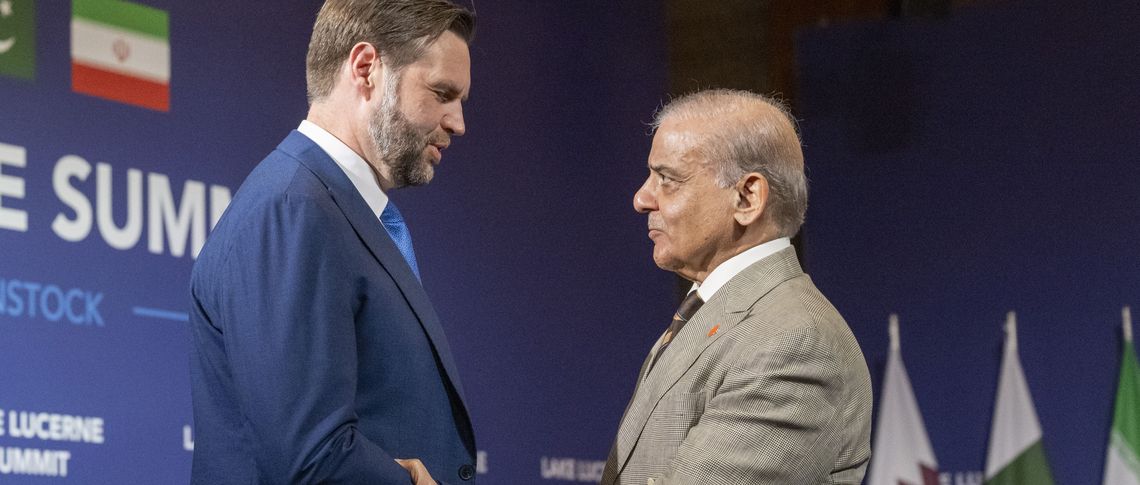
In the streets of Islamabad and across screens around the city, Prime Minister Shehbaz Sharif and Chief of Army Staff Field Marshall Syed Asim Munir were lauded for their role in securing peace. They spoke of the ‘Islamabad Memorandum’ – the June agreement that established a ceasefire between the US and Iran. Although the memorandum is currently under severe strain, it remains the only viable diplomatic framework to pull the region back from the brink of a wider conflagration.
It is difficult to watch these images and not be transported back a decade, when in 2015, the European Union was a central player on the Iranian file. The Joint Comprehensive Plan of Action (JCPOA) was the culmination of a mainly European-led diplomatic effort since the early 2000s to resolve the Iranian nuclear dossier peacefully. The JCPOA became a powerful symbol of effective multilateral diplomacy. Europe was not a bystander, but an essential diplomatic partner.
How completely the tables have turned. In 2026, Europe finds itself with virtually no leverage over Tehran, relegated to the role of a spectator while Pakistan steps into the mediator’s role. The question is not only how and why this happened, but what it tells us about how Europe can remain relevant in a diplomatic landscape increasingly shaped by regional powers.
Ultimately shared interest
The narrative of European failure is a straightforward one. After the US withdrawal from the JCPOA in 2018, the EU, led by the E3 (France, Germany, and the UK), failed to deliver the promised economic benefits that would have kept Iran in the deal. The specially devised trade vehicle known as INSTEX never proved to be functional. European firms, fearing US sanctions, abandoned the Iranian market, rendering the EU’s political commitments hollow. The E3 gradually moved closer to the more hawkish US position, culminating in an invocation of the snapback of the nuclear-related sanctions against Iran in the UN Security Council in 2025. This has effectively squandered Europe’s independent diplomatic capital.
However, this is not solely a story of European failure. It is also a story of Iranian choice. Tehran’s fateful decision to support Russia in its war against Ukraine – supplying the drones that terrorise Ukrainian cities – was a pivot born not just of disappointment with Brussels. Iran’s then-leaders, including Supreme Leader Ali Khamenei and Foreign Minister Hossein Amir-Abdollahian, actively embraced the Russian narrative that NATO’s expansion ‘provoked’ the war. The EU saw it as a profound strategic shift in Tehran’s posture which severely undermined ties.
The US and Pakistan have close military-to-military ties. Asim Munir built a strong relationship with US President Donald Trump.
Pakistan’s emergence as a mediator is not simply a consequence of European or American decline. It is rooted in Islamabad’s own strategic calculus – a blend of diplomatic ambition, historical tradition and the recognition that regional stability is also a domestic imperative.
For decades, Pakistan has sought to position itself as a bridge between adversaries. In the early 1970s, Pakistan provided a backchannel that allowed Richard Nixon and Henry Kissinger to reach out to Communist China – one of the most consequential diplomatic gambits of the twentieth century. That ambition to serve as a bridge between adversaries remains intact today. At the same time, the need to prevent a wider regional war and its destabilising spillover has made mediation not just an opportunity for Islamabad, but an imperative.
In that context, Pakistan leveraged its unique position as a state with longstanding ties to both Washington and Tehran. The US and Pakistan have close military-to-military ties. Asim Munir built a strong relationship with US President Donald Trump.
At the same time, Pakistan has a 900 km-long border and historically, religiously and culturally close relationship with Iran (for one, around one fifth of Pakistan’s population are Shia Muslims). In the 1980s, Pakistan attempted to mediate the devastating Iran-Iraq war. Pakistan has also expressed support for Iran’s right to a peaceful nuclear program. As a non-permanent member of the UN Security Council in 2025 and 2026, Islamabad condemned US and Israeli attacks on Iran.
Concerned with the potential spillovers of a wider regional war, Islamabad leveraged its credibility with both parties to push for off-ramps. Prime Minister Sharif and Field Marshal Munir launched an intensive, discreet diplomatic blitz, including multiple trips to Tehran. In doing so, Pakistani officials studiously avoided ‘megaphone diplomacy’ – voicing no judgments on the positions of the parties or public exhortations other than calls for de-escalation and negotiations.
Pakistan’s standing was also enhanced by something no mediator in the Gulf, such as Qatar or Oman, could offer: physical safety for Iranian negotiators at a time when Israel made no secret of its skepticism of the talks and its determination to strike anywhere in the Middle East at will. This approach paved the way for the highest-level talks between the US and Iran since 1979, eventually leading to the Islamabad Memorandum.
The EU and Pakistan share a common interest in regional stability.
Even as the memorandum falters, Islamabad persists. That persistence aligns with Europe’s own interest in averting a wider regional war at its doorstep. EU High Representative Kaja Kallas has rightly welcomed Pakistan’s mediating role and stressed the need for a ‘durable’ agreement.
The EU and Pakistan share a common interest in regional stability. Rather than lamenting Pakistan’s rise as evidence of its own declining influence, Europe should see Islamabad as a potential partner whose unique access and credibility can advance shared goals. One way of boosting Pakistan’s own resilience would be stepping up counter-terrorism cooperation against groups like Pakistani Taliban and Balochistan Liberation Army, within the framework of the EU’s international human rights commitments.
The EU will not always be the decisive mediator in every global conflict. The strategic response to this reality should not be retreat, but rather the cultivation of partnerships with regional actors who possess the access, trust and credibility that Europe may currently lack. Pakistan’s role in the Iran dossier serves as a concrete example of this development: in a multipolar era, European effectiveness depends on its ability to support and collaborate with new centres of diplomatic gravity.