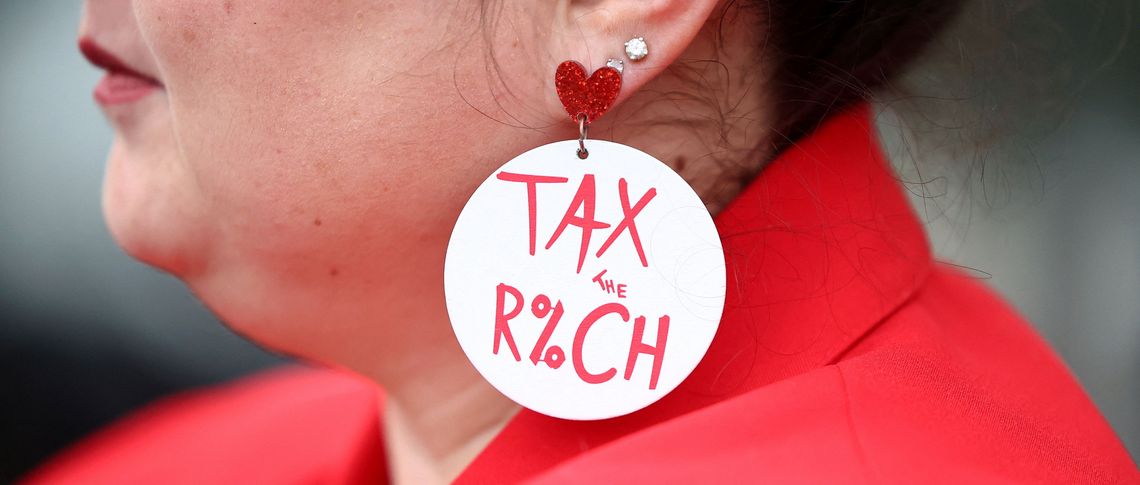
California could soon become the first US state to make billionaires pay a tax on their wealth. On 3 November, Californians will vote not only in the US midterm elections, but also on a one-time five per cent levy on the assets of every billionaire residing in the state. The tax is expected to raise around $100 billion, primarily for healthcare.
To secure the proposal’s place on the November ballot, the labour union behind the initiative had to overcome significant hurdles. It collected nearly one million signatures and faced fierce opposition from California Governor Gavin Newsom, who, alongside the billionaires themselves, fought relentlessly to block the measure. With the measure now on the ballot, a handful of billionaires – led by Google co-founder Sergey Brin, who has contributed over $100 million – have poured more than $156 million into a campaign to defeat it, all with the governor’s tacit approval.
But the stakes extend far beyond California. If adopted, this tax could spark similar initiatives in states like New York, Washington and Massachusetts — and even inspire global action. California, and the United States as a whole, could become the catalyst for a worldwide movement to end the tax impunity of the ultra-rich.
Start small, think big
This potential shift is particularly ironic given the current geopolitical climate. Donald Trump’s re-election has accelerated the crisis of multilateralism across geopolitical, trade, public health and humanitarian dimensions. Taxation is no exception. Trump has undermined international agreements on multinational corporations, threatening retaliation and securing exemptions that shield US multinationals from key provisions of the global minimum tax. The challenge is similar when it comes to the super-rich: despite the G20’s 2024 acknowledgement that the ultra-wealthy evade taxes globally and require a coordinated solution, rapid global agreement now seems unlikely.
Multilateral efforts nevertheless remain essential — despite the fierce attacks they are facing. This includes the Fourth International Conference on Financing for Development (FFD4) and the coalition led by Spain and Brazil, committed to advancing global wealth taxation. The UN Framework Convention on International Tax Cooperation (UNTC) has also begun addressing this issue, despite its glaring lack of resources.
Support for taxing the ultra-wealthy has never been more popular.
Of course, no one expects the Trump administration to support a global minimum tax on billionaires. This does not, however, grant the United States a veto over what other countries choose to do. This is why, given the current geopolitical landscape, the most effective path forward may be to complement global efforts with action at the national and regional levels, especially since support for taxing the ultra-wealthy has never been more popular. In the European Union, for example, 65 per cent of citizens support a minimum wealth-based tax on the top 0.001 per cent.
History supports this approach. The individual income tax did not emerge from an international agreement. It began with the UK’s 1909 People’s Budget, which introduced a 2.5 per cent supertax on the 10 000 wealthiest individuals. This triggered a global domino effect, spreading to France, the US and eventually achieving near-universal adoption.
A similar domino effect could help end the tax impunity of the super-rich today. When one country or progressive state implements such a tax, it breaks the political paralysis by proving that wealth taxation is both legally and administratively feasible. This sets a gold standard that neighbouring nations can adopt with reduced political risk.
This shift will be all the easier because research – including our own at the International Tax Observatory – has entered the debate by revealing the effective tax rates paid by all social classes. For the first time, we can see that the ultra-rich, the top 0.001 per cent, pay, on average, half as much in taxes as other groups. Once this reality is visible, it’s impossible to ignore. The debate shifts from whether a problem exists to how to solve it — or, as some politicians choose to do, to give up in the face of the power wielded by a handful of oligarchs, but with an increasingly high political cost.
The link between tax regressivity, inequality and the erosion of democracy is becoming impossible to ignore.
We’ve seen this play out in real time. In France, our work inspired the first legislative implementation of the G20’s proposal: a minimum tax on the super-rich that accounted for past mistakes. Critically, it included no exemptions and targeted total wealth — not income, which the ultra-wealthy can easily manipulate to near-zero levels. While the bill was ultimately rejected by the Senate after passing the National Assembly, we expect the issue to resurface this fall during budget debates and become a central topic in the 2027 presidential election. Similar bills are now expected in Spain, Belgium and the Netherlands. The issue is also stirring up the political scene in Germany, where the country’s social democratic SPD has announced it will make inheritance tax reform and wealth taxation a top priority, and in the UK following the change in prime minister in July.
There is, of course, one main objection to a country moving forward on its own, and this is, in fact, what terrifies politicians (or serves as their excuse for inaction): that it could cause billionaires to leave. This is a legitimate concern. However, evidence shows that tax-induced migration among the ultra-wealthy, while real, is limited. Moreover, it is not inevitable: countries can deter relocation by strengthening exit taxes and introducing trailing taxation, which would subject departing billionaires to the minimum tax for five, 10 or even 15 years after their departure, with credits for taxes paid abroad.
As more countries adopt compatible measures and coordinate them, these policies can gradually evolve into an international standard. National action can thus lay the groundwork for renewed international cooperation.
The link between tax regressivity, inequality and the erosion of democracy is becoming impossible to ignore, and the urgency of this crisis demands that we act now — even unilaterally. Inaction in the name of multilateralism would only allow oligarchs to further entrench their control over our democracies, while proactive steps today will ultimately strengthen the case for global cooperation tomorrow.