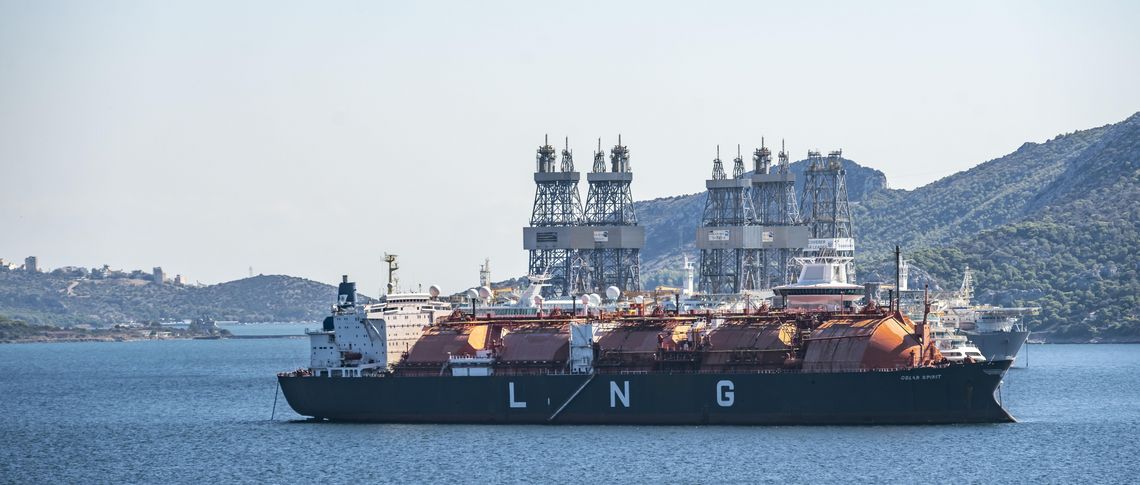
In July, the European Union adopted its 21st sanctions package against Russia. Initially described as the bloc’s most ambitious package to date, it arrived more than a week late, and only after Greece dropped a veto in exchange for a carve-out: European vessels may continue carrying Russian liquefied natural gas (LNG) to non-EU customers under contracts signed before the February 2022 invasion, with a cap at the annual volume exported in 2025.
Europe announces a new sanctions package against Russia every few months, and each time, the pattern is much the same. The boldest measures are quietly watered down — not by Moscow, but by an EU member state protecting its own industry.
The next package is due this autumn. If it is to be stronger than the last, the EU should look not to Moscow but to what happened in the negotiating room in Brussels, where the 21st package was diluted.
The problem starts in Brussels
The problem, then, is not Russian ingenuity in evading sanctions. Rather, it is the fact that for four years, Europe has closed loopholes one at a time while leaving intact the business model that makes them profitable. The shadow fleet is a fleet Europe failed to stop. The Dynagas fleet is one Europe has now agreed to protect.
Greece hosts the world’s largest merchant fleet, and it shocked other member states by demanding a revision of an LNG transport ban already agreed unanimously in an earlier package. The request was backed by Dynagas, a transport company owned by billionaire George Prokopiou, which, together with its subsidiary, has chartered 11 vessels to Russia’s largest gas facility, Yamal LNG.
Dynagas, together with Dynacom Tankers, have earned an estimated $915 million from Russian crude trading in three years. Athens backed the company’s argument that a ban would damage Europe’s maritime industry, cost jobs and do little to dent Moscow’s war chest.
Sanctions are a source of real leverage — and they work.
Two features make this more than a one-off concession. The exemption is defined by contract date rather than conduct, so the deepest pre-invasion commercial relationships are precisely the ones now shielded. And it is reviewed annually, meaning Athens never has to win the argument again. It needs only to threaten a veto once a year.
That is not simply a loophole. It is a renewable licence to weaken the EU’s own sanctions policy, with the result of helping to contribute to Russia’s war in Ukraine.
Although Greece has been a much-discussed example, the problem extends far beyond a single member state. In the same negotiation, Austria secured agreement to reconsider sanctions on Russian firm Rasperia to offset a €2.1 billion loss at Raiffeisen. And Hungary and Slovakia have spent years extracting exemptions for their refineries and, when it suited them, threatened to block aid to Ukraine outright.
None of this would matter if sanctions were failing. But the leverage is real, and it works.
Moscow is feeling the pressure
In the first quarter of 2026, Russia spent $76.2 billion on defence — that is about 65 per cent of its federal revenues and 30 per cent more than a year earlier. Meeting that bill is getting harder. This year’s April oil and gas revenues were still 21 per cent below those of April 2025, and of the 917 billion roubles raised by the mineral extraction tax, 378 billion went straight back to producers through compensation schemes.
Moscow is paying its own oil companies to keep pumping, while GDP runs 10 to 12 per cent below its pre-invasion trend. Every exemption is a transfer of relief to a state that has run out of easy money.
In June, Russia earned some €734 million a day from fossil fuels. Fifty-four per cent of its seaborne oil moved on sanctioned shadow tankers, and 43 per cent on tankers owned or insured in G7+ countries, meaning that more than two-fifths of the trade still depends on Western shipping and insurance. Downstream, refineries in India, Türkiye, Brunei and Georgia sold €814 million of Russian-crude products to sanctioning countries, eight cargoes of which were unloaded at EU ports despite the import ban.
Europe has answered each channel in turn: listing vessels, capping prices, banning imports, then banning refined products. What it has never done is treat the European maritime services complex – the owners, charterers, insurers and brokers without which Arctic LNG cannot reach a buyer – as the object of policy rather than a constituency to be accommodated.
Calling the problem sanctions evasion misdiagnoses it.
That distinction matters. Sanctions can prohibit a particular cargo or list a particular vessel, but if the wider commercial infrastructure remains available, the trade adapts. Russia’s shadow fleet is evidence of that adaptation.
This is why calling the problem sanctions evasion misdiagnoses it. EU enforcement is genuinely fragmented, with each state applying sanctions through its own legal system. But no authority can enforce against conduct the Council has authorised. A customs officer cannot detain a lawful cargo. The failure sits upstream, in the drafting room.
Unanimity is defended as a guarantee that every member state stands behind common policy. In practice, it guarantees that any government with a concentrated domestic interest can convert that interest into European law, because the price of its consent is paid by 26 others in exemptions.
This is the structural problem the next sanctions package needs to address. The issue is not simply whether Europe can devise another restriction. It is whether the Union can prevent individual exemptions from hollowing out the restrictions it has already agreed.
The answer should begin with the way derogations are handled. Every derogation should expire on a fixed date and require a positive unanimous vote to continue, so that the burden of assembling 27 votes falls on those who want the trade to survive.
Every extension is measured, eventually, in how long my country has to keep counting drones at night.
European-linked carriage of Russian LNG should be banned by ownership, flag, management and charter, with no contract-date exception. The maritime services prohibition should be extended to all Russian energy exports. Refined-product origin should become a due-diligence obligation with liability attached; eight cargoes in one month is not an intelligence problem but an absence of consequences.
These measures would not eliminate sanctions evasion. They would, however, address the European infrastructure that allows Russian energy to continue reaching global markets.
Sanctions have cost Russia over €1 trillion so far. This has seriously impacted the Russian economy, limiting its ability to wage brutal war on my country of Ukraine and causing a rise in public dissatisfaction with the progress of the war within Russia.
The question now is whether Europe is prepared to use the leverage it has created. Whether tough sanctions remain a major factor forcing Putin towards a peace settlement does not depend solely on Russian efforts to evade them. It depends on whether the European Union will write rules that bind all of Europe to the same policy — and stop turning exemptions into a permanent feature of it.
For Ukraine, this is not an abstract question of sanctions design. Every exemption extends the commercial relationships that help sustain Russia's war economy. And every extension is measured, eventually, in how long my country has to keep counting drones at night.