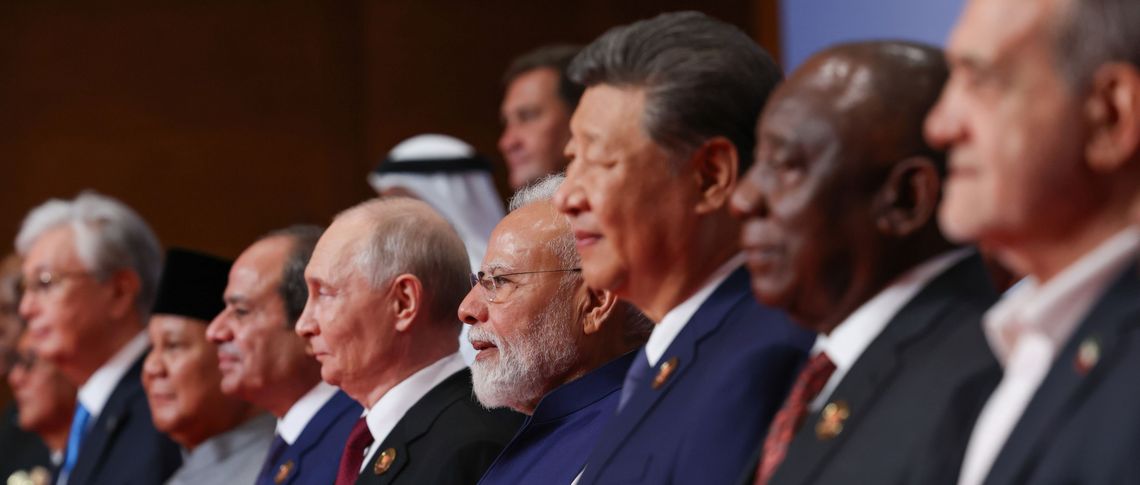
The Kremlin spokesman Dmitry Peskov stated that, at the most recent BRICS summit, which took place in New Delhi from 12 to 13 September, India and China had raised detailed questions regarding the agreement on Ukraine and had actively offered their ‘goodwill’ in order to find a solution. But just how much genuine willingness to mediate lies behind this gesture, which, of all places, the Kremlin is reporting on?
In fact, the host, Narendra Modi, is reported to have told Putin during a meeting on the sidelines of the summit that ‘dialogue and diplomacy are the way to resolve conflicts’ and – switching from Hindi to English for the next sentence – that one must move ‘from endless war to an end to the war’. It was already Modi’s second direct call of this kind: Just two weeks earlier, at the Shanghai Cooperation Organisation summit in Kyrgyzstan’s capital, Bishkek, on 31 August, he had called on Putin to bring the war in Ukraine to a swift end. India, said Modi, the land of Buddha and Gandhi, stands for one message: peace. China’s leader Xi Jinping was not quite so explicit, at least according to the reports. In his speech to the BRICS nations, he did speak of China’s rejection of ‘any violation of the sovereignty of other countries’. Yet in China’s rhetoric, this phrase is often directed against the West as well – for instance, when Beijing accuses it of ‘interference in the affairs of other states’. At the same time, it is regularly invoked when China is accused of supporting Putin in his war.
Vested interests
Rhetorically, both countries have little choice but to do so, as they – at least officially – adhere to a foreign policy doctrine of non-aggression and non-interference. In China, this is known as the ‘Five Principles of Peaceful Coexistence’; in India, as ‘Panchsheel’. These principles were first jointly proclaimed at a meeting between the Indian Prime Minister, Jawaharlal Nehru, and the Chinese Premier, Zhou Enlai – initially as guidelines for Sino-Indian relations, and later as the foreign policy doctrine of both countries.
Yet whenever China is asked by Western actors to take on a mediating role in the war in Ukraine, the Chinese government always gives the same response: China is prepared to act as a mediator if all parties involved are willing to do so. But what exactly does this condition mean? Prepared for what – for negotiations, for a ceasefire, for peace? If one examines the statement more closely, it becomes clear: this is not a traditional offer of mediation or goodwill. China is evidently not prepared to bear the risk of the negotiations failing itself. Rather, the offer of ‘good offices’ is limited to providing a platform for an agreement and, if necessary, bearing witness to it – much like the agreement between Iran and Saudi Arabia.
India has an interest in seeing the war end – not least out of concern that the conflict might drive Russia ever deeper into China’s embrace.
As far as a swift end to the war is concerned, the interests of India and China may diverge. New Delhi, the world’s second-largest importer of Russian oil after China, has certainly benefited from falling prices for Russian oil, but is facing increasing economic pressure from Washington’s punitive tariffs. India therefore has an interest in seeing the war end – not least out of concern that the conflict might drive Russia ever deeper into China’s embrace.
For China, on the other hand, the answer is: it depends on how the war ends. It is safe to assume that Beijing wants neither to see Putin lose nor to see him win. A defeat for Putin would most likely mean a chaotic transition and an unpredictable future – regardless of who might succeed him. If, on the other hand, Putin wins in Ukraine, the next question arises: Who can guarantee that he will not subsequently set his sights on another region that he regards as Russia’s backyard? For instance, Central Asia, where China has its own interests – not only because of its investments in the oil and gas sector, but also because the Central Asian states border Xinjiang. In short: from Beijing’s perspective, Russia must not lose – but nor must it win.
During the summit, Putin threatened Europe with war. Does this not make Russia, within the BRICS, something of a risk to the alliance – which sees itself as the architect of a new world order – particularly for countries such as China and India, which are closely intertwined with Europe economically? Yes, and it is precisely for this reason that, from the Chinese and Indian perspective, Putin should be closely integrated. For China, Russia has always been regarded as an unpredictable partner. If one is to believe Chinese experts on Russia, Xi does not meet Putin so frequently because he is particularly fond of him – even though there are those who believe that Xi likes and admires the Russian president – but because this relationship requires a great deal of management.
For China, Russia has always been regarded as an unpredictable partner.
The rapprochement between Russia and North Korea is also likely to be a cause for concern for the Chinese leadership – particularly the possibility that Moscow might share nuclear technology with Pyongyang. Nor should we forget history: in 1969, a border conflict between China and the Soviet Union nearly escalated into an open war between two nuclear powers, and diplomatic relations remained severed for 25 years afterwards. The two countries share a border stretching over 4000 kilometres, and the stability of this border is a top priority for China.
But suppose China did in fact have an interest in ending the war as quickly as possible: does Beijing even have the necessary leverage? After all, it is often said that Russia could scarcely continue the war without Chinese support. When speaking to experts in China, it seems that hardly anyone believes China has such leverage. Nor is there any belief that economic pressure could force Putin to change his strategy.
If its own stability is the top priority – and possibly the most important lens through which Beijing views its relationship with Moscow – then China’s willingness to mediate also has a clear limit: it must not jeopardise its relationship with Russia. As far as Beijing is concerned, the outcome for Russia must remain inconclusive – and China will only mediate as long as it has nothing to lose itself. Beijing is therefore not the risk-taking mediator. If anything, it is the notary who ultimately certifies the signatures.