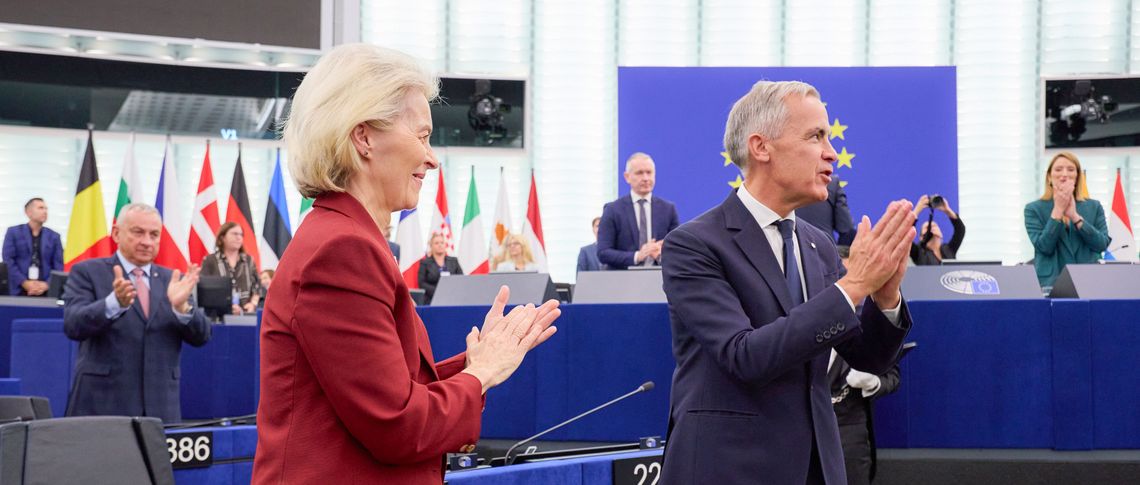
‘The EU is stronger and more vulnerable than ever before’, said Ursula von der Leyen, President of the European Commission, as she opened her long-awaited State of the Union address. Every year, both in Brussels and in Strasbourg, the State of the Union is a major political event. Not only is the Commission expected to set out its priorities for the coming year, but also to provide a clear assessment of the current global situation. Last year, the speech triggered strong reactions from the various political groups in the European Parliament. This year, however, the initial responses were more subdued: almost every political group seemed to find something for itself in the speech, albeit to very different degrees.
On closer inspection, however, a different picture emerges. Compared with last year, hardly any new initiatives were announced. Instead, the speech primarily continues the Commission’s existing political direction. It is precisely this continuity – beyond the numerous individual measures and announcements – that highlights how significantly the Commission’s political focus has now shifted towards competitiveness, deregulation and security. Many of the social issues that directly affect people in Europe played hardly any role in this context.
The economy wins again
One thing in particular stands out from the Commission President’s speech — the economy. The fact that this forms the first major section of the speech following the introduction underlines its central importance. Von der Leyen begins with a positive outlook: the European economy has weathered the numerous challenges of the past year. And indeed, the unemployment rate in the EU is at a historically low level. And yet, simultaneously, the President stated, ‘fiscal decisions’ must now be taken.
Even before the speech, the Social Democrats had criticised the fact that, of the nearly 400 promised initiatives, around half relate to competitiveness, whilst only about one in ten concern social justice. The ‘simplification’ (deregulation) process initiated by the Commission – which includes, amongst other things, the much-discussed omnibus packages – was also brought back into the spotlight, with the point being made that this alone is not enough to further boost the economy.
The central role of the economy is skilfully linked to the issue of security and the threat posed by China. Using rhetoric that is at times reminiscent of Donald Trump’s statements, von der Leyen refers to the trade deficit between the EU and China, while also highlighting the positive economic effects of the growing European security sector. A vivid imagination might read a great deal into these connections: economic and security policy are increasingly becoming two sides of the same narrative.
Von der Leyen also addressed numerous issues, which she summarised under the term ‘tipping points’ — ranging from the risks and opportunities of artificial intelligence to the challenges posed by climate change. Nevertheless, although the range of topics was broad, important points remained unaddressed, notably with regard to certain social issues.
What the speech left out
Housing shortages are a key issue for the Social Democrats. Whilst the speech did touch upon this, the coverage was comparatively brief given the scale of the European housing crisis — despite it being one of Europe’s most pressing social problems.
In many parts of Europe, rents have risen dramatically over the past 10 years: in Madrid, for example, by 75 per cent, and in Lisbon by as much as 103 per cent. More than half of Europeans regard high housing costs as a very serious problem. The proposed Housing Act could be a first step in this regard. Nevertheless, it remains to be seen whether it will seriously address the underlying structural causes of the housing shortage.
The gap becomes even more apparent when it comes to the issue of fair taxation. The President made no mention of this in her speech. Yet the EU faces considerable funding needs. An EU-wide minimum tax on capital gains, higher taxation of large fortunes, a tax on share buy-backs and the systematic taxation of windfall profits could be a starting point here. The calculations by the economist Gabriel Zucman illustrate just how necessary such a shift is: billionaires effectively pay only around 0.3 per cent tax in relation to their wealth. A minimum tax of two per cent on their wealth could mobilise around $200 to 250 billion annually worldwide.
Anyone who had expected a speech setting out a groundbreaking new programme is likely to have been justifiably disappointed.
This is not just about redistribution. It is about the fundamental question of who contributes to the financing of public goods, social security and the ecological transition. Particularly in times of tight public budgets, the question therefore arises: why has fair taxation not been mentioned at all?
On the issue of migration, which continues to dominate elections across Europe and is increasing political pressure from the right, von der Leyen largely stuck to familiar approaches. She announced an ‘early warning system with third countries’ as well as a new ‘European crisis response framework’, which is intended to allow for temporary ‘flexibility in standard procedures’ in the event of ‘mass movements’.
This inevitably raises the question of how far the Commission is prepared to make existing asylum procedures more flexible in the face of crisis situations. Von der Leyen herself deliberately phrased her position vaguely: ‘We always adhere to our values and fundamental rights. But when it comes to protecting our borders, we make no concessions.’
Development policy, by contrast, was not mentioned either in this context or elsewhere in the speech. Instead, in von der Leyen’s vision, the European Union appears increasingly to be defined by strategic and trade partnerships — partnerships that now exist with ‘more than 80 countries’.
On the subject of climate change, too, the President reaffirmed that the EU intends to continue to meet its climate targets. However, exactly how this is to be achieved remained largely unclear. Instead, there continues to be a strong emphasis on ‘preparedness’ — that is, on preparing for and managing the consequences of climate change. The focus is thus shifting from fundamentally tackling climate change to dealing with its damage.
It is no coincidence that this rhetorical shift is reminiscent of the discourse of German Chancellor Friedrich Merz, who also places greater emphasis on adaptation than on prevention.
It is also questionable just how little remains of the flagship climate policy project, the Green Deal. Here, too, the focus is once again on the economy: Europe is said to be a leader in green technologies and must continue to build on this position. This is undoubtedly important — but it gives the impression that the expansion of green technologies is seen primarily as an economic opportunity rather than a necessary response to the climate crisis.
Stability must not mean merely maintaining the status quo
Anyone who had expected a speech setting out a groundbreaking new programme is therefore likely to have been justifiably disappointed.
One unexpected announcement did, however, emerge: the invitation to Canada to become the first ‘Associate Member of the European Union’ as part of a new form of European cooperation. Von der Leyen left open, however, exactly what this status entails. This also raises questions about what such a status might mean for the other candidates for accession to the European Union.
In any case, Mark Carney did not sound particularly enthusiastic about this idea in his speech today to the European Parliament in Strasbourg. The proposal seems to have taken him by surprise, just as it did many others — especially as it was apparently presented very spontaneously and without prior consultation with the EU Member States.
Ultimately, what remains above all is the desire for stability in an increasingly unstable world. Yet stability must not mean merely maintaining the status quo. Especially in uncertain times, Europe must provide security in areas where people feel its impact in their everyday lives: housing, income, social security and climate protection. A strong Union should not only protect its economy and its borders, but also the social cohesion on which its stability ultimately rests.