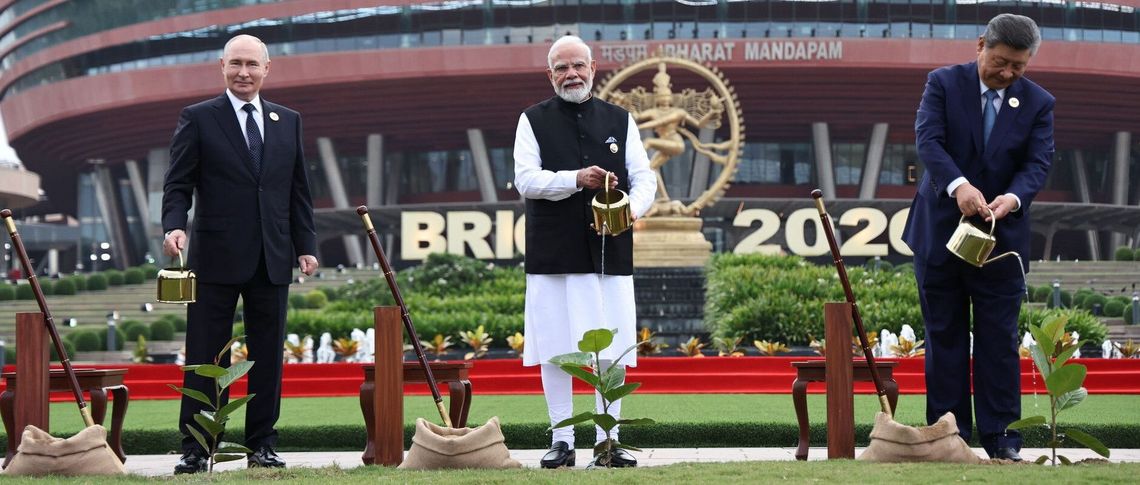
The leaders planted trees. That was the image New Delhi offered on 12 September: the delegations at Bharat Mandapam, Vladimir Putin at his first BRICS summit outside Russia since the war in Ukraine, Xi Jinping on Indian soil for the first time in seven years. Washington, for its part, had written the caption long before the photograph was taken: Donald Trump has called the grouping ‘anti-American’ and threatened tariffs on any country that aligns with it. A bloc is forming, ran the reading. Yet the photograph was the least interesting thing in Delhi.
Over two days, in the same room, the two guests of honour described two different futures. One wants to leave the building. The other wants the keys to it. That argument says more about where international politics is heading than any photograph could.
Exit or takeover?
Putin set the political tone. He declared the unipolar system to be passing, and named those resisting it: the people who still divide the world into a blooming garden and a wild jungle. That phrase belonged to then- EU High Representative Josep Borrell, who had used it in a speech in 2022, and Putin has been handing it back to Europe ever since. His economic pitch read as a procurement list: BRICS payment and settlement-depository infrastructure, a reinsurance mechanism, a grain exchange. Every item removes a point at which Western institutions can apply pressure. It is the agenda of a power that has concluded the existing bodies can no longer be reformed.
Xi, meanwhile, had a different opinion. BRICS, he said, should uphold the authority of the United Nations and oppose withdrawal from international treaties or the creation of rival systems. He defended the World Trade Organization by name and called for its reform rather than its replacement. His own proposals were not financial escape routes but a special economic zones partnership, a shared industrial cloud platform, smart manufacturing built to common standards, an engineer-training alliance and an open-source artificial intelligence community. Standards, supply chains, industrial policy: a bid to write the rules of the existing order from inside it.
The two carry different designs into the room — Russia looking for a buffer against Western pressure, China for a wider stage it can anchor. The asymmetry is structural. Russia has been locked out of the institutions it now proposes alternatives to; its agenda is that of a power trading from the margins. China has been locked out of nothing. Its economy is wired into the system Putin wants to route around. Beijing’s interest lies in inheriting it, not paying to rebuild it. From a distance, the two look like one front. Up close they are near opposites, and the difference decides what the formation becomes — a sanctions-proofing club, or a standard-setter with authorship over rules that almost nobody reads and everybody eventually obeys.
Treating attendance in New Delhi as a declaration of allegiance is the surest way to lose leverage with governments whose strategy depends on keeping several doors open.
De-dollarisation was the cleanest test, and the answer came back modest: national-currency trade encouraged, a common currency shelved. The one concrete step – the endorsement of BRICS Pay, linking India’s UPI, China’s CIPS and Russia’s SPFS – is messaging plumbing, not a reserve asset or clearing mechanism backed by member central banks. The reason is arithmetic rather than timidity. A grouping that now spans both Iran, under Western sanctions, and the UAE, a Gulf financial centre built on dollar clearing, cannot put a single logo on the pipes without costing one of them a great deal of money. Washington has sharpened the sum, threatening tariffs of 100 per cent on members that ‘play games with the dollar’. And what the membership is hedging is more modest than the headlines imply: not the reserve currency, which nobody proposed to replace, but the dollar as an instrument of US pressure — leverage that bilateral arrangements can already reduce.
India, as host, kept its place at the pivot rather than the edge. Modi’s pitch was that the Global South should stop being a rule-taker and become a rule-shaper. He proposed a 10-point reform roadmap, a mechanism to stop each rotating chair abandoning its predecessor’s work, and a digital register tracking whether decisions are implemented. Standing between Putin and Xi, he said BRICS is not directed against anyone. For a group that cannot decide whether it is an exit or a takeover, a chair offering procedure instead of ideology suited everyone in the room.
For Europe, the useful question is not whether to be alarmed but where to look. China takes the chair next year and also hosts the next summit. The agenda thus belongs to the member that wants to reform the order, not leave it: expect less about currencies, more about standards and industrial policy.
Treating attendance in New Delhi as a declaration of allegiance is the surest way to lose leverage with governments whose strategy depends on keeping several doors open. Europe has more invested here than the coverage suggests – the largest trade agreement Brussels has ever negotiated with India was concluded in January – and that relationship survives only if Europe can watch Putin plant a tree in New Delhi and still want it the following morning. BRICS did not build an alternative order in September. What it did was adopt by consensus a document treating multipolarity as a settled description of the world rather than an ambition for it. Orders rarely collapse. They lose their monopoly on plausibility first, and the alternatives become sayable in respectable company long before they become real. That is what was ratified on the lawn at Bharat Mandapam, under the tree.