When the US and Israel attacked Iran at the end of February this year, triggering a new spiral of military escalation in the Middle East and the Gulf, many observers saw it as only a matter of time before Yemen’s Houthis would also intervene. As an important part of the so-called ‘Axis of Resistance’, they were seen as a natural actor in any potential expansion of the conflict — for example, by resuming attacks on shipping in the Red Sea. Contrary to these expectations, however, the Houthis showed remarkable restraint. Although they strongly condemned the US and Israeli attacks and expressed their political solidarity with Tehran, they took no significant military steps to support the regime.
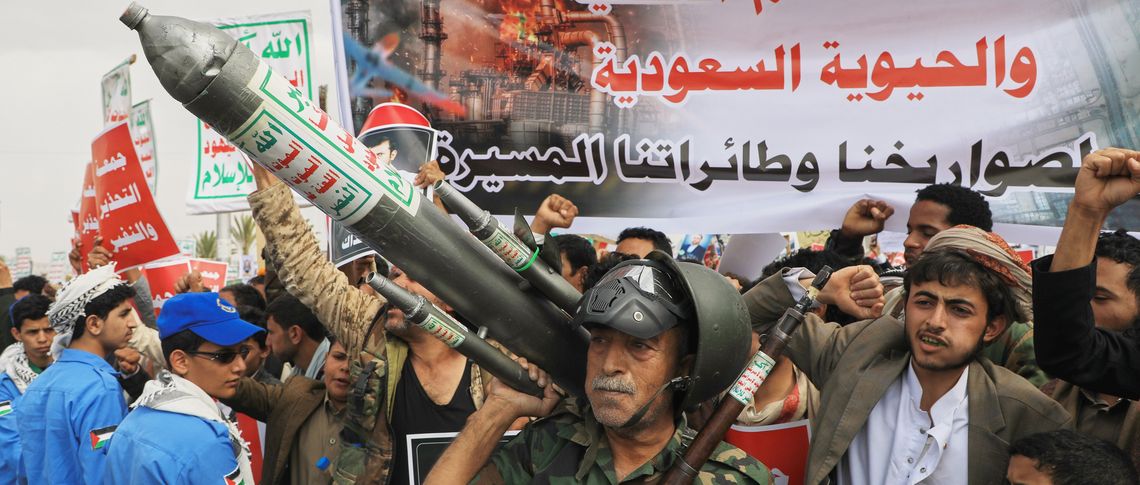
That changed in early July. Triggered by a dispute with Riyadh over permission for an Iranian aircraft to land in Sana’a, the Houthis resumed attacks on targets in Saudi Arabia — including facilities belonging to the oil company Aramco and reportedly ships bound for Saudi Arabia in the Red Sea. At the same time, they resumed their military confrontation with the Saudi-backed, internationally recognised Yemeni government. Attacks on military facilities, supply routes and civilian areas in Marib and Taiz, as well as along Yemen’s western coast, brought an end to a period of relative stability that had prevailed since the UN-mediated ceasefire of 2022.
A calculated approach
Yet, contrary to what it may seem at first glance, the Houthis are not opening a new front for Iran. Rather, they are using the war against Iran to reopen their own longstanding front. Their restraint in recent months was not passivity, let alone neutrality. Their position on the Bab al-Mandab, above all, gives them a geopolitical lever that extends far beyond Yemen. They can threaten one of the most important trade routes between Asia and Europe, thereby putting not only Saudi Arabia but also international actors under pressure. During the Iran war, they deliberately refrained from fully deploying this leverage. By waiting, the Houthis bought themselves time and kept their military options open without once again becoming the target of massive US or Israeli attacks.
That this ‘calculated wait-and-see approach’ now appears to be ending is likely due, above all, to a change in their cost-benefit calculation. The regional war has opened a strategic window: their adversaries are militarily preoccupied, politically distracted and divided over how to deal with Iran and its regional partners. At the same time, the status quo in Yemen is becoming riskier for the Houthis. A new government in Aden is trying to consolidate its position, while Saudi Arabia and other regional actors are reassessing their role in Yemen. And for the Houthis, a frozen conflict could become dangerous when the other side starts making better use of the calm than they are.
There is also domestic pressure: the economic and humanitarian situation in Houthi-controlled areas has deteriorated further in recent months, while there is growing willingness to openly challenge the movement’s rule and conduct. The renewed attacks may therefore also serve a domestic political purpose: they divert public attention from the problems of their own governance and allow the Houthis to once again present themselves as a protective force against external threats. The attacks on Saudi Arabia and the resumption of military confrontation in Yemen are therefore not merely expressions of renewed strength. They can equally be understood as a pre-emptive response to fears that the strategic balance of power could shift against them if they do not act.
Whether Yemen’s civil war will now return in full force remains an open question.
This conflict dynamic is particularly evident in Mokha. The strategically located port on the Yemeni western coast is more than just another military target: its location on the Red Sea, close to the Bab al-Mandab strait, gives an attack on it a regional dimension. For now, however, an attack on Mokha targets areas and infrastructure outside Houthi control and therefore strikes at the internationally recognised Yemeni government. Attacking Mokha therefore does not simply open another military front. It also targets the political and economic foundations of its opponents.
For the Yemeni government that has been in office since early February, this development is alarming. It presents the government with a dilemma that is difficult to resolve. If it fails to respond decisively to the attacks, it risks losing authority and reinforcing the impression that it can neither protect its territory nor its infrastructure. But if it responds with a comprehensive military counter-offensive, it risks triggering a new nationwide escalation — and with it an even greater dependence on Saudi Arabia and other external supporters. At the same time, the Houthis could exploit such a confrontation for propaganda purposes, once again portraying the government as an instrument of foreign powers. This is precisely where the political impact of the renewed escalation lies: the Houthis do not need to defeat the government militarily to weaken it. It may already be enough to permanently call into question its ability to govern and provide security.
Whether Yemen’s civil war will now return in full force remains an open question. But if it does, it would hardly be a mere repetition of the war that began in 2015. A new war would be characterised by drone and missile attacks, economic warfare and the increasing militarisation of the Red Sea. Yet it would also be enough for the state of emergency to once again become the norm, for attacks on infrastructure to increase, cross-border attacks to become routine and fighting to take place on several fronts simultaneously. Even such a gradual escalation could bring the already fragile political process to a standstill — without the conflict parties immediately returning to full-scale nationwide war.
Protecting shipping in the Red Sea remains necessary. But it must not become Europe’s only Yemen policy.
The most dangerous mistake would be to fall back into the old logic of the Yemen war: responding to a Houthi attack with a Saudi counter-attack, followed by renewed mobilisation, and in this way turning calculated escalation into another full-scale war. The response to the latest attacks must therefore neither give the Houthis a fresh pretext for further violence nor push Saudi Arabia towards intervention.
Europe should instead pursue a two-pronged policy of containment: limiting the military escalation while supporting Yemen’s political and economic stabilisation. Protecting shipping in the Red Sea remains necessary. But it must not become Europe’s only Yemen policy. Anyone seeking to secure Europe’s trade routes must not only combat the consequences of Yemen’s instability at sea, but also address its causes on land.
That is precisely why it would be wrong to read the latest escalation in Yemen merely as another front in the Iran war. The Houthis are undoubtedly exploiting the regional conflict and their proximity to Tehran to strengthen their own position. But their attacks also follow a logic of their own: they are putting Saudi Arabia under pressure, weakening Yemen’s already fragile government and bringing back into motion a conflict whose unresolved struggle for power never disappeared. The Iran war is thus providing them with the strategic environment to pursue their own war under changed conditions.