


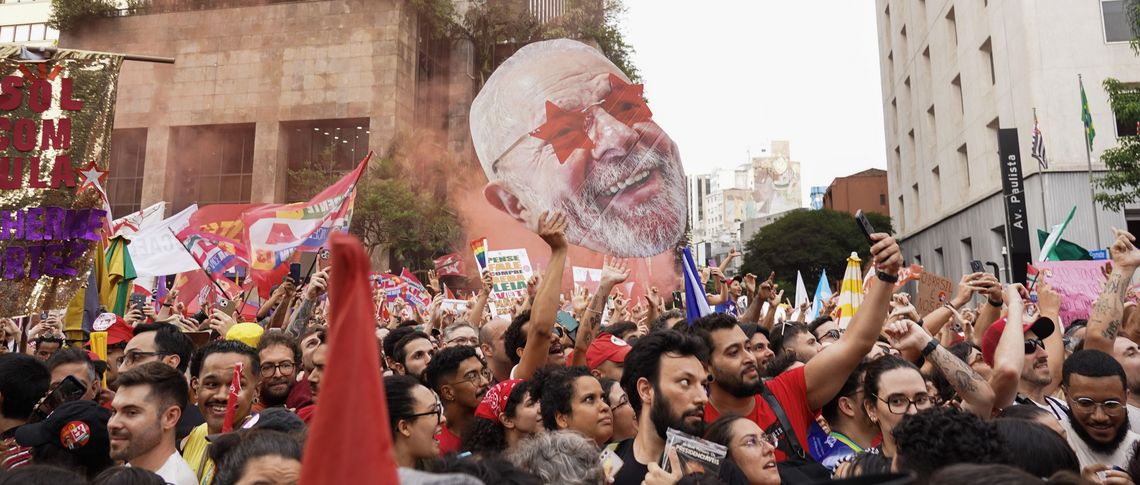
Lula da Silva’s victory in the run-off of the Brazilian presidential election came as a triumph of a magnitude few could have anticipated. Not even his most optimistic supporters had expected him to gain more than ten million votes on top of his first-round result.
Ironically, it was Flávio Bolsonaro’s surprisingly strong result in the first round that proved to be a stroke of luck for Lula. Because it fundamentally changed the mood and the dynamics of the election campaign. Before the first round, the campaign had been quiet, almost uneventful. In the streets, there was little sign of an electoral atmosphere. Apart from a few isolated rallies, there was hardly any indication that an election was imminent. The public debate centred mainly on corruption scandals and the crisis in the Supreme Court. Many people showed little interest, and Lula struggled to convince the public to support him for a fourth term in office.
The fact that, contrary to expectations, Lula failed to secure enough votes to go through to the run-off in first place, that Flávio Bolsonaro became the clear favourite overnight, and that Bolsonaro’s Partido Liberal (PL) performed strongly in parliament, alarmed Lula’s support base and the anti-Bolsonaro electorate. The apathy that had prevailed until then gave way to concern over the prospect of another Bolsonaro government, which was likely to push ahead with an illiberal restructuring of the state, curtail minority rights, encourage the deforestation of the Amazon rainforest and subordinate Brazil to US interests; this electrified sections of the population that had previously been largely unorganised. Their disappointment with Lula gave way to fear of Bolsonaro. It was precisely this that gave rise to a new dynamic of mobilisation.
Lula’s Army
As a result, two things happened. Students began to organise spontaneously and took to the streets to express their opposition to Bolsonaro and their support for Lula. Civil society organisations followed suit, organised themselves more effectively and became more active, particularly in the digital sphere. In parallel, the re-elected MP André Janones mobilised millions of Lula supporters within a very short space of time using a WhatsApp group called ‘Exército do Lula’ (Lula’s Army).
The three weeks of digital mobilisation were a decisive factor in Lula’s ability to turn the election around. Following his victory, Lula thanked his ‘General’ Janones and credited him with playing a key role in the election success – an assessment shared by numerous analysts. Janones has already been approached by Pablo Sanchez to support his current election campaign. Previously, the Partido dos Trabalhadores (PT) had already revealed that Meta was distributing its content and Flávio Bolsonaro’s content unevenly on its platforms, favouring the right-wing candidate’s content. Janones knew how to skilfully exploit the algorithms for his own ends, effectively turning the tables. His innovative guerrilla methods and their resounding success are likely to be studied in political communication departments around the world in the future.
Alongside Instagram and X, the campaign relied heavily on WhatsApp and, in particular, on sharing content via WhatsApp Status.
Just under eleven million people joined Janones’ WhatsApp group between the first round of voting and the run-off. The group’s followers were referred to as ‘Lula’s soldiers’ and received daily ‘missions’ via the group from Janones. These were specific calls to action, formulated in military language.
For example, members were called upon to ‘like’ and comment on specific Instagram videos in unison. This meant the content was given greater weight by the algorithms, thereby achieving a wider reach. In addition, the group provided specific hashtags and content that Lula’s ‘soldiers’ were to share via social media. Alongside Instagram and X, the campaign relied heavily on WhatsApp and, in particular, on sharing content via WhatsApp Status. Almost everyone in Brazil uses WhatsApp. Unlike on Instagram, where shared content mainly spreads within one’s own network, WhatsApp status updates can also reach people with whom users have had contact somewhere along the line. These include, for example, distant acquaintances, tradespeople, shop assistants or customers – in other words, people outside one’s own political bubble.
During the televised debate between Lula and Bolsonaro, members were also asked to search for specific terms on Google. As a result of the numerous search queries, these terms rose to the top of the most-searched terms on Google Trends. It was precisely these words that were displayed live on screen by the television channel during the debate. In this way, coordinated search queries were used to feed specific narratives about Bolsonaro into the broadcast. The focus was on his links to the militias in Rio de Janeiro and other negative aspects designed specifically to damage his image among swing voters and dissuade them from voting for Bolsonaro.
On the day before the election, Lula’s final public appearance in São Paulo drew a larger crowd than any other political event in the country’s recent history.
These and other strategies were designed to exploit the way social media algorithms work to their own advantage and to reach as many people as possible beyond their own support base. However, campaigns outside social media, in the analogue world, also had an impact. For instance, Lula’s supporters demonstratively wore the Brazilian national team’s football shirt – normally a distinguishing mark of Bolsonaro’s electorate.
All of this fostered a sense of togetherness and a shared identity amongst the participants. Specific calls to action proved more effective than simply urging people to support a candidate: they gave participants the feeling that they were making a tangible contribution to the election victory themselves. This generated enthusiasm and optimism amongst the participants, who carried their excitement into the real world. The digital strategy complemented the mobilisation on the streets and amplified its impact. On the day before the election, Lula’s final public appearance in São Paulo drew a larger crowd than any other political event in the country’s recent history. Rallies and other mobilisation activities also took place in many other parts of Brazil.
Students, civil society groups, ‘Lula’s soldiers’ and many others who feared a potential Bolsonaro government came together. Opposition to Bolsonaro thus gave rise to a broad mobilisation in support of Lula. This created significant momentum for election day.
Strategic reforms paying off
Another factor contributing to Lula’s victory were the reforms implemented between the two rounds of voting. In a major victory for the PT, the six-day working week was abolished, affecting a third of formally employed workers in Brazil. On top of that, the standard maximum working week is gradually being reduced from 44 to 40 hours. Given that the reform enjoys broad public support, Bolsonaro publicly presented himself as a supporter of it during the election campaign and portrayed himself as a champion of workers’ rights, even though he had tried until the very last moment to block the reform in the Senate.
Lula also imposed restrictions on online gambling, which had previously been largely unregulated and had driven many families into financial ruin. In addition, he increased the benefits under the Bolsa Família social programme and launched a support scheme for small and medium-sized enterprises.
As well as young people, voter turnout among the over-70s also rose significantly.
All this paid off on election day. Three groups of voters were particularly crucial to Lula’s victory. First, his former supporters, who had been disappointed by his third term in office and had become disillusioned with him. In the first round, they had either abstained or voted for other candidates, but they were mobilised once again for the run-off. Added to this were voters who were opposed to both political camps and did not want either candidate as president. In the run-off, however, their rejection of Bolsonaro carried more weight than their opposition to another term with Lula. Ultimately, Lula also benefited from those right-wing voters who, whilst they would never vote for him, stayed away from the run-off after their preferred candidates – such as Renan Santos or Ronaldo Caiado – had been eliminated.
As well as young people, voter turnout among the over-70s also rose significantly. Voting is not compulsory for this age group; moreover, casting a vote is often fraught with difficulties due to the sometimes inadequate infrastructure. Many nevertheless went to the polls to prevent Bolsonaro from winning.
The first round of voting was, in a sense, a plebiscite on Lula and a reckoning with what many saw as the disappointing record of his term in office so far. The result, which was disappointing for him, reflected the dissatisfaction amongst the population. The second round, by contrast, became a plebiscite on Bolsonaro. Lula’s triumph was thus less a vote of confidence in the incumbent than a vote against his challenger. It was not enthusiasm for Lula, but rather opposition to the Bolsonaro family that had brought millions of people to the ballot box.
In his victory speech, Lula announced his intention to change the way the government is run in his next term and to place greater emphasis on digital communication. He also held out the prospect of stricter regulation of social media and digital platforms – not least in light of the experiences of this election campaign. Such regulation is significant not only for Brazil, but also for other countries that wish to facilitate a democratic exchange of opinions and ideas in the digital public sphere. At the same time, through the methods employed over the past few weeks, Brazil has shown the world how, even under the current conditions – in which social media platforms are not consistently geared towards democracy and the common good – a successful digital election campaign can be waged using creative means.


