
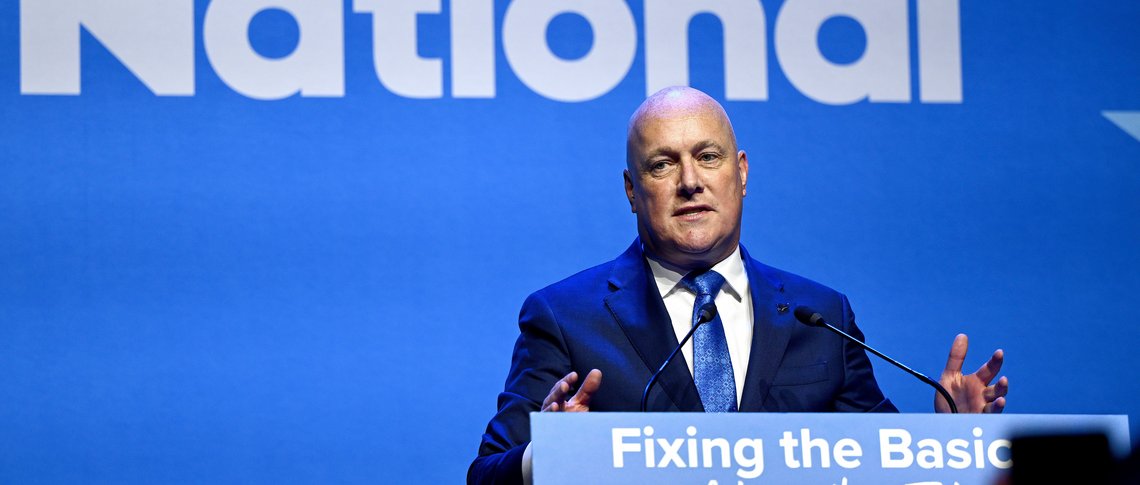
When I travelled to Wellington three weeks ago, nobody I spoke to wanted to venture a bet on Saturday’s election outcome – the race between Labour and National and their respective camps was simply too tight. However, one cynical observer quipped: ‘Chris is gonna win and we’re all gonna lose’. As for the first part, that much was always clear, with the National Party’s Prime Minister Christopher Luxon poised for another electoral contest with Labour Opposition Leader Chris Hipkins. For the time being, though, neither of the ‘two Chrises’ has won or lost just yet. The result of the election is so narrow that it will depend on the final count of all so-called special votes to determine the outcome. These ‘Specials’ make up roughly 400 000, or 15 per cent of the total, and include the late enrolled voters, overseas votes and votes cast outside the voter’s own electorate. Their counting undergoes special scrutiny, and the final tally will not be known until 27 November.
In the past, the Specials have always boosted the vote left of the centre and could still be decisive in this particular election. The preliminary result has the current conservative three-party coalition on a razor-thin majority at 67 of 131 seats. Luxon’s National Party would win 42 of these seats, but crucially six of them are so-called overhang mandates. Unlike the Nationals, Labour didn’t get any overhang mandates and only gets 36 seats, despite both parties sitting on roughly the same share of party votes at just over 29 per cent. Regardless of who ends up in power, however, one challenge is already becoming apparent: the increasing fragmentation of the party system could make it more difficult for New Zealand to tackle the country’s pressing problems.
Defeating its purpose
In the Mixed-Member-Proportional system (MMP), New Zealanders cast two votes: one for their member in one of the 71 electorates, and the other for their preferred party. Once all direct electorate seats have been allocated, the remaining 49 seats of the House of Representatives are filled with party list candidates to achieve a proportional allocation in accordance with party preference votes. But overhang mandates come on top of the standard 120 seats and do not get balanced out by granting additional mandates to the other parties (as used to be the case in the very similar German system).
National’s significant advantage is due to their candidates having won direct electorate seats above and beyond their proportional seat share, most likely because of tactical voting by the supporters of National’s smaller coalition parties – populist New Zealand First and right-libertarian ACT Party. They split their vote to bring National candidates over the line in the electorates while continuing to support their own party with the second vote. In the left camp, the same has happened, with supporters of the Maori Party (TPM) splitting their vote between their own electorate candidates and a party vote for others on the left. In fact, for the moment all of TPM’s up to five seats, won in special Māori electorates, are overhang. In a number of electorates, the contest is so tight - with only a few hundred votes separating winner from runner-up -, that the remaining count could still flip some seats. Depending on the size and exact nature of the expected swing, Labour could still wrest government from National in a four-party coalition, or parliament could be locked in a tie.
The electoral winners are the Greens to the left of Labour with their best result ever at 13 per cent, as well as the smaller parties to National’s right at 11 (ACT) and 10 per cent (NZ First).
Whatever the final outcome – we can be sure that the MMP electoral system will be revisited again in the coming parliamentary period. It had been introduced by referendum in 1993 to replace the British-inherited First-Past-The-Post, because proportionality was considered to be the fairer form of representation. If it is now the overhang that determines who can govern on the basis of tiny margins in a handful of electorates, and if parties enjoying the same level of voter support get significantly different seat numbers, it would seem to defeat a key purpose of the change.
Too many small players on the field
Back to the politics of the election, the most evident development is the further fragmentation of the party system and weakening of the former people’s parties, National and Labour. Their combined vote share has fallen below 60 per cent for the first time. Winners are the Greens to the left of Labour with their best result ever at 13 per cent, as well as the smaller parties to National’s right at 11 (ACT) and 10 per cent (NZ First). While this may point to a growing polarisation of politics as witnessed in many other established democracies across the globe, it is only half the story in New Zealand: With the Opportunity Party (TOP), a seventh player is joining parliament for the first time and – being centrist – could well become the kingmaker in a hung House with its seven seats.
TOP’s social and ecological agenda is more compatible with a centre-left coalition, and even if the numbers swing significantly, Labour could only form government with TOP’s support. Prime Minister Luxon had excluded cooperating with TOP before the election, but will surely reconsider that stance should TOP be his only path to remain in power, as his own party might well drop him as leader otherwise – he only narrowly survived two recent internal coup attempts and National is still far from united behind him. In any event, TOP’s fresh young leader, Qiulae Wong, might chose to opt for a support model short of a formal coalition agreement, offering ‘confidence and supply’, guaranteeing the necessary majorities for government formation and for a budget, but letting a minority coalition find its own legislative support on a case-by-case basis.
A perception of political stand-still while economic conditions deteriorate could easily feed into further fragmentation.
Either way, the next government could be hard to manage, and this is where – thinking of our cynic above – New Zealanders could all risk to lose out in light of the election result. If unwieldy three- or even four-party coalitions become the norm in New Zealand, necessary adjustments to the rapidly shifting geopolitics of the region, to the rise of AI and to various other serious challenges (that hardly featured in the cost-of-living focused campaign) may risk to be further delayed. In 2023, Luxon had to spend 41 days in coalition negotiations - the second longest ever -, and then still had to waste much of the preciously short three-year legislature dealing with pet projects of his coalition partners. A perception of political stand-still while economic conditions deteriorate could easily feed into further fragmentation.
Whichever Chris wins the race, he will have to prove that even an increasingly fragmented political landscape allows for effective political action. A deadlock might even present an opportunity to overcome traditional partisan divides and explore new forms of cooperation. Ultimately, that might not be the worst possible outcome.