
The theme of this year’s UN General Assembly – ‘Restoring trust, managing transformation: a United Nations that delivers for all’ – captured something of the unease surrounding contemporary multilateralism. In his opening address, Secretary-General António Guterres drew together the overlapping challenges of war, climate breakdown, displacement, debt, food insecurity and increasingly fragile public institutions. Such connections have helped establish ‘polycrisis’ as a prominent vocabulary for describing a world in which seemingly separate emergencies increasingly reinforce one another.
Yet recognising that crises are interconnected tells us little about the political choices made in response to them. More than that, the language of polycrisis can even obscure these choices, making the resulting insecurity appear as inevitable features of a world in turmoil rather than the product of decisions about how resources, responsibilities and risks are distributed.
Governments and international institutions exercise considerable discretion over which crises to prioritise, whose insecurity warrants intervention and which populations are expected to bear the costs of recovery. These decisions are key because resilience – the ability of societies and institutions to withstand and recover from shocks – is not necessarily a measure of progress. An institution or country may become more resilient precisely because the costs of adapting to crises have been shifted onto less powerful populations. To understand whether crisis management is really successful, we must also ask who benefits and who pays the price.
Resilience at whose expense?
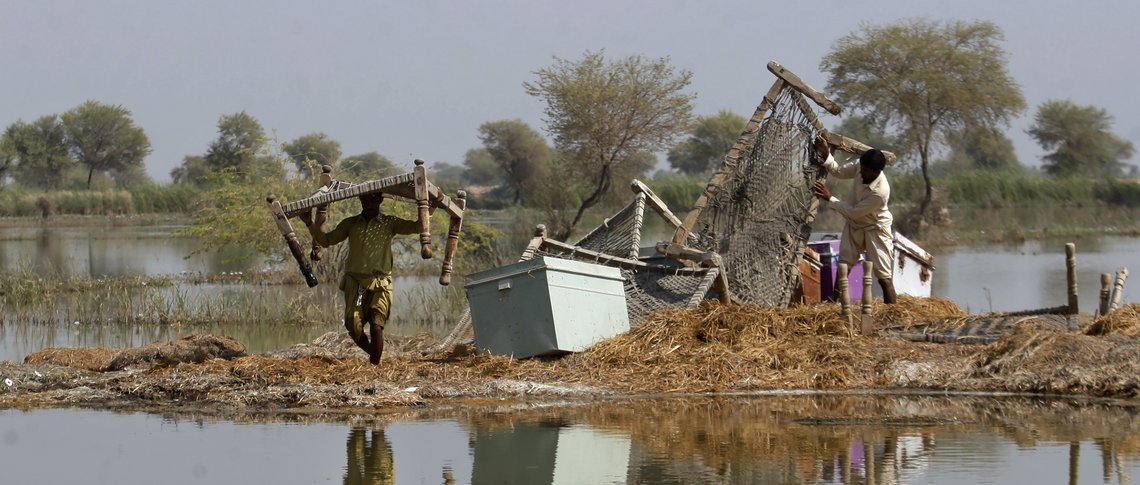
These tensions become particularly visible where climate disaster intersects with already constrained public finances. Pakistan’s catastrophic floods in 2022 affected some 33 million people, killed more than 1 700 and caused damage and economic losses exceeding $30 billion. The World Bank estimated that between 8.4 and 9.1 million additional people could be pushed into poverty. But behind these figures lay profoundly uneven capacities to survive the immediate destruction and begin rebuilding afterwards, shaped by differences in land ownership, savings, secure housing, public infrastructure and access to assistance.
As floodwaters receded across Sindh and Balochistan, the question of recovery became inseparable from decisions about international finance, public expenditure and household resources. Families whose homes, crops and livelihoods had been swept away faced the immediate costs of reconstruction, while a government already operating under severe fiscal constraints confronted an estimated $16.3 billion in rehabilitation and reconstruction needs. The possibilities for recovery consequently depended upon decisions taken in finance ministries, development banks and creditor institutions far removed from the communities experiencing the destruction.
How Pakistan chose to finance its recovery would have consequences far beyond the immediate reconstruction effort. Additional borrowing could deepen the country’s debt burden, leaving less public money available for healthcare, education and social protection in the years ahead. The costs of a climate disaster would thus extend well beyond the communities directly affected, potentially falling on future generations and people dependent on already overstretched public services.
Governments and international organisations should assess resilience through the distribution of security it produces.
Alternatively, international climate finance could support reconstruction through grants, debt relief and investment directed towards communities facing the greatest exposure. Both approaches might strengthen the country’s capacity to withstand future disasters. But they would distribute the costs of recovery, and the risks of future crises, very differently.
This tension is also visible in the emerging architecture for climate loss and damage. By April 2025, governments had pledged approximately $768 million to the Fund for Responding to Loss and Damage — a fraction of the more than $30 billion in damage and economic losses caused by the floods in Pakistan alone. While the creation of the fund represents an important recognition of the responsibility to address climate-related losses, the resources currently pledged remain far below the scale of need. For vulnerable countries, this shortfall means that the costs of recovery continue to fall disproportionately on governments and communities with the least capacity to bear them.
In my new book, The Social Life of Justice, I explore how principles of justice acquire practical force through precisely these kinds of institutional arrangements. The distribution of rights, resources and recognition is shaped through classifications, procedures and everyday decisions, whose cumulative effects establish the terms on which people can make claims upon one another and upon the institutions governing their lives.
Making justice a measure of resilience
A justice-centred approach to polycrisis would bring these distributive arrangements into the assessment of crisis management itself. In international climate finance, this would mean prioritising grants and debt relief for highly exposed countries rather than adding to their debt burdens, with transparent criteria for determining which communities receive reconstruction assistance and meaningful participation for those whose livelihoods are at stake. The same principle applies beyond climate policy. Migration partnerships, for example, should be assessed by their consequences for people whose journeys are redirected. Access to protection, respect for rights and accountability for the treatment of migrants should be central to evaluating their success.
More generally, governments and international organisations should assess resilience through the distribution of security it produces. This means asking whose risks have been reduced, where costs have been transferred, how decisions about assistance are made and which populations remain exposed. It also means making the terms of those decisions publicly contestable, recognising that the legitimacy of crisis management depends upon the people affected having a meaningful say in decisions that shape their futures. Without such scrutiny, resilience risks becoming a mere measure of institutional success.
These are practical demands directed at institutions that already make consequential decisions about the allocation of public resources, international assistance and responsibility for protection. Putting them into practice would bring the politics of distribution into clearer view and provide a more demanding measure of what successful crisis management should achieve.
The language of polycrisis captures the connections between emergencies that increasingly define our world. The language of resilience expresses the ambition to withstand them. But neither tells us how the costs of doing so are distributed. Justice directs attention to these political choices through which that endurance is made possible, and towards the people whose lives carry its costs. Their experiences reveal how the capacity of some institutions to withstand disruption is bound up with the insecurity of others. It is through these relationships that the politics of polycrisis takes shape, and through their transformation that a more just form of resilience might become possible.