
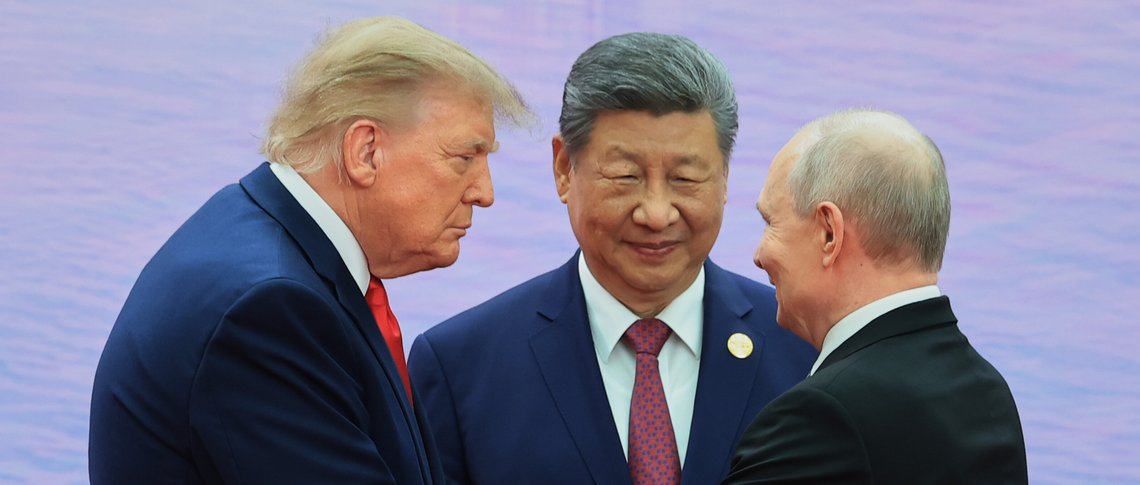
Yesterday’s meeting between Donald Trump, Xi Jinping and Vladimir Putin on the sidelines of the APEC summit in Shenzhen was historic. Never before had the presidents of the United States, China and Russia come together for a trilateral summit. Although the meeting, which lasted just over an hour, produced little that was new, it left an uneasy feeling that the wartime ‘Big Three’ format could be making a comeback.
Back then, the victorious powers divided the world between themselves. In February 1945, US President Roosevelt, Soviet leader Stalin and British Prime Minister Churchill met in the Crimean resort of Yalta, of all places. Today, we live among the ruins of the world order they established. And if there was one thing the new Big Three in Shenzhen had in common, it was the belief that the next world order, too, would be shaped in the capitals of the great powers.
But historical comparisons can be misleading. History does not repeat itself, neither as farce nor as rhyme. In Shenzhen, two great powers – the United States and China – met alongside Russia, whose global standing has diminished considerably in recent years. It would therefore be more accurate to speak of the ‘Big Two and a Half’, whose interests compete in many parts of the world. The United States and China are vying for technological supremacy in the AI race, as well as for military power and political influence in Asia. There is also a long-term rivalry between Moscow and Beijing: in Central Asia, China has long been the most important economic partner, while Russia maintains its position as a security guarantor. In North Korea, the Kremlin is expanding its influence at China’s expense. Moscow and Washington are on opposing sides in Ukraine. Even Belarus is increasingly seeking room for manoeuvre in its foreign policy between the two. In the Arctic, each is pursuing its own interests.
The optics count
Just how little the three countries have in common was already apparent in the run-up to the trilateral summit, when they could not even agree on an agenda. The initiative came from the person who needed the meeting most: Vladimir Putin. In early October, he proposed to Trump in a phone call that they discuss the war in Ukraine together with Xi. Putin’s calculation was clear: Russia was to sit alongside the United States and China in Shenzhen, on an equal footing, negotiating spheres of influence as well as war and peace in Europe. The message would have been precisely to his liking: Europeans would not be at the table but on the menu when their security was being discussed. No concrete results were needed to achieve this. The symbolism of the images was enough: three of the most important members of the UN Security Council, with the world’s largest nuclear arsenals, coming together to determine the rules of the world. Despite its weaker economy, Russia remains part of this exclusive club.
Trump, for his part, continued to believe, undeterred, in Shenzhen as elsewhere, in the power of personal encounters between great men to resolve geopolitical crises. For years, he has sought good relations with Xi and Putin, often at Europe’s expense. This time, he wanted to discuss nuclear arms control. Since the last US-Russian treaty expired in February 2026, this has become a prestige project for Trump on his path towards the Nobel Peace Prize. Xi appeared open to the idea but believes the United States and Russia should make the first move, given that their nuclear arsenals are considerably larger. For Putin, such talks are attractive: when it comes to nuclear weapons, Russia still stands on an equal footing with the United States. But, as became clear in Shenzhen, any concessions from Moscow would come at a high price. For Putin, arms control is inseparable from negotiations over Ukraine and Europe’s security order. His ambitions extend far beyond the war: he wants to revise the terms under which Europe has organised its security since the end of the Cold War, in Russia’s favour.
And China? The hosts initially seemed uneasy about the idea of a Yalta 2.0. For Beijing, the APEC summit was supposed to be the main event. China wanted to present itself as a modern economy and a constructive actor in international relations. Xi has invested considerable political and economic capital in building an international order that offers an alternative to Western dominance. The Belt and Road Initiative, multilateral institutions such as BRICS and the Shanghai Cooperation Organisation, as well as global initiatives on issues such as the regulation of artificial intelligence, all reflect a preference for economic development and national sovereignty over human rights, democracy and values-based alliances. Beijing sees itself as a voice for the Global South, negotiating with the United States on an equal footing. It has no need for Russia or reminders of the Second World War to do so.
Rather than working towards a shared vision of the international order, the three countries are exploiting short-term geopolitical and geo-economic opportunities for their own benefit.
Yet, according to Beijing, being a good host meant accommodating the wishes of the two largest participants in the APEC summit and organising a trilateral meeting. Shortly before the summit, Beijing nevertheless began describing it as ‘ground-breaking’ and subsequently emphasised the three powers’ responsibility for peace and stability in the world. In the end, even for Xi, the optics of the meeting outweighed the limited substance of its results.
This is symptomatic. Rather than working towards a shared vision of the international order, the three countries are exploiting short-term geopolitical and geo-economic opportunities for their own benefit. This is particularly true of self-proclaimed dealmaker Trump. His overtures to Xi and Putin have so far yielded little. The US-Russian summit in Alaska in August 2025 ended without any tangible results. Nor has there been a breakthrough in the negotiations over Ukraine. With Xi, Trump has at least agreed, following three meetings since his return to the White House, on ‘constructive strategic stability’ in bilateral relations. What this actually means, however, remains unclear. So far, implementation of the Chinese concept has largely been limited to purchase commitments for soybeans and aircraft, a trade conflict that has merely been put on hold, and a series of small-scale agreements on an AI dialogue. The structural conflicts between the two powers have barely been eased. In China, the arrangement is therefore increasingly being described as merely a ‘tactical truce’.
The pursuit of self-interest also dominates relations between China and Russia, despite their proclaimed ‘friendship without limits’. Putin needs Beijing’s diplomatic backing and its support to continue his war of aggression against Ukraine. This is more important than ever following Ukraine’s successful attack on the Kerch Bridge. The extent of Russia’s dependence on China varies from one sector to another. Russia can produce a substantial share of its own steel, ammunition and missiles, and pay for them in roubles. It also finances its high military salaries from its own resources. Microelectronics are a different matter: here, Russia’s dependence on China has grown significantly since the start of the war.
From Beijing’s perspective, Russia’s war of aggression ties up US resources and attention in Europe and exacerbates tensions within the transatlantic alliance. At the same time, mistrust between the unequal partners and historical rivals remains considerable. Beijing has little reason to object to Russia’s military weakening and growing economic dependence. From Moscow’s perspective, however, dependence on China runs counter to its imperial self-image. It was partly to escape this embrace that the Russian delegation travelled to the ASEAN summit in Manila just days before the Shenzhen meeting, armed with an extensive trade agenda. Russia wants to export oil, gas, coal, fertilisers and grain to Southeast Asia and build on its existing commodity trade with Vietnam, Indonesia and Thailand.
The hype surrounding the Shenzhen summit should therefore spur Europeans to work on their own strength and find new partners so that they can hold their own against the great powers.
A G2 or G3 world looks very different from the mixed bag of issues and interests presented in Shenzhen. For Europe, this is hardly good news. Following the United States’ retreat from the world order it created, the rise of China and Russia’s continued capacity for destruction, the international situation remains volatile and unpredictable. The crises stretching from Ukraine and the Persian Gulf to the South China Sea and the Taiwan Strait are interconnected and pose major challenges to Europe’s economic model and security order. There is also a risk that rival great powers will reach agreements at the expense of smaller and medium-sized countries. If major geopolitical and geo-economic crises are increasingly negotiated along the lines of Shenzhen, in a kind of UN Security Council without Europe, further upheaval is all but guaranteed. The Chinese side has already proposed precisely this.
The hype surrounding the Shenzhen summit should therefore spur Europeans to work on their own strength and find new partners so that they can hold their own against the great powers. This means taking responsibility for their own security, strengthening their competitiveness and pursuing flexible international partnerships with middle powers on trade and multilateralism. The fact that Europe is now investing substantial sums in its own defence, has concluded numerous free trade agreements and is approaching China with renewed confidence points in the right direction.
The same applies to the Berlin meeting of the Coalition of the Willing, which is taking place at the same time as the Shenzhen summit — probably no coincidence. It brings together countries that, despite American reluctance, are providing a substantial share of Ukraine’s financial and military support. Moscow is watching this closely. However, the weight Europeans carry in negotiations over Ukraine will depend on whether they can agree on a common position with Kyiv. This includes the question of what security guarantees they can offer Ukraine — and who would be prepared to honour them if it came to the crunch.
Shenzhen has made one thing clear: it takes the many smaller and medium-sized countries to counterbalance the ambitions of the few great powers and finally lay the ghosts of Yalta to rest.