


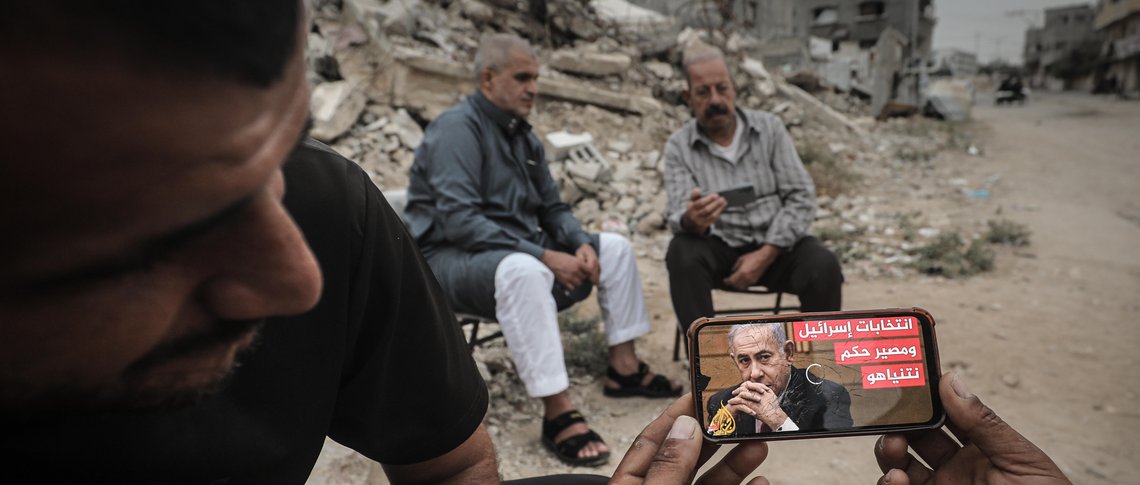
Israel has voted, but by no means did everyone living under Israeli control have a say in the election. This applies in particular to the approximately 5.5 million people living in East Jerusalem, the West Bank and Gaza, whose lives are far more profoundly shaped by Israeli policies than by those of the Palestinian Authority or the resurgent Hamas in the Gaza Strip.
Yet even if the elections lead to a change of government, little is likely to change fundamentally for Palestinians. A new government could certainly bring about some improvements in specific areas, but a political resolution to the conflict would remain a long way off.
At the same time, their fate – which today has become a focal point for identity politics, particularly among large sections of the younger generation in Europe, the United States and the Global South – barely featured in the election campaign debate on a sustainable resolution to the conflict. The Palestinian question was addressed almost exclusively in terms of security, potential new threats and territorial claims beyond the 1967 Green Line. Questions of Palestinian self-determination, or even simply improving living conditions in Palestine, were scarcely heard across the Zionist party spectrum. Only the Palestinian parties and electoral lists gave these issues significant attention.
Even the positions of the left-Zionist camp, today represented primarily by Yair Golan’s HaDemokratim, which won eight of the Knesset’s 120 seats in the election, are heavily shaped by the securitised logic of Israeli discourse. Golan is indeed fundamentally in favour of a political resolution to the conflict and a demilitarised Palestinian state, but he couples this vision with far-reaching Israeli security reservations. This contradiction is particularly evident in his call for permanent and unrestricted Israeli security control over the Jordan Valley. Such an arrangement would be difficult to reconcile with the prospect of sovereign Palestinian statehood.
What future for Palestinians?
How much the situation could improve, at least in the short term, will depend on the outcome of government formation. Three scenarios appear possible.
First, settlement construction is halted or at least slowed down, and the E1 project is abandoned. At the same time, the situation eases in certain areas. Three possible starting points can be identified here. The tax revenues that Israel has been illegally withholding for more than a year – accounting for around 60 per cent of the Palestinian Authority’s (PA) budget – are released to stabilise the PA. A new government could also finally take action against settler violence in the West Bank, which has spiralled completely out of control. Finally, progress could be made on implementing the 20-point plan for Gaza, which has been stalled for months and was breached by Prime Minister Netanyahu for electoral reasons.
This scenario would require a government formed by the existing opposition parties under the leadership of Gadi Eisenkot, who has described radical settler violence, for example, as ‘Jewish terrorism with the backing of the Israeli government’. President Isaac Herzog officially gave Eisenkot the mandate to form a government on Sunday, but the path remains complicated. Eisenkot’s background in the Israeli security establishment and his political positioning in the centre-right suggest that he may have an interest in stabilising the PA, albeit primarily as a subordinate administrative authority for the Palestinian population rather than as the political representative of a future sovereign state. His criticism of Israeli settler violence, too, follows a primarily securitised logic: the focus is less on the rights of those affected than on the potential security implications for Israel and the risk of further erosion of its international legitimacy.
Without substantial international pressure, such a government would not address the question of a sustainable resolution to the conflict. It would merely offer a respite.
A government led by Eisenkot would therefore mark a return to the conflict-management approach pursued by the so-called Government of Change under Naftali Bennett and Yair Lapid (2021–2022). The main focus would be on targeted improvements while maintaining the status quo and existing power relations. Without substantial international pressure, such a government would not address the question of a sustainable resolution to the conflict. It would merely offer a respite, with an uncertain future.
A second scenario, currently being promoted by the United States, is the formation of a national unity government. Under this arrangement, one or two parties from the opposition bloc would join Netanyahu, who would in turn drop the far-right ministers Itamar Ben-Gvir and Bezalel Smotrich. The United States has already made clear that the latter two should not be part of any future coalition. So far, the main obstacle to a possible national unity coalition has been less a matter of political differences than of personal tensions between the potential coalition partners. However, pressure from the United States and a possible new round of war with Iran could persuade them to put their differences aside and present the coalition as a political necessity.
In this scenario, the impact on Palestine would be similar, albeit less pronounced. The extent to which Likud has radicalised and become a right-wing populist party drifting, in part, towards the far right has so far received little attention in public debate. The differences between it and the extremists Ben-Gvir and Smotrich, who shape perceptions of the Israeli far right internationally, are often merely a matter of degree, if they exist at all. In a coalition in which the Likud was the largest faction, measures to improve the situation in Palestine would therefore face considerable resistance. Their impact would be correspondingly limited. A halt to the E1 project and at least some curbing of settler violence would be conceivable – primarily as a means of limiting international reputational damage – alongside the stabilisation of the PA at a low level. The humanitarian situation in Gaza might ease somewhat, but large-scale reconstruction would appear unlikely under such a government.
In a third scenario, no government is formed, and Netanyahu VI remains in office as a caretaker government until new elections are held. Here, two paths are possible. On the first, the prime minister dismisses the ministers from the far-right parties, as he no longer has a majority in the Knesset and therefore no further use for them. The aim would be to limit international reputational damage and regain room for manoeuvre with international partners, accompanied by some modest measures to improve the situation in Palestine. On the second path, he keeps them in government and continues the course of escalation, further worsening the situation and potentially leading to full-scale escalation, in the hope that new elections will give him a chance to reconstitute his coalition with them.
If Benjamin Netanyahu is indeed replaced by Gadi Eisenkot, many European governments are likely to seek a swift return to the pre-7 October relationship.
However different these scenarios may be, they have one thing in common: even a change of government would do little to alter the fundamental power relations. While improvements of varying degrees are likely in all scenarios except the escalation scenario, that would be as far as it goes. The roots of the conflict – the denial of Palestinian self-determination – would remain untouched, at least in the absence of international efforts. What we would see instead is a return to mere conflict management.
For Europe, this raises a crucial question: what consequences should it draw from a change of government in Israel? If Benjamin Netanyahu is indeed replaced by Gadi Eisenkot, many European governments are likely to seek a swift return to the pre-7 October relationship. Here, European interests also come into play, particularly their interest in purchasing Israeli air defence systems and in intelligence cooperation with Israel.
A sustainable resolution to the conflict that addresses the rights of the Palestinian population would, in this case, be sacrificed to Europe’s own security and geopolitical interests. Europe would instead settle for improvements in everyday living conditions. If Netanyahu remains in power in one constellation or another, a return to the previous relationship would be considerably more difficult, and relations with Israel would remain severely strained. The EU should nevertheless avoid mistaking a change of government in Israel for a political fresh start. The decisive question must be whether a political future actually opens up for the people of Palestine.


