
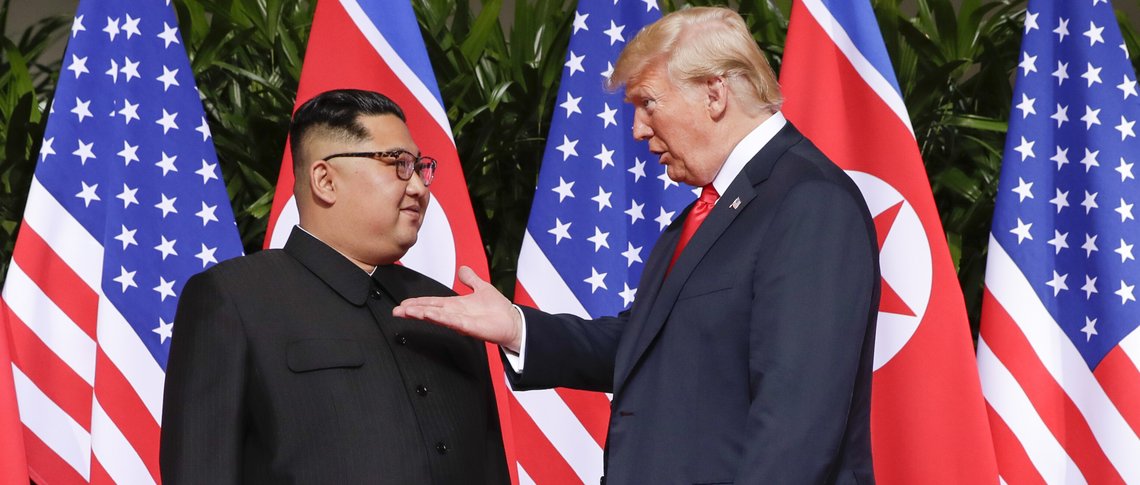
The US’ North Korean policy has until now been a failure. Since the 1990s, Washington has essentially been pursuing four goals: stopping North Korea’s nuclear and missile programme, isolating the country internationally, using sanctions to force concessions and providing military support to South Korea. But this policy has long since lost touch with reality. Its goals are simply no longer achievable.
Despite all efforts, North Korea continues to expand its nuclear and missile programme, while its rapprochement with Russia increasingly undermines both the policy of international isolation and the sanctions regime. China, too, is lending a helping hand to the authoritarian state through economic aid. And now the Trump government has even called into question its military cooperation with South Korea.
This week’s APEC summit could offer an opportunity to take the first steps towards a new strategy. Donald Trump not only wants to negotiate with the presidents of China and Russia about the war in Ukraine but is also showing interest in a dialogue with North Korea’s ruler, Kim Jong Un. Such a rapprochement would be attractive to both sides. A repeat of the failed summit diplomacy of 2018 and 2019 is, however, a genuine risk. Back then, the US insisted that the denuclearisation of North Korea was a prerequisite, while Pyongyang focused primarily on the lifting of sanctions.
Until now, these fundamental positions have remained unchanged, as has the mutual desire for a normalisation of relations. Kim Jong Un is without doubt interested in improving North Korea’s international standing and in being recognised as the head of state of a ‘normal’ country among the leading powers. The US, on the other hand, continues to regard North Korea’s nuclear and missile programme as a security threat. Added to this is Trump’s personal interest in a diplomatic success: following what, from his point of view, turned out to be disastrous midterm elections at the start of November, he will not want to go down in history as a loser. A breakthrough in the conflict with North Korea – something which all US Presidents since the 1990s have failed to achieve – would undoubtedly flatter his ego.
From denuclearisation to arms control
If, however, such discussions are to be successful, the US would have to fundamentally revise its previous stance: instead of insisting on complete denuclearisation, it should, at least temporarily, accept North Korea’s nuclear arsenal as a reality and focus first on arms control and risk minimisation. This would require a long-term negotiation format that goes well beyond the spontaneously arranged presidential meetings that took place during Trump’s first term in office.
Until now, the Trump government has not demonstrated a coherent policy towards North Korea. A meeting between Trump and Kim could, however, pave the way for a rapprochement. It is precisely Trump’s notoriously erratic foreign policy that might offer an opportunity for unexpected and unconventional results.
Chung-in Moon, a security advisor to a former South Korean president, outlines what such an initiative might look like: ‘Let’s assume that the US makes a truly surprising offer: to give up the ‘policy of animosity’ towards North Korea, normalise bilateral relations, suspend joint military exercises with South Korea, lift its unilateral sanctions in finance and other areas, guarantee the peaceful use of nuclear energy and pave the way for investments from abroad in North Korea. Under these conditions, Pyongyang could indeed be interested in starting a dialogue with Washington.’ In exchange, North Korea would probably have to temporarily suspend its missile tests and freeze operations at the central nuclear complex in Yongbyon to persuade Washington to adopt such a far-reaching change of course.
The stark reality is that all attempts to put an end to the North Korean nuclear programme have failed.
Little resistance is to be expected from South Korea’s current government. On the contrary: already in September, President Lee Jae Myung was advocating at the United Nations for sanctions against North Korea to be lifted, as long as Pyongyang froze its nuclear programme in return. Lee argued that the sanctions were, in any case, ineffective, and that the strategy employed for many years of isolating North Korea internationally had proved to be a failure.
New negotiations on the normalisation of relations are therefore a matter of urgency. Those who want to limit or even reverse North Korea’s nuclear arms build-up have hardly any alternative. It is unrealistic to hope that Pyongyang will at some point give in. Military options were considered by different US governments but always discarded on account of the huge risks involved. In light of the conflict with Iran, they now appear to be even more unrealistic. A continuation of the international isolation also seems unlikely to bring success because of North Korea’s rapprochement with Russia and China. And a change of regime in Pyongyang is just as unrealistic.
The stark reality is that all attempts to put an end to the North Korean nuclear programme have failed. For this reason, it is time to cease demands for North Korea to immediately disarm its nuclear arsenal. Instead, Washington should temporarily accept the country’s nuclear weapons as reality and focus on arms control to minimise risks.
A new framework for Korean peace
A new North Korea policy could come about in two stages: first, it would be advisable to encourage the country to rejoin the Treaty on the Non-Proliferation of Nuclear Weapons and second, to develop long-term negotiation strategies to resolve the Korean conflict.
North Korea joined the Treaty on the Non-Proliferation of Nuclear Weapons in the mid-1980s, but in 2003 became the only country to date to have resigned its membership. Even back then, discussions took place among the signatory states as to whether the withdrawal should even be accepted. If North Korea were to rejoin, its nuclear weapons arsenal would require it to receive a special status. This could be for a limited period, as the long-term goal would continue to be the country’s complete nuclear disarmament. The key advantage in rejoining the Treaty on the Non-Proliferation of Nuclear Weapons would be the inspections by the International Atomic Energy Agency that this would entail.
Russia and China also still have an interest in curbing North Korea’s nuclear arms build-up — not least to secure their own status as nuclear powers. China also fears that other countries in the region might strive to gain possession of nuclear weapons, if attempts to persuade North Korea to reverse its course were to fail. Although Beijing has lost influence following the rapprochement between Pyongyang and Moscow, North Korea’s economic dependence on China continues to be an important factor.
Fresh negotiations should not, however, be limited to the US and North Korea. Effective arms control is unlikely to be possible without involving China. A model for a long-term diplomatic process for ending a Korean conflict that has been smouldering since the 1950s could be provided by the Two Plus Four process which paved the way for German reunification.
Such an approach would not only entail North Korea’s long-term relinquishment of nuclear weapons. Security guarantees for Pyongyang, an agreement on the future cooperation between North and South Korea and the prospect of North Korea’s complete reinstatement in the international community would be of equal importance. Alongside North and South Korea, the US, China, Russia and Japan would need to participate in the negotiations. The EU could also have a role to play, particularly when it comes to North Korea’s economic development and humanitarian aid. The historical Two Plus Four format would therefore become a Two Plus Five process. A precondition for this would, however, be a complete change of course in Washington: away from the requirement for immediate denuclearisation to a form of diplomacy focusing initially on what is feasible.