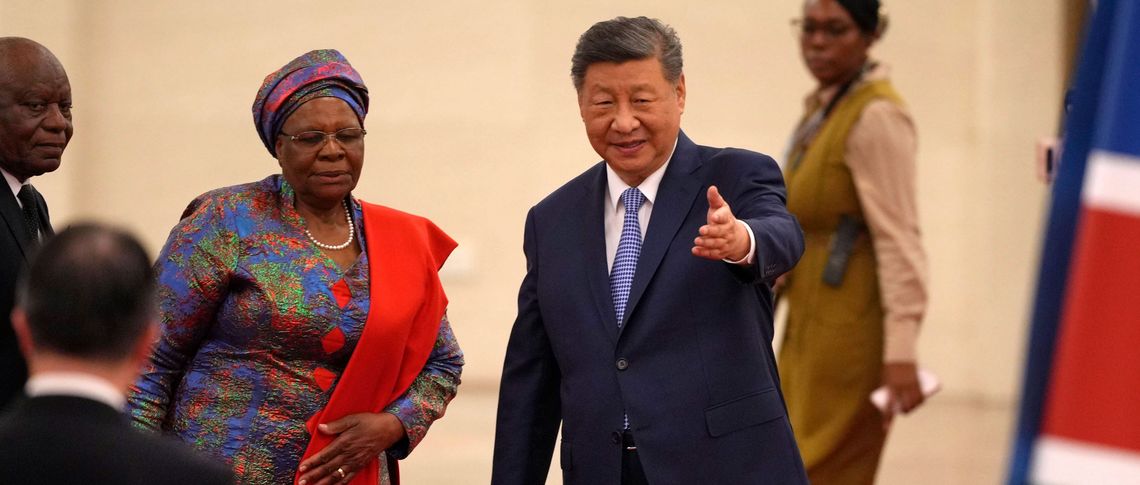
After Xi Jinping unveiled the Belt and Road Initiative in 2013, China elevated nuclear technology exports from a commercial ambition to a declared national strategy, and its state nuclear champions – China National Nuclear Corporation (CNNC) and China General Nuclear (CGN) – have fanned out across Africa, signing cooperation agreements, training regulators and buying up uranium mines. Roughly 22 African states have told the International Atomic Energy Agency they want nuclear power, and China has moved to satisfy this growing demand for clean and affordable energy.
While nobody has yet switched on a Chinese-built power reactor in Africa, what is underway across the continent is not a single infrastructure project, rather, the slow construction of a relationship that could bind African states to Beijing for the better part of a century. This is because the difference between a nuclear deal and a road, a port or a railway is durability. Roads can get repaved by a different party. Debt gets renegotiated or written off, especially if China wants to avoid the PR disaster of Hambantonta. Meanwhile, a nuclear power plant, once built, locks a country into its supplier’s fuel cycle, safety standards, spare parts, training pipelines, licensing and eventually its waste-management arrangements for 50 to 80 years. That is not a loan; it is much longer in term and with a wider ripple effect. And this is precisely why nuclear energy – more than the railways and ports that dominate Belt and Road headlines – may prove to be China’s deepest and least reversible instrument of influence on the continent.
Fierce competition
China’s current developments were built on the modest cooperation opportunities it secured in Africa just after it began liberalising its markets during the 1980s. Indeed, China’s oldest African nuclear footprint dates to 1983, when it agreed to build Algeria’s Es-Salam research reactor. Ghana’s GHARR-1 reactor, supplied in the 1990s, received a joint Chinese-assisted core conversion in 2017, and in 2024 Accra signed on for a full-scale Hualong One reactor with the CNNC. Meanwhile, Kenya has separate memoranda with both CNNC and CGN and is targeting a 1000-megawatt plant by 2034, already in Phase II of the IAEA’s Milestones process for newcomer nuclear states. Nigeria, Sudan, Uganda, South Africa, Egypt and Morocco all have some form of Chinese nuclear cooperation agreement in the books. In 2024, nuclear cooperation was written into a declaration during a China-Africa Cooperation summit for the first time; a small bureaucratic detail that signals a large strategic shift.
Then there is the upstream, or sourcing, story, which gets less attention but matters equally. Namibia is one of the world’s top uranium producers, and Chinese state firms now control its two largest mines. CGN owns and operates the Husab mine, and a CNNC subsidiary bought Rössing Uranium from British-Australian Rio Tinto in 2019. Owning the ore, not just the reactor, lets China capture value at both ends of the nuclear fuel chain: mining rents on one side, and providing reactor exports and fuel services on the other. Meanwhile, Western mining giants have been retreating from the region amid instability in the area on one hand and an inability to standardise prototypes for mass export and installation on the other. Indeed, as Western firms prioritise process innovation over design innovation, the result is a series of costly prototypes which are effective but nevertheless not as feasible for developing nations as Chinese alternatives. Design innovation and standardisation require massive and sustained R&D investment which are challenging to sustain in the private sector, leaving the room for Beijing (and Moscow) to etch nuclear export agendas into long-term policy and then back local manufacturers to produce and export at scale.
Nuclear infrastructure differs from conventional infrastructure because dependency is reproduced through technical systems rather than merely through finance.
And yet, none of this makes China’s position unchallenged. Russia’s Rosatom is arguably the more advanced competitor in Africa right now: it is actually pouring concrete at Egypt’s El Dabaa plant, financed by a $25 billion Russian loan, and has signed a cooperation roadmap with Ethiopia. The United States, dogged for years by the collapse of its own domestic reactor-building capacity, is fighting back with small modular reactor diplomacy: Ghana has partnered with the American firm NuScale even as it simultaneously is negotiating with the CNNC for a Hualong One, and has recently returned to Niger to ink a $414 million nuclear deal. South Korea is trading on its credibility from the UAE’s Barakah plant. France and the EU remain influential upstream, though Orano’s uranium operations in Niger have been disrupted by political upheaval. The result is not a Chinese monopoly but a genuine multipolar bazaar, with Ghana alone juggling American, Chinese and French suitors simultaneously.
That competition matters enormously for how this story ends. Rather than simply focusing on Chinese nuclear involvement creating dependency, one must ask why that dependency matters for African states and what alternatives are available to them. Nuclear infrastructure differs from conventional infrastructure because dependency is reproduced through technical systems rather than merely through finance. A country that relies on a single foreign supplier for fuel, reactor maintenance, spare parts, safety certification and specialist training has fewer meaningful options when political or commercial relations deteriorate. This can constrain policy autonomy long after the original contract has been signed. The danger is particularly acute for states with limited regulatory capacity, where the supplier may simultaneously be a contractor, technology provider, trainer and source of technical expertise.
African states may therefore exchange dependence on one dominant actor for a more complicated form of dependence involving several actors.
Yet the alternative to Chinese involvement is not necessarily to reject nuclear power or to replace Beijing with another external patron. The more consequential alternative is to diversify the relationships surrounding the nuclear sector. African governments can use competition among China, Russia, the United States, South Korea, France and other suppliers to negotiate technology transfer, domestic manufacturing, independent regulation and training commitments. They can also cooperate regionally, pooling regulatory expertise and developing common standards rather than reproducing small, nationally isolated nuclear bureaucracies. In this sense, multipolarity can be a source of leverage rather than dependency, provided African states act in coordination with each other, in a nuclear Concert of Africa, and retain the institutional capacity to bargain among competing suppliers.
At the same time, however, the growing number of external players creates its own risks. Competition can encourage suppliers to offer attractive financing and political commitments while shifting long-term costs into areas that are less visible at the contracting stage. It can also produce fragmented regulatory standards, incompatible technologies and multiple foreign-controlled supply chains across the continent. African states may therefore exchange dependence on one dominant actor for a more complicated form of dependence involving several actors. The central issue is consequently not whether Africa should choose China, Russia or the West, but whether African states can transform external competition into greater domestic and regional capacity. Without that capacity, a multipolar nuclear market may increase the number of available partners without substantially increasing African autonomy.