


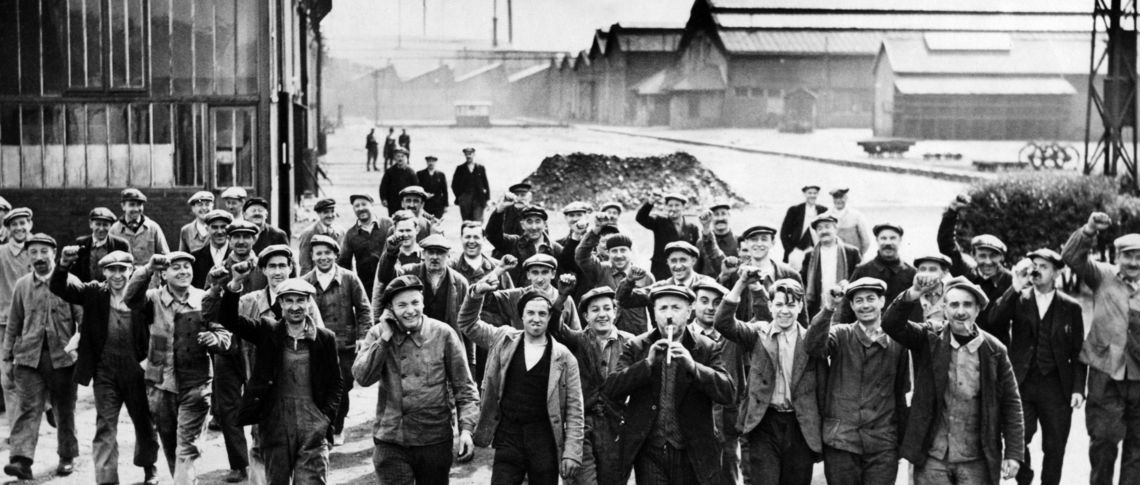
On the first of May, we remember the victories of the international labour movement. From the eight-hour workday to paid holidays and the weekend, we often take for granted the gains won through years of organisation and struggle. These fights were long and costly, and many workers and labour organisers gave their lives so that ours could be richer, more fulfilled and freer from oppressive systems of exploitation and inequality.
And yet, this year’s celebration of International Workers’ Day felt different. It has become palpably clear that Europe’s working class is under mounting pressure, and the labour movement itself is losing ground. A protracted industrial crisis, with steel factories reducing capacity and major employers such as Volkswagen announcing dramatic layoffs, shows that the current emergency is deep, profound and longstanding.
The latest energy shock resulting from the closure of the Strait of Hormuz has once again made this painfully clear. Europe’s exposure to volatile oil and gas markets is not just an environmental problem — it is an economic and geopolitical vulnerability. And as always, the costs are not evenly shared. Rising energy prices will hit working-class families the hardest — both directly through bills and indirectly through job losses in energy-intensive industries.
At the same time, organised labour is struggling to respond. Union membership has never been lower, particularly among younger workers, many of whom no longer see unions as relevant to their lives. This erosion of collective power comes at precisely the moment it is needed most.
Taken together, these pressures expose a deeper problem: Europe’s green transition risks deepening inequalities because it is being shaped without workers.
But crises also create openings. The question is not whether Europe will transform its economy, but how — and for whom.
Transformation, not delay
In the short term, European policymakers must act to protect citizens from immediate price hikes that could have devastating consequences for their livelihoods. Since the energy crisis triggered by the invasion of Ukraine, the European Trade Union Confederation (ETUC) has called for stronger employment protections in response to the strain on Europe’s industries. Analysts have also advocated for subsidised energy allocations to ensure households can access a basic level of affordable energy and weather the crisis.
At the same time, Europe must pursue transformative policies that reduce the continent’s vulnerability to such shocks in the future — while ensuring these measures are designed with a clear awareness of their differing impacts across social classes.
Evidence is mounting that decarbonisation can shield both citizens and economies from the volatility of energy price shocks. Countries like Spain, which have invested heavily in renewables, have been far less exposed to such shocks. As a result, the country currently has some of the lowest energy prices in the EU.
Yet Europe’s current approach remains politically fragile because it is socially uneven.
What is needed is a decisive break with the idea that markets alone can deliver a fair transition.
Many key decarbonisation programmes in Europe disproportionately benefit higher-income households while offering little for low-income families. For example, programmes that incentivise buying new electric vehicles overwhelmingly benefit those who can already afford new cars. Meanwhile, policies like the EU’s crown jewel decarbonisation policy, the Emissions and Trading System, push up costs in ways that fall hardest on lower-income groups and on regions dependent on energy-intensive industries.
In other words, Europe is currently pursuing a transition that relies heavily on market mechanisms, while failing to correct their predictable social consequences. Experts have referred to this as ‘carbon shock therapy’ and warned that in the face of volatile energy markets and intense international competition, this approach leads to deindustrialisation. Increasing costs for energy-intensive industries without adequate and coordinated state support for new alternatives results in a ‘disordered’ decarbonisation process that risks massive job losses and shrinking industrial capacity.
The result is a growing sense that the green transition is something being done to workers, not for and with them. Unsurprisingly, this has fed resentment and strengthened far-right forces eager to weaponise economic insecurity against green policies.
What is needed is a decisive break with the idea that markets alone can deliver a fair transition. Instead, Europe needs a more ambitious, state-led industrial strategy — one that treats decarbonisation as a collective project rather than a market correction.
There are already glimpses of what this could look like. France’s ‘social leasing’ initiative, which provides low-cost access to electric vehicles for households, expands access beyond affluent households. Additionally, investments in affordable public transport deliver far greater benefits for lower-income groups than subsidies for private consumption. And Europe’s Industrial Accelerator Act provides resources to support the decarbonisation of ailing industries.
But these efforts remain fragmented and insufficient.
A serious strategy would combine large-scale public investment with job guarantees, retraining programmes and stronger employment protections. It would also require new forms of public or collective ownership in key sectors to ensure that the benefits of the transition are broadly shared. Crucially, this also requires a more proactive role for unions themselves — not only as defenders of existing jobs, but as co-designers of industrial transformation. This requires crafting policy responses with workers and unions in ways that highlight the centrality of labour in transition away from fossil fuels.
In short, decarbonisation must be designed as labour policy.
No transition without labour
None of this will happen without pressure. Europe is currently caught in a moment of competing visions for how to escape from Europe’s fossil-fuel straitjacket. Delays, such as scrapping the EU’s ban on new internal combustion cars, reflect a fear of bold action and concession to legacy carmakers, while reopening discussions on drilling in the Arctic will only distract from the bold action that is needed.
At the same time, the persistent reliance on deregulation as a growth strategy reflects a political unwillingness to confront the scale of structural change required and represents more of a wish list of multinational lobbying rather than serious industrial policymaking.
This is where the labour movement must reassert itself. Ambitious political action for policies to transform Europe’s economy in a way that is led by Europe’s workers will require pressure and coordinated action. This also means securing a seat at the table where industrial policy is shaped. For it is workers and their unions that know better than anyone else what kinds of policies are needed to transform European economies in ways that can encourage buy-in and popular support for ambitious decarbonisation.
Ultimately, it is workers who will build the infrastructure necessary for Europe’s decarbonised future and workers who bear the brunt of the devastation that could come from getting it wrong. That gives them both a material stake and a unique authority in shaping what comes next.
The history of the labour movement is one of struggle, forcing change that once seemed impossible. There is no reason to believe this moment will be different. The pressure to force these policies must come from a labour movement that is confident and coordinated, rather than permissive and subdued.
For unions, this is also an opportunity. By placing themselves at the centre of the green transition – demanding concrete gains, fair distribution and democratic control and co-creating policies – they can rebuild relevance and reconnect with younger generations.


