


Australian dairies can continue to call the Parmesan they produce by that name. With several concessions regarding geographical indicators and market access quotas for agricultural products, the EU-Australia Free Trade Agreement was finally concluded after more than two years of delay. The agreement is more than just a trade deal — it is a first sketch of a new geo-economic order. Geographical indicators have always been a particular irritant for the Australian side, as many producers with a European migrant background see themselves as legitimate custodians of the relevant recipes and production methods. At least in this respect, the emotional ties to the old continent have always been strong in Australia.
At the political level, however, the picture was often more complicated. Despite shared values and largely overlapping interests, the mutual expectations between Australia and its European partners have not always been met. Australia’s solidarity and valuable support for Ukraine are highly appreciated by Europeans, as is Europe’s steadily growing commitment to the Indo-Pacific region by Australia. And yet, misperceptions of each other’s respective political geography have time and again led to misunderstandings. The conclusion of the AUKUS partnership in 2021 under the last conservative government in Canberra, at the expense of the existing submarine procurement project with France, was a most evident case in point. Conversely, the image of the EU as a protectionist bloc, cultivated since the 1970s, persisted stubbornly in Australia, and the EU’s institutional limitations in foreign and security policy, and its at times cumbersome decision-making procedures, stood in the way of closer engagement.
Strategic urgency
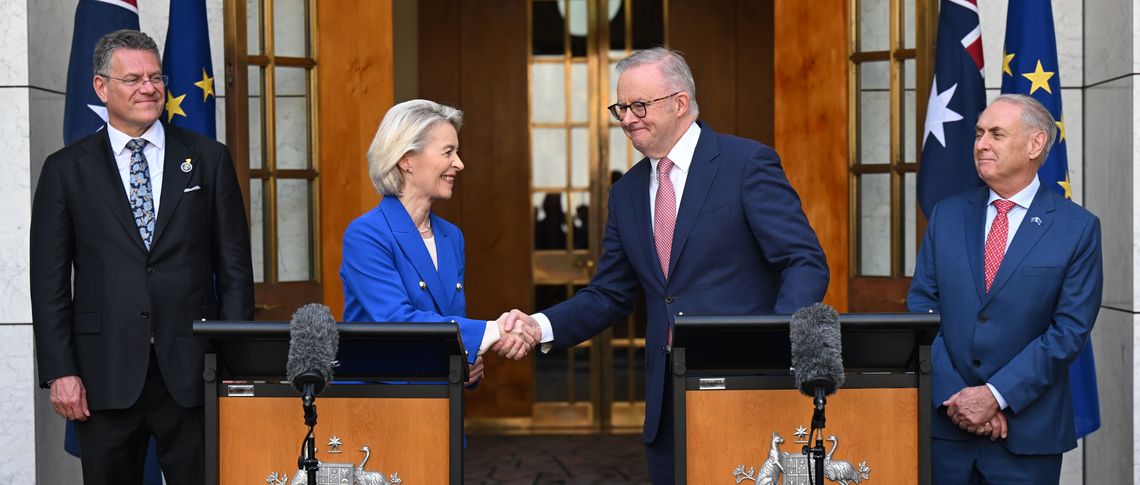
The outstanding results of EU Commission President Ursula von der Leyen’s visit to Australia last week are therefore all the more important. Against the backdrop of the geopolitical shifts of our time, the key players decided that disagreements over details can no longer stand in the way of the overarching goal of closer cooperation. Expanding and deepening the relationship between the EU and Australia in three crucial areas at once is a historic success indeed. In addition to the conclusion of the Free Trade Agreement, a Security and Defence Partnership was established last week, and Australia’s imminent association with the EU research and innovation programme Horizon Europe was announced. In their speeches, von der Leyen and Prime Minister Anthony Albanese rightly emphasised how this will enable closer cooperation in policy areas that are currently of particular importance to both.
This includes better and, above all, reliable trade and investment conditions to ensure the development and expansion of alternative supply chains in critical sectors during times of increasingly regular economic shocks. Moreover, cooperation in the fight against cyber attacks and other hybrid threats will be strengthened, as will cooperation in the defence industry — a point that was also emphasised during German Defence Minister Boris Pistorius’ high-profile visit to Canberra the following day. Finally, closer integration of Australia’s excellent higher education and research sector with Europe will be beneficial for both sides at a time when technological dominance is increasingly used as a means of political and economic compulsion.
The European Commission, of late, has amply demonstrated its ability to conclude complex free trade agreements and to thus respond very visibly to the challenging new global situation.
In their formal Joint Statement, Albanese and von der Leyen refrained from explicitly referencing the increasingly challenging global situation. Nevertheless, it is clear that this success has two unwitting stepfathers in Presidents Trump and Xi and is intended to send a signal against the growing disregard for international rules and principles and the increasing willingness to pursue political goals through economic and military coercion.
The European Commission, of late, has amply demonstrated its ability to conclude complex free trade agreements – India and Mercosur come first to mind – and to thus respond very visibly to the challenging new global situation. The message: where Trump is resorting to tariffs, the EU continues to rely on and promote rules-based free trade, including now with Australia. In her speech to business leaders in Sydney, von der Leyen even floated the idea of driving stronger EU cooperation with the CPTPP (Comprehensive and Progressive Agreement for Trans-Pacific Partnership), thereby establishing a ‘global reference point for stability and economic security’. This idea had been explored before in Australia and New Zealand and, following such endorsement at the highest level, could now be pursued with greater vigour.
The Commission President was also prepared to explicitly address the challenge posed by China in her remarks. In fact, the threat posed to Europe – and to Germany’s industry in particular – by China’s industrial overcapacity seems far more acute than in Australia, which has itself limited industrial capacities to protect, believes it has stabilised relations after the recent bilateral freeze and is counting on the continued strong complementarity of its trade relations with China.
Furthermore, von der Leyen’s praise of Australia’s pioneering role in protecting young people on social media was noteworthy. Already when Australia had presented the rationale of the legislation during the UN General Assembly last year, the Commission President had strongly endorsed the social media ban for under-16s as a ‘common sense’ approach. It is easy to see here a signal to US tech executives that the EU will not bow to Washington’s anger at Brussels imposing its regulations on social media platforms.
China will remain a crucial economic partner for Australia, and the US its indispensable security partner.
As far as Australia is concerned, the new pacts with the EU follow after a series of recent cooperation agreements with neighbours such as Indonesia, Singapore and Papua New Guinea, as well as increasingly close collaboration with Japan. The restrictions placed on the university sector in the US have also affected Australian research collaborations, thus strengthening the case for association with Horizon Europe, long lobbied for by Australian universities. All that said, China will remain a crucial economic partner for Australia, and the US its indispensable security partner. The aim is diversification, not replacement, and following successful Australian diplomacy towards that objective in its own region, the EU agreements serve to broaden the effort.
In appreciation of the joint achievement, President von der Leyen was given the honour of addressing both houses of the Australian Parliament and of becoming the first female international leader to do so. As is customary, she was welcomed by the Prime Minister and the leader of the opposition. Angus Taylor, newly elected leader of Australia’s opposition Liberal Party, chose to portray the agreements with Brussels as an alliance to protect Western civilisation: ‘We are the custodians [...] We must defend and protect the inheritance we cherish.’ It would seem that the target of his speech was not so much the Commission President, but rather the domestic electorate, which had just supported the right-wing populist One Nation party over the struggling Liberals at state elections in South Australia. Even though Labor easily won these elections, the results suggest that Australia, too, could soon be facing polarising identity politics debates, especially if the Liberals were to adopt a narrative of looming ‘civilisational erasure’ as was projected on Europe by the latest US Security Strategy.
The Australian government has so far very subtly navigated under the radar of Trump's incalculability, taking a cautious, pragmatic and transactional approach. Since the antisemitic terrorist attack at Bondi Beach last December, Australia’s multicultural model has understandably come under increased scrutiny. However, necessary debates in Australian society would hardly benefit from the country’s domestic politics becoming a negative projection screen for MAGA ideology, as has been the case in Europe. Coinciding with von der Leyen’s visit, the National Security College of the Australian National University presented the results of a survey of threat perceptions in Australia. The notable rise in public anxiety correlates with the rapid erosion of the international order over the past few years. A closer exchange on these issues with European partners is therefore warranted and underscores the timeliness of reforging closer links between Europe and Australia.


