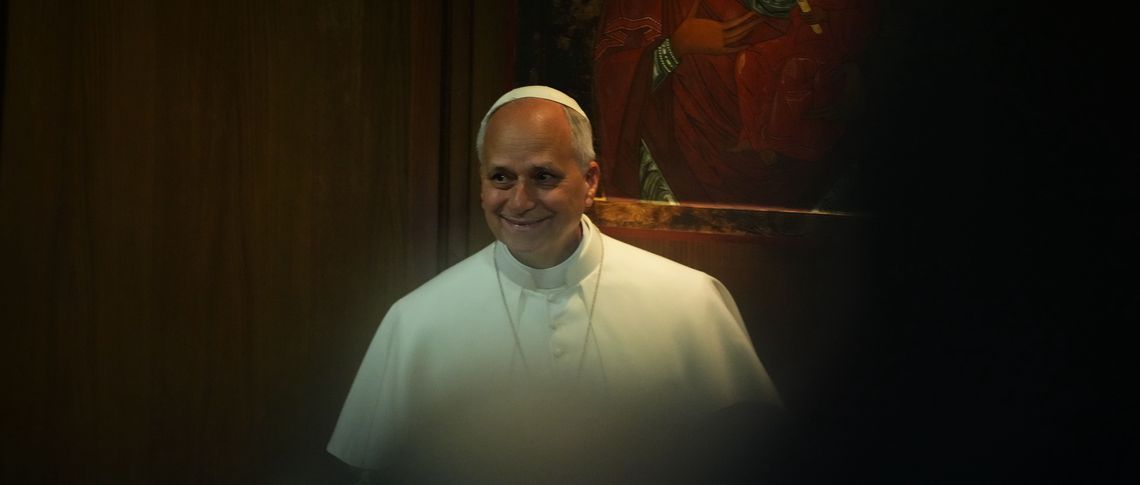
The Pope has posed perhaps the most important political question about artificial intelligence: who controls the digital order of the future — and whom does it serve? While European governments tend to approach the AI debate in largely technocratic or economic terms, Leo XIV formulates a fundamental critique of concentrated power, data control and digital inequality in his first encyclical. In doing so, he fills a gap that democratic politics has so far left open.
The past weeks and months have already shown that Leo XIV intends to embrace this role assertively. Following his public clash with US President Donald Trump over the war with Iran, the Pope now also does not shy away from confrontation with the tech industry. With his first encyclical, Magnifica Humanitas, he not only intervenes in the debate on artificial intelligence but also raises fundamental questions about power, control and social responsibility in the digital age.
An expression of social and political power
While Brussels, as well as many European governments, have reacted surprisingly defensively to many geopolitical and technological upheavals, Leo XIV poses the question of power without losing sight of the values inherent to the Catholic Church. His primary concern is whom this technology serves and who controls it. That is a different starting point. Consequently, he places people rather than technology at the centre of his reflections. This is precisely where other debates reveal a blind spot: they have so far failed to interpret digital transformation without resorting to extreme scenarios.
The encyclical was signed not only symbolically on the 135th anniversary of Rerum novarum, the papal encyclical written by Pope Leo XIII at the end of the nineteenth century. That encyclical represented a key socio-ethical response to the Industrial Revolution and its consequences for labour, capital, poverty and social cohesion. Factories, machines and industrial production fundamentally transformed societies then. Today, data, platforms and learning systems play a similarly interventionist role. Leo XIV consciously builds on this tradition. He transfers central principles of Catholic social teaching into the digital present while simultaneously expanding them, for example through the principle of social justice — something that will certainly surprise social ethicists. From the Pope’s perspective, AI becomes an expression of social and political power.
For precisely that reason, the encyclical should also be read as a contribution to defending and strengthening democratic processes and political responsibility. In the past, major infrastructures were usually planned by states or at least visibly subject to political responsibility. Today, companies such as Google, Microsoft and Meta possess data reserves, computing capacity and financial resources that far exceed those available to governments. The AI debate is therefore no longer simply a question of technology. It is a question of power.
Progress is explicitly viewed positively — albeit under one condition: it must serve human dignity, freedom and the common good.
Leo XIV puts it like this: ‘Technology has the power to heal, connect, educate and protect our common home; but it can also divide, exclude and generate new forms of injustice.’ And further: ‘In the abstract, technology in and of itself is not a solution to humanity’s problems, just as it is not inherently evil. In practice, however, technology is never neutral, because it takes on the characteristics of those who devise, finance, regulate and use it.’
Embedded in this is a clear rejection of the idea of technological neutrality. At the same time, it raised eyebrows during the presentation of the encyclical on 25 May that Christopher Olah, of all people a prominent representative of the AI industry, was seated directly beside the Pope. Whether this already signals a serious dialogue between moral authority and technological power remains unclear.
It is striking, in any case, that Leo XIV has not produced an anti-technology text. Progress is explicitly viewed positively — albeit under one condition: it must serve human dignity, freedom and the common good. That is precisely what makes the text interesting both within the Church and beyond Catholic circles. This becomes particularly clear in its conception of property. Leo XIV writes: ‘Today, among the goods that are universally intended for everyone, we must also include new forms of property, such as patents, algorithms, digital platforms, technological infrastructure and data.’ This shifts the debate away from individual risks of use towards a fundamental question of political economy: who controls the digital spaces of the future? And what rules will apply there?
The Pope explicitly connects these questions to a Christian understanding of humanity. Those who control data, algorithms and capital do not merely pursue economic interests. They shape social possibilities, public communication and ultimately human development itself. The latter is especially important to Leo XIV, who devotes an entire section to it.
What kind of society emerges when key digital infrastructures are controlled by a small number of private actors?
Europe sometimes appears directionless in its approach to artificial intelligence. Those who view AI exclusively as a threat to industrial competitiveness ultimately leave the social narrative to the major technology companies themselves. Leo XIV certainly does not present himself as a better economic policymaker. But he raises questions that political debates often neglect: what kind of society emerges when key digital infrastructures are controlled by a small number of private actors? What democratic counterweights are needed to ensure technological progress becomes something more than simply an expansion of economic power?
That is precisely why the encyclical deserves closer attention. It states: ‘truth is a common good and not the property of those with power or influence.’ From this, Leo XIV derives the demand for an ‘ecology of communication’. What he means is a public order that creates transparency, protects personal data and strengthens democratic intermediary institutions. He specifically includes strong intermediary bodies among these – to which political parties and churches alike should count themselves – alongside serious journalism and educational work in families and schools. Schools, he argues, should not attempt ‘to follow the pace of the digital world’ but instead create spaces for ‘shared time for learning and developing trustworthy relationships’. The idea feels particularly timely because many democracies are currently failing precisely because of this experience of acceleration.
At a geopolitical moment when authoritarian forces increasingly challenge multilateralism and the rules-based order, the moral voice of the Pope carries considerable weight. Leo XIV does not present himself as a politician. But he does offer political orientation: ‘if technology becomes the ultimate criterion, the human person risks being reduced to data, a cog in a machine or a commodity’, he writes. In doing so, he rejects the notion that technological change is inevitable.
That is where the real provocation of this encyclical lies. It demonstrates not only that Catholic social teaching can be applied to the digital present. More importantly, it reveals the scale of the gap that democratic politics has so far left open. If the Pope, of all people, asks more clearly than many governments whom AI serves, who owns it and who controls it, this is less a peculiar ecclesiastical phenomenon than a political warning signal. The question of power in the digital age will not disappear simply because politics chooses to manage it technocratically.