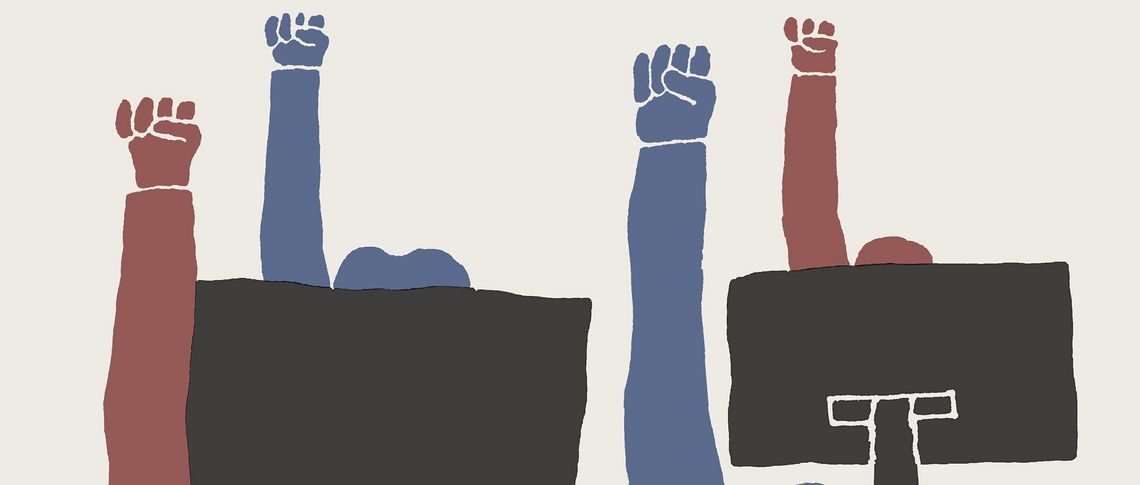
This month, UK-based workers at Google DeepMind, the company’s artificial intelligence research laboratory, decided to unionise. One of their motivations was concern that their employer was supplying AI tools to militaries.
In April, more than 600 Google employees sent a letter to the company’s chief executive, Sundar Pichai, demanding he refuse any Pentagon contract that would deploy Google’s AI for any classified work — to ensure it couldn’t be used for lethal autonomous weapons or mass surveillance, or in other ‘inhumane or extremely harmful ways’. ‘The only way to guarantee that Google does not become associated with such harms’, they wrote, ‘is to reject any classified workloads.’
Across the tech industry, the people who understand AI most intimately – the ones who write its code, train its models and watch its capabilities expand in real time – are increasingly alarmed by what they are building and for whom. Some, like the Google employees, are concerned they are contributing to dangerous military developments. Others worry that AI poses a threat to jobs — their own, as well as in industries as far-reaching as the arts, media, law and banking. Still others are frightened by the privacy implications of the new technology.
By organising, they are insisting that the people closest to AI’s development should have a voice in its direction. They can see risks before regulators, lawmakers or the public can. Listening to them is not just a matter of workplace fairness. It is essential to our society’s ability to govern the direction of AI.
Real power — or is it?
Tech workers’ anxieties about the social impact of their work are not new. In 2018, Google employees organised a large campaign against the company’s involvement in Project Maven, a Pentagon initiative using machine learning to analyse drone footage. They circulated an open letter, asked pointed questions at company meetings and created an online group to raise concerns and discuss ways of protesting. It worked. Google eventually announced it would not renew the contract.
Employees across the tech industry got the message — if they acted collectively, they could exercise real power over what their companies build. Contracted Google workers in Pittsburgh would vote to unionise in 2019; Kickstarter employees formed one of the first companywide tech unions the following year; the Alphabet Workers Unionlaunched in 2021; and The New York Times tech workers voted overwhelmingly to unionise in 2022. A labour movement among tech workers is no longer theoretical.
And yet, despite all this activity, tech worker organising has not scaled. Private-sector union membership across all industries in the United States has fallen to six per cent, even as nearly 70 per cent of Americans approve of unions. The professional and technical-services sector is even less unionised than the private sector as a whole — only 1.3 per cent.
Tech workers often choose their careers at least in part because they believe technology can benefit society.
What explains the gap? The standard answer points to culture. Tech workers often see themselves as professionals aligned with management, not labourers facing exploitation; they identify with their companies’ purported missions of driving innovation and solving complex challenges; they are well compensated and enjoy conditions that other workers envy.
But recent research suggests that the tech industry’s unique professional culture can also enable collective action. Tech workers often choose their careers at least in part because they believe technology can benefit society. When their employers violate that belief by building drone targeting systems, supporting immigration enforcement agencies or harvesting workers’ expertise to train their replacements, many experience it as a profound betrayal.
Turning those frustrations into sustained organisation requires grappling with legal obstacles. Unlike in much of Western Europe, where workers are unionised at high levels and can bargain as an entire sector to address problems in their industries, in the United States, the legal system makes organising and bargaining exceedingly difficult. The National Labor Relations Act, the federal law that governs organising and bargaining among private sector workers, promises to protect the right to unionise but often fails to do so in practice. Employers can delay union recognition for months or years through multiple legal challenges. When they illegally fire workers who organise, a disturbingly common practice, or fail to bargain in good faith, the penalties are so weak that they are nearly non-existent.
Despite the obstacles, American tech workers have more power than they may realise.
Even where unions exist, the law requires employers to bargain only with their own employees; it does not require bargaining to benefit all workers in a sector or a supply chain. This structure is especially ill-suited for responding to concerns raised by AI, which is built through chains of engineers, contractors, cloud workers, data annotators, content moderators and vendors spread across firms.
Despite the obstacles, American tech workers have more power than they may realise. Tech workers, especially engineers building generative AI, are expensive to hire, expensive to train and difficult to replace. They understand the systems they are building better than the regulators trying to govern those systems, better than the executives deploying them and certainly better than the pundits debating their consequences. When they act collectively, they can help safeguard not only their own interests, but society’s interests more broadly.
Workers in other industries have shown what that kind of leverage can accomplish. Hollywood writers and actors did not wait for Congress to solve the threat of generative AI; they used strikes and collective bargaining to win rules over how studios could use scripts, voices and likenesses. Earlier in history, autoworkers transformed what were low-wage jobs into the backbone of the middle class, and their organisation’s leadership went on to support the civil rights movement. Worker power can do more than improve individual workplaces: It can reshape an industry’s obligations to the public.
If we want AI policy that actually works for the public, then decisions cannot be made by executives and investors alone. Workers must have a say in what they build, whom it serves and how it is used. If they do, the rest of us will have a better chance of living with technology governed by democratic values, not merely by corporate and military imperatives.