


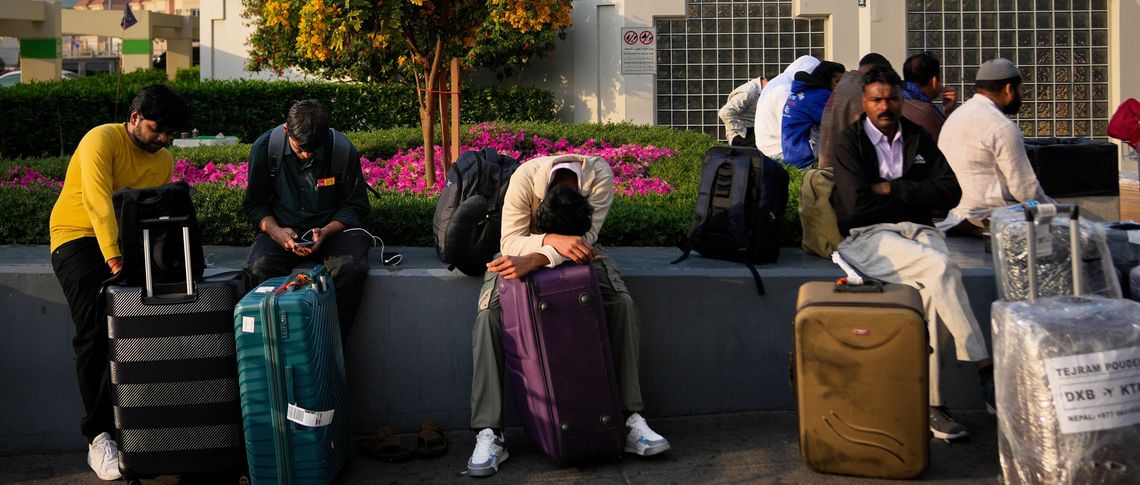
The German government, along with a number of other countries, are currently organising flights to evacuate travellers and influencers stranded in the Gulf states. For many citizens of other nationalities, however, there is no such assistance. They remain stuck in precarious situations, marked by exploitation and insecurity.
The war in the Middle East demonstrates with brutal clarity that the Gulf states’ economic model is built on the systematic vulnerability of migrant workers. More than half of the region’s workforce are from abroad. Millions of people come from the Philippines, India, Bangladesh and African countries to work in the Gulf states — often for many years. Their biggest fears stem from the dangerous security situation, massive loss of income and total uncertainty about whether or not they will even be able to remain in their host country. Returning to their home country, on the other hand, is out of the question. In Nepal and Jordan, remittances from the Gulf states alone account for eight per cent of gross domestic product. Many emerging economies depend not only on oil and gas from the Gulf region, but also on jobs.
A system based on exploitation
The fact that these migrant workers cannot be evacuated is due to structural reasons. In the Gulf monarchies, the kafala system binds migrant workers to a kafil, or sponsor. This modern form of servitude gives employers virtually unlimited control over their workforce. The Gulf model only functions because workers are permanently kept in temporary employment. They are imported, but not integrated. Their rights remain limited, social security is minimal and political participation not permitted. This arrangement is not a shortcoming but a prerequisite for maximum flexibility and low costs.
The fact that the Gulf states’ economic model is reaching its limits is also increasingly the subject of current debate. In a much-discussed New York Times essay, Richard Florida explains that the economic model in Dubai and the United Arab Emirates (UAE) is actually exacerbating the crisis. His question – ‘Could this be the end of Dubai?’ – can certainly be answered in the affirmative, at least from a social perspective. The Gulf states have all failed to provide a social safety net for their millions of workers. The mere import of workers, and complete absence of integration or social security, signal the end of the Dubai model. For decades, the Gulf states have profited from permanently keeping their workers in temporary employment. This model may be economically efficient, but it is structurally vulnerable.
Not one Gulf state has a functioning system of unemployment insurance.
The current war is acting as a stress test for this system. And it has shown that there are no institutional mechanisms in place to protect migrant workers. While citizens are being evacuated, millions of migrant workers are left behind. While supply chains are being secured, there remains a lack of the most basic protection for those who keep those chains running. Nobody is taking responsibility — it is just being passed from pillar to post, between countries of origin, employers and governments.
An International Labour Organization (ILO) study showed that social security, if it exists at all, only ever applies to formal employment contracts. In almost all the Gulf states, these regulations place the burden on the employee. Health insurance is mandatory and must be purchased privately. Not one Gulf state has a functioning system of unemployment insurance. Saudi Arabia is the only state that provides social security coverage for workers from certain countries of origin. This model of temporary migration appears to be so successful that even the current crisis will not change it. It is not in the interests of the Gulf states to provide social security as they derive no benefit from it themselves.
Not a single Gulf country has ratified the landmark ILO Convention 189 on decent work for domestic workers, though Qatar, Saudi Arabia and the UAE have at least made slight improvements to their national legislation and acknowledge the problems. In Kuwait, Bahrain and Oman, union activity is not strictly prohibited, and trade unions are working to better integrate migrant workers. However, the crisis caused by the war is now so dire that the extent to which the situation has improved for domestic workers seems of secondary importance. Whether through trade unions, government measures or employer obligations, what matters is that the situation for migrant workers in the Gulf states is fundamentally improved. Reforms will achieve little. It is time for systemic change.
Developing a social safety net
The executive secretary of the Arab Trade Union Confederation, Hind Benammar, has criticised the kafala system, but at the same time advocates for channels of communication to be opened with Saudi Arabia. Such diplomatic efforts are important now as they can help initiate reforms and resolve conflicts between governments. But the fundamental problem remains: How can working conditions be improved in the long term, and what form might an effective social security net take?
The victims of Iranian attacks in Dubai and the UAE were almost all migrant workers. In Dubai, there were even alarming social media posts about labour migrants being imprisoned. The strict internet censorship in these countries complicates the situation, as members of migrant communities are often unable to openly discuss the conditions on the ground. The fact that in this situation, it is the migrant networks – not governments – that are picking up the slack is not a sign of resilience but systematic failure.
One of the few organisations that are actually helping migrant workers at the moment is the International Domestic Workers Federation (IDWF). The IDWF organises emergency accommodation and coordinates aid, thereby effectively replacing government safety nets. Social security only exists where it is improvised. The millions of jobs as cleaners, nannies and nurses are primarily carried out by women. Domestic workers are often not even allowed to leave their workplaces, let alone move freely in public spaces. The social isolation of these workers is reminiscent of the pandemic. Here, too, they had nobody to rely on except for their own communities.
Reactions so far suggest that the cost of the crisis will, in fact, continue to be shifted onto migrant workers.
When governments, employers and insurances fail to provide assistance, communities must step into the breach. The IDWF approaches the embassies of workers’ countries of origin, calls for repatriation flights to be organised and provides its members with individual-level safeguards. They make contact with domestic workers through community leaders. These individuals, who together play a role similar to that of a works council, provide information about the situation, offer support in emergencies and organise training sessions on issues such as mental health, which is becoming increasingly important in light of the severe social isolation. In some of the Gulf states, this work has been criminalised, and several community leaders have even been detained. For domestic workers, but also for those in the construction and transportation sectors, this is a matter of sheer survival. For the most part, however, the Gulf states have no established trade union tradition. In the Gulf monarchies, policy-making is controlled by a handful of powerful men.
Over the last few years, Qatar and Saudi Arabia have sought to make financial contributions to the ILO. But the Gulf states will not be able to simply buy themselves a clean slate. Ambet Yuson, general secretary of the six-million-member Building and Wood Workers’ International (BWI), has condemned the fact that Saudi Arabia’s reforms by no means signify an abolition of the kafala system, claiming they are in fact little more than rebranding. In Saudi Arabia, stadiums for the 2034 World Cup are currently being built, but the construction sector also lacks a basic social safety net. It would be disastrous if the mistakes made in Qatar were to be repeated here. There, too, the kafala system resulted in exploitation, as any worker who lost their job found it nigh on impossible to switch to a new sponsor. Recruitment practices and indebtedness in the home country further exacerbate this dependence.
Thus, the war has not only exposed a crisis — it has marked a boundary. A model that consistently shifts risks onto legally marginalised workers will only remain stable provided no shocks occur. As soon as they do, it becomes clear that there is no social security because uncertainty is an inherent part of the system. The Gulf crisis shows just how important it is to develop the social safety net that the trade unions are advocating for. The much-discussed question of reforms does not go far enough. The real problem is structural. Yet this does not automatically result in systemic change. On the contrary: reactions so far suggest that the cost of the crisis will, in fact, continue to be shifted onto migrant workers.
Change will therefore not come from the Gulf states alone. Here, external and transnational levers are crucial. Countries of origin must enforce stronger protection mechanisms and binding social security agreements; international organisations such as the ILO must strengthen minimum standards; and European countries must take responsibility, for instance by regulating recruitment practices, supply chains and labour standards.


