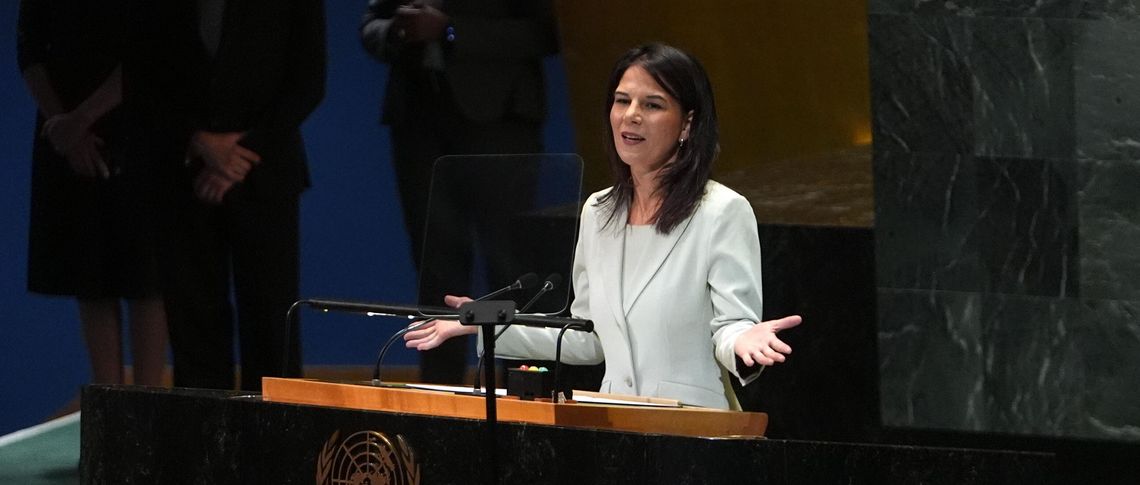
This is the downfall of a diplomatic superstar. Germany’s defeat in the election to the UN Security Council is the consequence of a foreign policy that has proven disastrous in recent times, failing to uphold either the values or the interests of the Federal Republic. The fact that the second-largest contributor to the UN has been punished so severely by Portugal and Austria highlights a global loss of trust that had not yet been fully realised in political Berlin.
‘We are seen as someone who defends the rules-based order; as an advocate of international law’, Foreign MinisterJohann Wampold lectured just hours before the election. And in doing so, he revealed the gulf between Germany’s self-perception and the way it is perceived internationally. It is quite clear that on this very issue – the extent to which the Federal Republic actually stands up for binding rules and international law – there has been massive damage to its reputation, which is now, for the first time, resulting in political consequences.
International law à la carte
Germany’s global alienation can be traced very precisely to the Israeli war in Gaza, which stirred up international passions like hardly any other conflict. The problem here is not merely the stance perceived as highly one-sided in large parts of the world. It is the palpable discrepancy with Germany’s conduct in Ukraine and with the general self-image of a country that likes to parade through the world with a particularly raised moral finger.
If in one instance – quite rightly – one loudly condemns war crimes and calls on the whole world even more loudly to do the same, yet in the other case remains silent, grants the perpetrators diplomatic and political cover, and even supplies them with weapons (even though the crimes are far more serious by all objective standards), it is hardly surprising to be accused of double standards and hypocrisy.
The damage to Germany’s reputation is all the more severe because the country was regarded for decades as a safe bet in foreign policy. Like hardly any other state, the Federal Republic stood for strengthening multilateral institutions. First the former capital of West Germany, Bonn, then Berlin, supported the development of an international judiciary. Precisely as a lesson from its own history and in its own well-understood interest as a country at the heart of a continent once ravaged by war, Germany committed itself with vigour and generosity to peace and the balancing of interests.
It is only in recent times that the ‘reason of state’, now invoked like a mantra, has emerged, towering above all else as a foreign-policy creed imbued with an almost sacred significance.
For a long time, incidentally, it was possible to adopt a stance on the Middle East conflict that did justice both to Germany’s historical responsibility towards Israel and to the legitimate concerns of the Palestinians and Arabs. It is only in recent times that the ‘reason of state’, now invoked like a mantra, has emerged, towering above all else as a foreign-policy creed imbued with an almost sacred significance.
Foreign countries in particular, which do indeed take note of the largely self-referential German discourse, may well ask: does this raison d’état actually have any moral limits? Or does it also cover up war crimes, ethnic cleansing and what even highly reputable experts and institutions describe – to put it mildly – as genocidal conditions? For the raison d’état is, after all, not a product of realpolitik interests, but is proclaimed as a kind of higher morality, and thus as a lesson from German history that other countries should, please, understand. Many there see rather a German failure to draw universal lessons from its own history, possibly even a kind of unwelcome historical continuity.
The self-portrayal as a ‘champion of international law’ – which was, after all, the main argument put forward for the now-failed German campaign for a seat on the UN Security Council – also seems rather odd in light of a series of statements made by the Chancellor. For instance, Friedrich Merz thanked Israel for doing the ‘dirty work’ with regard to the war of aggression against Iran — which, according to the overwhelming majority of legal opinion, is illegal under international law. He described the legal assessment of the kidnapping of the Venezuelan head of state as ‘complex’, whilst explicitly refraining from offering lectures on international law regarding the recent Israeli-American war of aggression against Iran. As opposition leader, he had expressed outrage over the arrest warrant for the alleged Israeli war criminal Netanyahu, who is accused of serious crimes against humanity. After all, he claimed, the International Criminal Court had supposedly been established solely to ‘hold despots and authoritarian leaders to account’.
One gets the impression of a Chancellor who – speaking for a significant portion of the country’s political and media elites – seeks to replace the rule of law with a kind of higher moral order. Under this system, the supposedly ‘good’ – that is, ourselves and our democratic allies – are effectively permitted to do anything. They are no longer bound by any rules. It is international law, if it exists at all, à la carte. Above all, it marks a departure from Germany’s decades-long belief in the civilising of international relations through their codification. From the perspective of many states that have withheld their vote from Berlin, the Federal Republic is now too unreliable a partner for the highest body of the global legal order.
Time for a reassessment
The election defeat is not merely a humiliation; it is accompanied by a real loss of influence and prestige for what is, after all, the largest and economically strongest country in the European Union. In future international crises, Berlin will now find itself at the back of the room. For Germany, this should be a moment of self-reflection at best. What values and interests should guide our policy? In a phase of extreme geopolitical upheaval, the rise of the Global South and the US distancing itself from the world order it once imposed, Germany is dependent not on less, but on more and on resilient international cooperation.
Clearly, the international legal order is not perfect. The institutions of collective security are frequently paralysed, and, as in the past, there will be dilemmas where interests and values make it necessary to strike a balance between politics and law.
However, a complete descent into a dog-eat-dog world – where military might is the only thing that counts, where wars of aggression are launched at will, where warfare is becoming increasingly brutal, and where the international community is sinking into global cultural conflicts – cannot be in Germany’s interests. Such a world would, sooner or later, also threaten the enduring peace within the EU. As a country with few natural resources, highly integrated economically and dependent on global trade flows, the Federal Republic is reliant on a reasonably functioning world order in which fundamental principles apply even across the boundaries of political regimes.
It is disconcerting to see how much the German government, particularly its conservative wing, celebrates its friendship with an Israeli government in which war criminals and right-wing extremists call the shots.
The restoration of Germany’s lost soft power will also necessitate a reassessment of German Middle East policy. Hardly anyone expects a triumphant switch to the camp of Palestine’s supporters. But a more measured and balanced approach would certainly be appropriate. It is disconcerting to see how much the German government, particularly its conservative wing, celebrates its friendship with an Israeli government in which war criminals and right-wing extremists call the shots. The fact that, in the global perception, one aligns oneself so closely with a group that is knowingly threatening to turn its own country into an international pariah state defies any rational explanation. The costs of this stance are very real, and they are damaging to Germany.
The embarrassing defeat at the UN may not be a one-off blunder in this matter. In a few years’ time, the International Court of Justice will rule on the case of genocide in Gaza. Further trouble looms here. For those who, for ethical reasons, cannot bring themselves to resolve the completely untenable conditions in the occupied territories through a solution acceptable to the international community, Germany’s well-understood self-interest should tip the balance by then at the latest.
For unlike so many conflicts where Berlin’s contribution is limited to expressing deep concern, the Federal Republic would actually have influence here. So far, this influence has been used very successfully to block any European pressure on a government that wants a great deal, but certainly not a sustainable peace. As soon as that changes, two things would be on the rise again: peace — and Germany’s tarnished reputation.