


On 31 July, the so-called Board of Peace published the implementation plan for the second phase of the Gaza agreement initiated by US President Donald Trump. What is surprising is less the plan itself than Hamas’ acceptance of a principle that, for decades, had been considered unthinkable: the gradual disarmament of its military wing in exchange for an Israeli troop withdrawal, the reconstruction of the Gaza Strip and a political process leading to Palestinian self-determination. Whether Israel will ultimately agree to the plan remains uncertain. Yet Hamas’ decision alone raises a fundamental question: is the movement on the verge of its greatest political transformation since its founding, or is this merely a tactical manoeuvre?
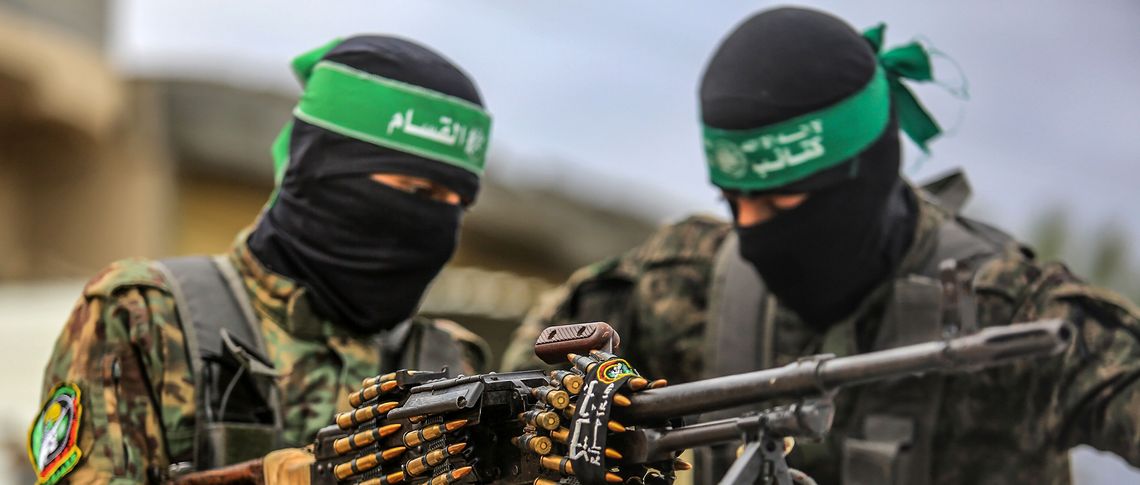
The decision came immediately after the conclusion of the movement’s internal leadership elections, which saw Khalil al-Hayya emerge as its new political leader. Several Hamas officials acknowledged that the debate over relinquishing its weapons had been among the most difficult decisions in the organisation’s history. After all, this is not simply about military capabilities but about the core of its political identity. Since its founding, Hamas has combined political leadership with armed resistance. The Al-Qassam Brigades have never been merely its military wing but have also been a central source of its legitimacy.
For precisely that reason, genuine disarmament would be far more than a technical security measure. It would mark a fundamental transformation of the movement. Hamas would have to evolve from an organisation whose identity has for decades rested on armed resistance into a political actor that derives its influence primarily through civilian means. In some respects, this step would build on Hamas’ 2017 policy document, which for the first time recognised civilian forms of resistance alongside armed struggle as legitimate instruments. What began then as a programme of principles could now have practical consequences.
True transformation or mere tactics?
Nevertheless, scepticism remains warranted. Many observers see the decision primarily as a tactical move. From this perspective, Hamas itself does not expect Israel to carry out a full troop withdrawal or to embark on a genuine political process leading to the establishment of a Palestinian state. The movement may therefore be presenting itself as willing to compromise in order to shift responsibility for any failure of the agreement onto the Israeli government.
This argument cannot be dismissed entirely. At the same time, it does not go far enough. Pressure on Hamas has been mounting for months, not only militarily but politically as well. Within Palestinian society, support for armed resistance has been declining in the face of the enormous human losses and the widespread destruction of the Gaza Strip. At the same time, Hamas is losing important regional backing. Türkiye and Qatar in particular have long been pressing the movement to transform itself into a political party. Its relationship with Iran also appears to be changing. According to reports, Tehran advised Hamas against accepting the agreement. The new leadership nevertheless chose to do so.
Against this backdrop, there are good reasons to believe that the decision represents more than mere tactics. Much points to a deeper strategic reassessment. Hamas appears to have concluded that it can survive in the long term only by redefining its role, shifting from a military movement to a political one. Whether the announced disarmament will in fact become a historic turning point, however, does not depend on Hamas’ willingness alone. The real test is only just beginning. Significant obstacles stand between a political agreement in principle and its implementation.
Major obstacles
The first and greatest obstacle is the position of the current Israeli government. So far, it seems to have rejected the plan in its current form. While it too accepts the objective of a disarmed Hamas in principle, there are major disagreements over how to achieve it. Whereas the peace plan envisages the gradual surrender of weapons alongside a phased Israeli withdrawal, the Netanyahu government insists that Hamas must be fully disarmed before any troop withdrawal takes place. Adding to this are objections to key elements of the plan, including the role of Qatar and Türkiye and the proposal to place the weapons in storage rather than destroy them. With an election campaign approaching, it is also likely to be politically difficult for the Israeli government to accept an agreement that could be portrayed domestically as a compromise with Hamas.
This points to another broader problem. Peace processes often fail when one side feels it is being forced to capitulate in public. A narrative of total defeat may be politically attractive at home, but it regularly undermines the implementation of agreements. Hamas is no longer a monolithic organisation but an increasingly fragmented movement with multiple centres of power. The more its leadership appears to have surrendered unconditionally, the greater the risk that individual factions will refuse to support the new course and instead continue armed resistance on their own.
A second obstacle concerns the practical implementation of disarmament. Collecting weapons is comparatively straightforward. Preventing new weapons from being acquired or manufactured over the long term is far more difficult. The future of thousands of fighters also remains unresolved. Peace processes therefore do not usually stop at the surrender of weapons but also include the demobilisation and reintegration of former combatants. This is precisely where the current plan contains significant gaps. The Gaza Strip currently has little functioning economy, and reconstruction is only due to begin once progress has been made on disarmament. For many fighters, surrendering their weapons therefore means, above all, losing their livelihood without any reliable prospect for what comes next.
If disarmament remains disconnected from a credible political future for the Palestinian people, it is unlikely to amount to more than an extended ceasefire.
The greatest obstacle, however, lies on a different level altogether. The proposed plan treats disarmament primarily as a security issue. In reality, however, it is above all a political process. Armed organisations rarely disappear simply because their weapons have been collected. Lasting peace processes emerge where the political causes of armed conflict are addressed, at least in part. In the case of the Gaza Strip, this means that without a credible prospect of Palestinian self-determination and a political process that goes beyond merely managing the status quo, lasting disarmament is unlikely to endure.
Ultimately, this is also what will determine whether Hamas’ decision truly marks the beginning of a political transformation or merely another ceasefire whose failure becomes apparent in the next round of conflict. In the end, the crucial question is not whether Hamas actually lays down its weapons. The real question is whether a military agreement can be turned into a political process. This is precisely where many peace agreements have failed in the past. Weapons can be collected. It is far more difficult to create the political conditions under which armed resistance permanently loses its legitimacy.
For now, Hamas’ decision signifies one thing above all: for the first time since its founding, the movement has declared itself willing, in principle, to define its future not exclusively through armed resistance. That alone is already a remarkable step. Whether it ultimately leads to a historic transformation now depends on all those involved — Hamas, Israel and the international mediators alike.
This is precisely why the current debate often misses the point. It focuses almost exclusively on the technical aspects of disarmament: who will collect the weapons, who will control the tunnels and who will oversee implementation. All of these questions matter. But something else is decisive. The real test begins only once the guns fall silent.
If disarmament remains disconnected from a credible political future for the Palestinian people, it is unlikely to amount to more than an extended ceasefire. If, however, it gives rise to a political process that combines self-determination, reconstruction and credible security guarantees, Hamas’ decision could indeed go down in history as the beginning of the most profound transformation since the movement’s founding.
For now, it remains entirely unclear which of these two scenarios will prevail. The only certainty is this: the success of this agreement will not be decided in Hamas’ weapons depots, but by the political will of all parties involved to bring the conflict to an end.


