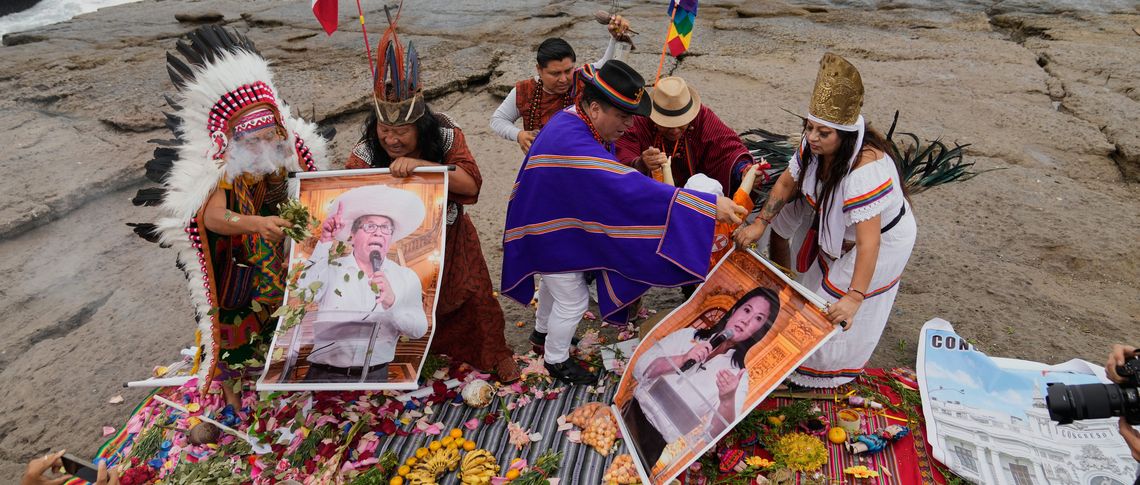
There’s everything to play for in Peru this coming Sunday. Peruvians have to make a choice between right-wing populist Keiko Fujimori and a left-wing surprise candidate. Fujimori, daughter of controversial former dictator Alberto Fujimori, has already lost three presidential elections in a row. This time, however, the geopolitical outlook is highly favourable. Rampant criminality and the influence of Trump’s MAGA movement have shifted the political pendulum to the right in Latin America.
Emotions are running high about whether the country should go right or left. Does Peru need a strong hand to combat crime? Or would that merely pave the way for authoritarianism and US interference? Would a left-wing victory risk economic mismanagement and instability? Would the right usher in nepotistic corruption and cuts in social security?
The newly elected congress contains nearly two dozen people with criminal records, 10 of them in Fujimori’s party alone.
These are all key questions, but in Peru they are little more than campaign rhetoric and pipe dreams, and in any case no more than sticking plasters. In the past 10 years the country has had eight heads of state of varying political stripes. Seven of them are under house arrest, in prison facing charges or barred from leaving the country for offences ranging from an attempted coup to corruption and money laundering.
This suggests that in Peru crime does not so much clash with politics as fit right into it. In the outgoing congress, the public prosecutor’s office was investigating around half of the elected representatives. The newly elected congress also contains nearly two dozen people with criminal records, 10 of them in Fujimori’s party alone. No wonder 90 per cent of Peruvians regard parliament as a den of thieves, three-quarters hold judges in contempt, and even heads of state and governments find the majority of the population firmly against them almost right from the outset. This indicates that Peru’s political system is fraught with deep-lying structural problems. To get to the root of it, we need to consider the country’s history.
A long history of ideological struggles
In the 1960s and 1970s, like many other Latin American countries, Peru was a military dictatorship. In contrast to its neighbours, however, in Peru even the military was ideologically split. In 1968 left-wing nationalist General Juan Velasco Alvarado seized power and, among other things, implemented land reform, made Quechua, the lingua franca of the Inca empire, the official language alongside Spanish, and leaned heavily into cooperative structures. With his ‘third way’ between capitalism and communism, Velasco sought to break the grip of the traditional elites and reduce dependence on US capital. The consequences included overindebtedness and economic crisis. In 1975, a right-wing general seized power. With US support, he pushed through a neoliberal austerity programme and cracked down on the political left.
The ideological struggle continued even after the onset of democracy. From 1980 to 1985, for example, there was an orthodox centre-right government under Fernando Belaúnde, followed by a left-wing social democratic administration under Alan García. In the shadow of the debt crisis and cuts in public spending, together with high inflation under Belaúnde, the population became impoverished and the extreme left-wing guerrilla group ‘Shining Path’ flourished. García’s unorthodox policies, including price controls, multiple exchange rates and the suspension of debt servicing, served only to pour oil on the flames. The state was virtually bankrupt, and hyperinflation ravaged the economy. Shining Path terrorists set off bombs in the capital city, and the population lost all faith in political parties and the traditional elite.
In 1990, this crisis catapulted outsider Alberto Fujimori to power. Son of Japanese immigrants, he took his campaign to the countryside, clad in a traditional poncho in a demonstrative effort to win over marginalised population groups. In contrast to his opponent, later Nobel Prize winner Mario Vargas Llosa, Fujimori was not a member of Lima’s light-skinned aristocracy. He promised gradual reforms and to abjure Vargas Llosa’s brutal economic shock therapy. But he broke this promise in his first year in office. He radically deregulated the economy and prices skyrocketed, although inflation and the exchange rate slowly stabilised. In tandem with this, Fujimori cracked down harshly on Shining Path and its supporters, paying scant regard to human rights. In 1992, guerrilla leader Abimael Guzmán was apprehended. Fujimori thus emerged as the shining hero who had conquered both hyperinflation and ‘terrorism’.
Half the population works in the informal sector, deprived of social security, beset by criminal extortion gangs and oppressed by a brutal, corrupt police force doing the bidding of foreign investors.
Riding this wave, and with the help of the military and the security services, he closed down opposition-dominated congress, restructured the judicial system and suspended the constitution. The narrative he peddled was that a successful state doesn’t need congress or parties, but a strongman, backed by the military and security services. This represented the nadir of democracy in Peru, but the public welcomed it, striking a devil’s bargain with the president. No more democratic debates, human rights, separation of powers and free press in exchange for security and economic stability.
Initially, this seemed to work. Fujimori’s new constitution in 1993 underpinned a centralised political system and an orthodox (neo)liberal economic model, with an autonomous central bank, strong investor and property protection, a commitment to a balanced budget and a business-friendly bureaucracy, dominated by the ministries of the economy and of mines. Peru is celebrated to this day by international investors and financial institutions, including the International Monetary Fund, as a (neo)liberal technocratic success story. Only years later did the dark side of all this come to light. Fujimori made no effort to transform his electoral coalition into a functioning party with its own structures. He relied on transactions, not institutions. National Intelligence Service chief Vladimiro Montesinos simply bought off the media, the judges and politicians, ensuring their loyalty through blackmail.
After a small independent cable company broadcast a series of compromising videos in September 2000, however, Fujimori fled to Japan and resigned, ending up in jail a few years later. Nevertheless, the system he established still shapes Peru today: a neoliberal, business-friendly economic model that for the past 20 years has brought stable economic growth averaging four per cent annually, based on mining, tourism and agricultural exports. However, this goes hand in hand with a weak, corrupt and inefficient state incapable of providing either functioning health care or public education, decent infrastructure or security. Half the population works in the informal sector, deprived of social security, beset by criminal extortion gangs and oppressed by a brutal, corrupt police force doing the bidding of foreign investors.
Peru is a profoundly corrupted, dysfunctional democracy propped up by apparent economic stability.
This economic system sits alongside the empty husks of ravaged institutions and corrupt political parties on sale to the highest bidder. Crime has thus enjoyed an easy passage into politics, and congress has become a bazaar in which there is no discussion of the public good within the framework of competing political visions, but rather a trading floor for special interests and lobbying.
This rules out any sort of long-term strategic development planning. Every president thus enters office under a virtual sword of Damocles. The fact is that if sufficient members of congress gang up against him, the president can be removed on the ground of ‘moral incapacity’, even by criminals whose interests he might have crossed. Politics in Peru is a circus of the macabre.
By contrast, the economy appears to be a bastion of orthodox stability. Central bank chief Julio Velarde, feted by economists for his stabilising monetary policy, has been in office since 2006 and has seen off 10 presidents. Only an absolute majority can remove him. If that were not daunting enough, a two-thirds majority is needed to reform Peru’s constitution and economic system. That’s a pretty tall order for such a divided congress, and a number of presidents have perished on this rock. In any case, ordinary Peruvians are unenthusiastic. The trauma of hyperinflation and historical mistrust of an indifferent state run deep.
What remains to be said? Peru is a profoundly corrupted, dysfunctional democracy propped up by apparent economic stability. But in fact it merely underpins the privileges of the few, fosters social exclusion and degrades politics into a debauched reality show, in which corrupt lobbyists face no economic consequences whatever when their schemes go wrong. The Peruvian people thus think nothing of backing disruptive populists, while denying them a majority in congress out of a reluctance to risk economic instability on a vague promise of reform. This predicament cannot be resolved through elections alone.