


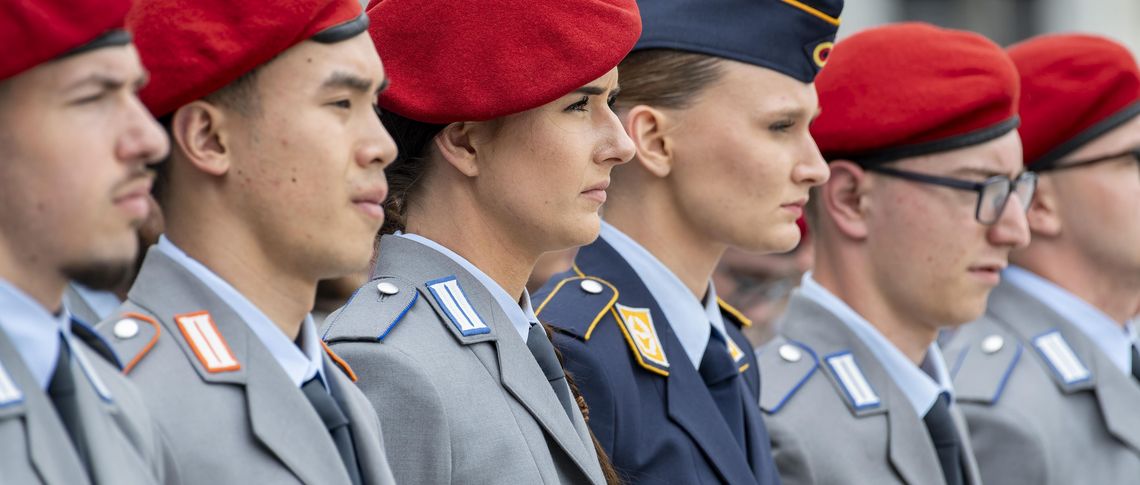
In The Economist, the Italian political scientist Nathalie Tocci argues that Europe must prepare for war not only militarily but also mentally. The starting point for her analysis is the conviction that Russia is not only threatening Ukraine but, in the long term, calling into question the European security order as a whole. Her central argument is that deterrence only works if societies are prepared to make sacrifices and accept military force as a real political option. Even the deployment of European ‘boots on the ground’ in Ukraine should therefore no longer be taboo. War, she argues, is not only a threat to Europe but also an opportunity to rediscover lost virtues such as courage, resilience and social cohesion.
The call for European ground troops in Ukraine is one thing. At least as troubling, however, is the tone in which Tocci presents her argument. In Tocci’s essay, war does not appear primarily as a synonym for unimaginable human suffering, but as a test of society’s resilience. It is about a willingness to make sacrifices, courage and even creativity. For long stretches, the essay reads like a manual for the psychological mobilisation of Europe.
In Poland, weapons training is now part of the compulsory school curriculum.
The reader learns surprisingly little about the cost of war. The author focuses primarily on its supposedly productive aspects. War as a school of character. War as a catalyst for social renewal. War as a supposedly necessary maturing process for a continent that has for too long made itself comfortable in the illusion of eternal peace.
This is precisely where the romanticisation of military violence begins. The essay is written in a language that has lost touch with the grime of the battlefield. It glosses over what happens at the front, where drones and highly automated weapon systems hunt down anything that moves in the so-called ‘death zone’.
‘Boots on the ground’ sounds like a matter-of-fact description from a NATO briefing. What lies behind it, however, are young people who kill, are maimed or die. Families who lose loved ones. Traumas that last a lifetime.
The Economist article is no isolated case. It is emblematic of a discourse on security policy that has shifted at a remarkable pace. Conscription, combat readiness, operational readiness, deterrence – all these topics are now discussed with a matter-of-factness that would have been unthinkable just a few years ago.
Of course, at a time when borders are being redrawn by force of arms right in the heart of Europe, we must talk about defence. However, what is needed is a level-headed debate on security policy. Panic is certainly a poor guide in this regard. Anyone who, out of fear, begins to treat war as the new normal in society runs the risk of losing precisely what is supposed to be defended. The situation becomes particularly problematic where war and its consequences are lost sight of. It is, of course, easy to write about the willingness to make sacrifices and the deployment of soldiers when it is not one’s own children who are being conscripted.
In Poland, weapons training is now part of the compulsory school curriculum. Fourteen-year-olds no longer learn just maths or history, but also how to prepare for an armed conflict. The official aim of the lessons is to teach pupils shooting skills. Anyone who takes this for granted may well have become more accustomed to war than they realise.
For Havryshko, Ukrainian men – even in the eyes of Western supporters – are increasingly being treated less as citizens and more as expendable military resources.
The fact that even former conscientious objectors from the Green Party are now becoming reservists and campaigning for universal conscription fits into this picture. German MP Janosch Dahmen’s retraction of his objection feels like a symbolic staging of the new zeitgeist. Of course, he will not have to pay the price of war himself.
Whilst think tanks and opinion pieces discuss deterrence, resilience and military options, the Ukrainian historian Marta Havryshko describes a different reality for UnHerd: young men hiding from conscription officers and being forcibly dragged into minibuses. Families torn apart as a result. For Havryshko, Ukrainian men – even in the eyes of Western supporters – are increasingly being treated less as citizens and more as expendable military resources. There is a world of difference between this reality and the demands made by Western European experts from the comfort of their warm leather armchairs.
There are, however, also dissenting voices. One of the most vocal does not come from a think tank or a university, but from the Vatican: peace, according to the message of Pope Leo XIV, is not achieved through a never-ending arms race. On the contrary: those who view security solely in military terms generate, above all, fear, mistrust and new spirals of escalation. For him, disarmament is not a sign of weakness, but a prerequisite for lasting peace.
Over two thousand years ago, the Roman poet Horace wrote: Dulce et decorum est pro patria mori – it is sweet and honourable to die for one’s country. The British poet Wilfred Owen, who fought in the First World War, witnessed the agonising deaths of soldiers with his own eyes and lost his life at the front at the age of 25, simply called this notion ‘the old lie’ in his famous anti-war poem.
Anyone who describes war primarily as a source of courage, creativity and social renewal runs the risk of no longer seeing it for what it is: one of the greatest man-made catastrophes of all time.


