


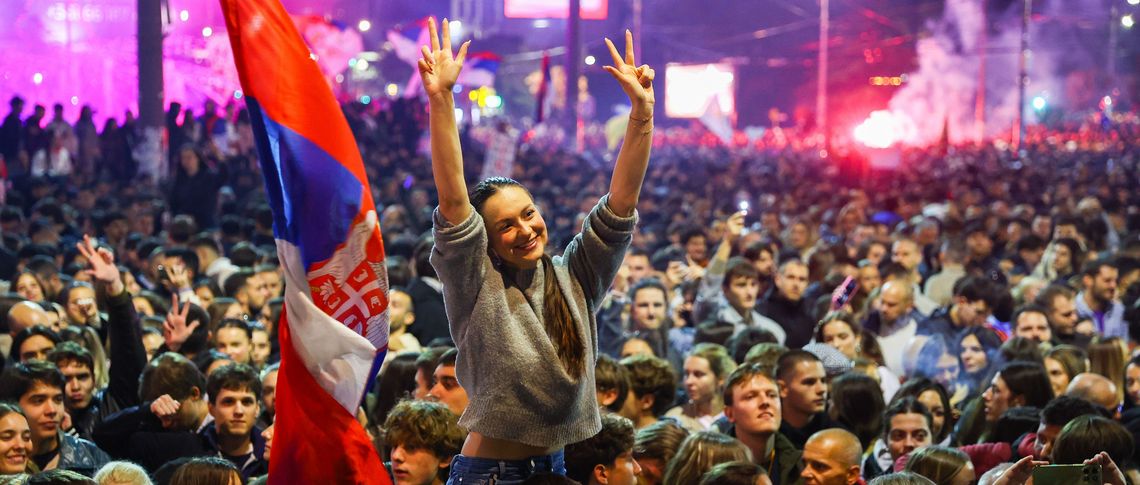
After 14 years of authoritarian rule, Aleksandar Vučić and his Serbian Progressive Party (SNS) have been ousted from power. Although polls had predicted a close election, the student-led opposition ultimately won by a wide margin. In an election that was neither free nor fair – owing to media capture, violence against the government’s opponents and the SNS’s blatant misuse of state resources – the Student List won 53 per cent of the popular vote, which translated into 141 parliamentary seats and an absolute majority. Vučić and his SNS trailed badly, with 38.8 per cent and 103 seats.
The students’ victory was the culmination of months of protests that began in November 2024, when a canopy at the Novi Sad railway station collapsed, killing 16 people. With the government doing little to punish those responsible, the public outcry continued to build, and popular mobilisation paved the way to change through the ballot box.
New faces and an own agenda
But this is not the only lesson for pro-democracy forces around the world. In Serbia’s case, both the popular mobilisation and the later electoral campaign were led by new, younger faces whom the public instinctively trusted more than the old elites, including those hailing from opposition parties. When the traditional opposition is weak, compromised or discredited, new blood is usually necessary to defeat an entrenched autocrat.
Moreover, rather than merely emphasising the shortcomings of Vučić’s regime, the students’ message was emotionally compelling, and thus broadly appealing. Social psychology teaches us that people are less drawn by policy convictions than by a fusion of identity, recognition and solidarity.
Although their message was mainly based on corruption – the issue raised by the tragedy in Novi Sad – the student movement did not treat the issue merely as a policy matter like any other. Rather, they framed their anti-corruption appeal as advancing a values-based counternarrative rooted in the rule of law, democracy, and a shared sense of community and meaning. As Ilija Srdanović, the lead candidate of the Student List, has often said, ‘Another, better Serbia is possible.’
The struggle for democracy and the rule of law thus became a struggle for the Serbian nation’s survival.
Accordingly, Serbia’s student movement presented democracy not as an abstract concept, but as the instrument for upholding deeply held values and advancing tangible goals such as social inclusion, personal dignity and economic prosperity.
Meanwhile, Vučić portrayed himself as the ‘saviour’ and ‘defender’ of an endangered Serbian nation against ‘traitors’ fighting for the kind of ‘colour revolutions’ that brought democracy to Ukraine and Georgia, supposedly on behalf of foreign powers. In previous elections, Serbia’s opposition parties tended to ignore such charges or tried to outbid Vučić’s ethnonationalism, thus playing into his hands.
But apart from making sporadic statements about Vučić’s betrayal of the former Serbian province of Kosovo, the student movement did not engage with his description of Serbia as a victim of Western powers. Instead, the students set their own agenda, championing inclusive values and good governance, and used patriotic iconography, like the national flag, to rally people behind it. The struggle for democracy and the rule of law thus became a struggle for the Serbian nation’s survival.
Moreover, the students disseminated their ideas by talking directly to citizens, even in remote villages. The decentralised nature of the movement fostered the development of the movement’s local infrastructure and empowered volunteers and activists to spread the word, thereby reaching millions. This grassroots activism proved to be particularly important because most of the Serbian media are captured by the government, leaving the opposition without a voice.
Dismantling an illiberal regime poses perhaps an even greater sustained challenge than defeating it at the ballot box.
Following the Hungarian parliamentary elections this past spring, when Prime Minister Viktor Orbán was ousted after 16 consecutive years in power, we have once again witnessed the merits of ‘old-school’ campaigning, which includes direct dialogue and door-to-door engagement with voters.
A final lesson for those defending democracy worldwide is that the opposition must compete, no matter how uneven the electoral playing field may be. Learning from the old opposition’s past mistakes, Serbian students recognised that electoral boycotts had only helped Vučić entrench his power.
Shortly after the polls closed, Vučić conceded electoral defeat, which surprised many. He did so partly because of the large vote difference between the SNS and the Student List, which made post-election manipulation difficult, but also because he and his allies are betting that the new government will not deliver. In that scenario, the resulting disillusionment would give him an opportunity to stage a comeback.
As we have seen from previous defeats of authoritarian incumbents, including in Serbia, dismantling an illiberal regime poses perhaps an even greater sustained challenge than defeating it at the ballot box. One hopes that Serbia’s students have learned from past mistakes here, too.


