
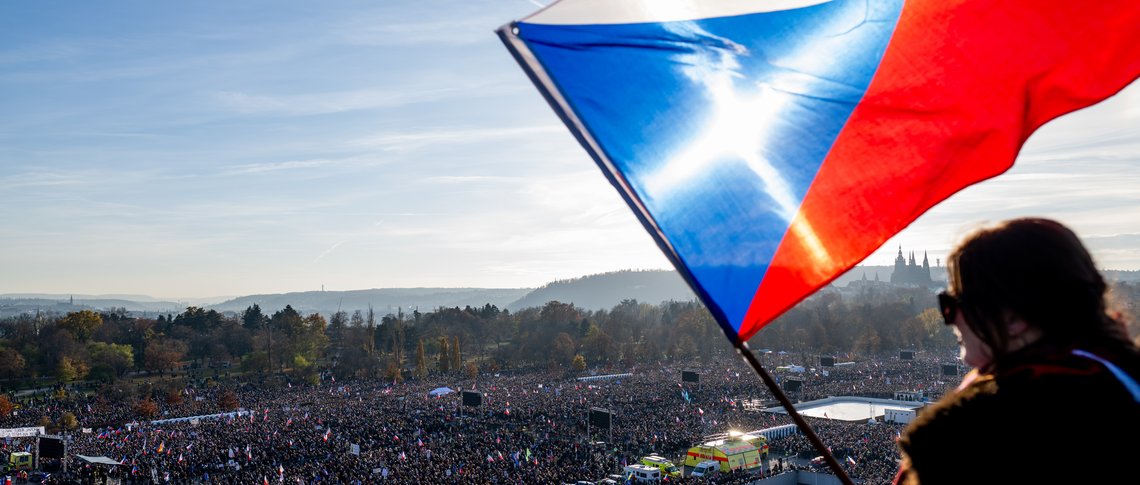
Czechia is experiencing its largest protests in years under the right-populist government of billionaire Andrej Babiš. Opposition-backed organisers have drawn thousands into the streets across the country. On Sunday 15 November, one of the biggest public spaces in Prague, Letná field, was packed with people; organisers claimed 350 000 – 450 000 participants. Even if inflated, it would rank among the largest protests since 1989.
Protesters demand the government drop a bill that would change how public radio and television are financed, accusing the ruling parties of seeking to destroy media independence. But is the danger real? Can Czech public media follow the path of their Polish and Hungarian counterparts?
The answer: Yes, the danger is real but also largely exaggerated.
In Poland and Hungary, governments tightly controlled public-media appointments. Poland’s 2016 National Media Council law gave the ruling coalition three of five seats and decisive influence over appointments. The Tusk government in 2023 promised to replace it with a less politicised body but has not yet delivered; instead, it placed Law and Justice-era state television into liquidation and runs it through a government-appointed manager.
In Hungary, under Orbán, public-broadcasting management was appointed by the head of the media authority, who was chosen by the prime minister. A June 2026 law under Péter Magyar creates a nine-member council nominated by political and civil groups, yet all members still require parliamentary approval, preserving significant government influence.
Czechia’s system is more balanced. The management of Czech Television and Czech Radio is appointed by Supervisory councils, whose members are elected by both the Chamber of Deputies and by the Senate. Neither the government nor a single parliamentary chamber has full control. The proposed legislation does not change this arrangement.
The opposition cries foul, but critics have long argued the broadcaster is bloated and spends way too much on dance and baking shows, uneven TV series and a 24/7 sports channel instead of news and public affairs.
What it changes is financing. Public broadcasters are currently funded by a household licence fee. The government wants to abolish the fee and switch their funding to the state budget. The opposition says this will end their independence.
Of the 27 EU countries, 15 fund public media from the state budget. Licence-fee countries number less than half that. The rest use special taxes or electricity-bill levies. Budget financing is the EU majority model and has not destroyed public media independence in most places that use it.
It can be argued that budget funding does create greater dependence on government, but not to the degree claimed.
The bill would cut Czech Television’s budget by about 15 per cent and end its VAT exemption (an extra loss of up to 5 per cent). The opposition cries foul, but critics have long argued the broadcaster is bloated and spends way too much on dance and baking shows, uneven TV series and a 24/7 sports channel instead of news and public affairs. Germany and Denmark tightly restrict sports and entertainment programming for publicly financed television; the Netherlands largely prohibits it. The Czech bill adds no content rules, leaving Czech Television freer than its German or Dutch counterparts in its programming choices. Supporters of the bill hope the cut itself will force it to return to its core mission.
The stronger worry is the financing mechanism. After the cut, the budget will be indexed only once cumulative inflation reaches 10 per cent — weaker than annual indexation in Lithuania or Sweden, though better than the total absence of mandatory indexation in Denmark or Spain. But because the money sits inside the annual budget, a simple parliamentary majority could still change it at any time. That’s the main argument of the bill’s critics.
Under the pressure Babiš has begun to shift. He now says television should probably not be financed directly from the budget. But this is not a retreat: he still outright rejects mandatory licence fees or a new dedicated tax. The option he has floated is voluntary fees.
In reality, what is under greater threat today is not public television’s independence but the wider political culture.
Formally this would free the broadcaster from government financial control. In practice its income could collapse far more than the planned 15 - 20 per cent.
Probably by that proposal Babiš is only teasing his opponents. After all, the opposition largely created the crisis itself. While in government it hugely expanded the licence-fee base. Before, the fee was paid by those who had TV-sets or radios. After the change anyone with an internet-connected screen (including smartphones). Businesses with 25 or more employees also became liable, with fees determined by workforce size. Hundreds of thousands of people who never watched television suddenly received bills. Thousands of small companies saw their fiscal obligations increase.
The change was hugely unpopular. Polls showed almost three-quarters of population opposed it. The timing was also terrible: first bills arrived less than six months before the election. Babiš immediately seized the opportunity and promised to cancel the fees. That pledge became a major reason for his victory. He will not abandon it, while clear majorities according to recent polls still want the fees gone.
But the same polls also show that more than two thirds of people want Czech Television to stay independent. This gives the opposition an opening to claim that Babiš ultimately wants to bring media under control.
In reality, what is under greater threat today is not public television’s independence but the wider political culture. Czechia has never been as polarised as Poland or Hungary, at least not in modern times. Checks and balances held even in heated battles, and rivals did not try to destroy one another. In recent years that restraint has eroded. Neither camp shows willingness to compromise; each treats the other as an existential enemy. The country has not yet reached Hungarian, Polish or American levels of polarisation, but it is moving in that direction, slowly but steadily.
Public media are envisioned as a kind of glue holding society together. A safe, neutral space, a middle ground where people divided by a fractured private media landscape can meet and talk. Unfortunately, as the current Czech crisis proves, this is not always the case, and public media themselves can become a source of further polarisation.