


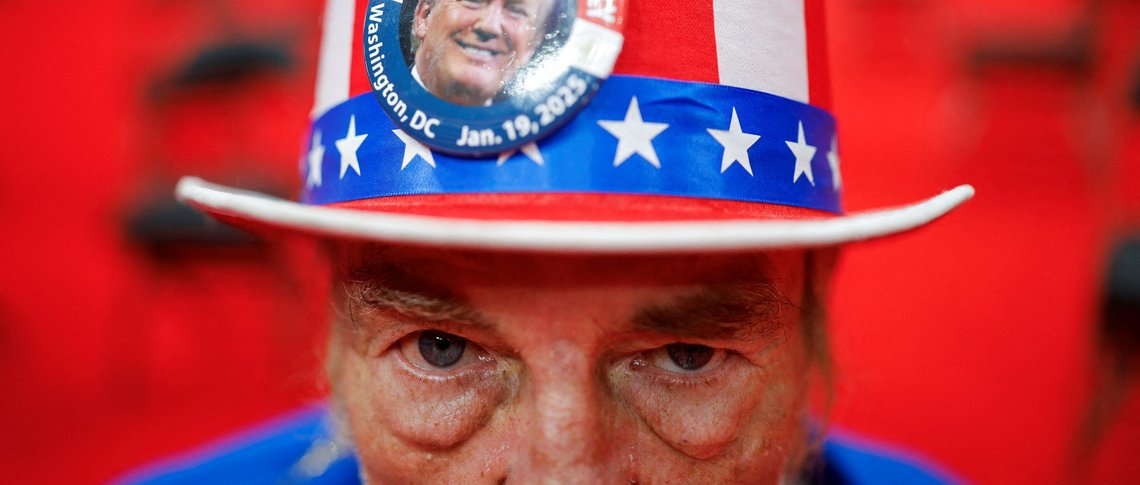
Autumnal weather and a split calendar year? Then a US election can’t be far off. This November sees yet another round of mid-term elections, in which Americans not only elect all members of the House of Representatives and a third of the Senate, but also indirectly pass judgement on the performance of their national leadership. And even as election campaigns become more volatile and the will of the people more fickle, the omens are clear: for incumbent Donald Trump and his Republicans, things are anything but good. The loss of the House of Representatives seems to have long been factored in internally; in the Senate, the lead is somewhat more comfortable, but here too the figures do not bode well.
The Senate race in Texas could mark a particular turning point. In the spiritual heartland of US conservatism, the Democrats have backed a strong contender in the form of the young and charismatic preacher James Talarico; the 37-year-old is narrowly ahead of his Republican rival Ken Paxton, a staunch Trump supporter. In addition to various legal disputes and his divorce from his wife Angela (for ‘biblical reasons’), it is above all his closeness to the White House that could prove his undoing. Yet even in other reliably Republican states such as Iowa, Ohio and Alaska, the presidential party’s candidates are under considerable pressure and could come off second best for the first time in many years.
So one need not be a prophet or an augur to see that the pendulum, which had swung so unexpectedly and decisively in Trump’s favour in 2024, is now swinging back quite a long way. Whilst this is not unusual in mid-term elections, if the swing is forceful enough, it does mark a turning point for the President and his cabinet. After all, with a hostile Congress, governing unchallenged is even less possible than before. Every bill, every appointment of an ambassador or judge, and above all every budget negotiation becomes a potential bargaining chip, reining in the government. Those who cannot simply outvote the opposition must charm and win them over, must moderate their stance and make concessions, and must seek out and find gaps in the opposition’s defences.
The pressure of being the opposite of Trump
Both in Washington, DC and in the capitals of Europe, therefore, plans seem to be being made for all eventualities – not only for the coming year, when Trump may have become a lame duck, but also for 2028, when, for the first time in twelve years, he will no longer be on the ballot paper. At times, one might even get the impression that in Rome, Berlin or Paris, this date has been marked in red on the calendar and a resolution made to hold one’s breath until then. Just get through these two years, so the hope goes, and then everything will turn out as had been expected back in 2020 following Joe Biden’s election: a return to normality. No more paralysing shock because Trump is once again speculating about annexing Greenland. No more endless tiptoeing around the sensitivities and moods of a notoriously erratic figure.
This hope is understandable, but it must seem optimistic in two respects. For one thing, it is by no means certain that the 2028 election will actually be as successful for the Democrats as the current political climate suggests. After all, presidential elections follow a logic all of their own, and even a crushing mid-term election result for the Republicans would have little predictive value. It is therefore entirely conceivable that, from January 2029, it will not be Kamala Harris, the at times highly touted Gavin Newsom or Pennsylvania’s Governor Josh Shapiro sitting in the Oval Office, but the perpetually underestimated Vance. Without the constant presence of his boss, who has become set in his ways, he might find his own political path.
It would be a mistake to conclude that a shift in communication also signifies a U-turn in policy – in other words, to believe that a successor government will immediately undo all the measures Trump has put in place.
On the other hand, however – and this is the more interesting scenario – following a Democratic takeover, far less might change than expected. One often comes across the assumption that a liberal at the helm of the state must play the ‘anti-Trump’ card in every respect and, where Trump had said black, must now always say white. He would have to tear down the walls that have been erected and remove the border posts that have been put up, tone down the confrontation with Europe, scrap the tariffs and, in a gesture of goodwill, once again bestow the transatlantic ‘brotherly kiss’ upon Brussels. Yet none of this can be taken for granted. Certainly, such a successor would speak a different language: one that is warmer and more engaging. He would praise his allies rather than threaten them, and would present himself as a caring friend rather than a stern disciplinarian.
However, it would be a mistake to conclude that such a shift in communication also signifies a U-turn in policy – in other words, to believe that a successor government will immediately undo all the measures Trump has put in place. Democratic Congressman Jim Himes also took this line, offering some behind-the-scenes insights during a recent appearance at the Warsaw Security Forum. Himes, who represents Connecticut’s fourth congressional constituency – a district that is as affluent as it is liberal – expressed confidence that support for Ukraine would resume following a change of majority in Congress, but at the same time tempered his European audience’s expectations somewhat. Even if, in the coming years, ‘everything could appear to change on the surface’, as he replied to a question from Joel Linnainmäki, one must not overlook ‘a fact of fundamental importance’: ‘There is a consensus in the United States that the costs we have borne in the post-war era (…), that was too much.’
In concrete terms, this means that even the democratically governed United States would neither abandon Trump’s demands for a fairer distribution of the military burden nor necessarily ‘adopt a far more liberal stance on trade issues’. Especially as it is becoming increasingly clear that an aggressive tariff policy, as a means of safeguarding prosperity, also fits in well with the agenda of many a protectionist on the left wing of the party. Against the backdrop of US society’s fundamentally isolationist stance and a rapidly mounting debt burden, there will therefore be little choice but to demand that Europeans take greater responsibility for themselves and, indirectly, streamline their welfare systems. Otherwise – though this is left unsaid, it can be inferred from what has been said – a new Trump would probably be only a matter of time.
Even amongst Trump’s opponents there is a not insignificant current that wishes to move beyond Obama’s ‘sunshine liberalism’ and make various adjustments to foreign policy.
Now, such speculation about the stance of a government that is not yet in office, and which may not even come to power, must naturally be taken cum grano salis. Nor should one be too quick to regard the ideas put forward by Himes as representing an internal party consensus. Yet even when read with caution, they point to two points that are well worth noting in one’s guide to American politics: firstly, even amongst Trump’s opponents there is a not insignificant current that wishes to move beyond Obama’s ‘sunshine liberalism’ and make various adjustments to foreign policy. And secondly, these critics differ from their Republican counterparts less than either side would publicly admit. The problem is not so much what Trump does, but rather how he does it and for what reason.
To put it another way — it's more a question of competence than of mere substance. The fact that one might come to believe that the reindustrialisation of the country (and with it the political pacification of the lower middle class) requires a healthy dose of protectionism is just as unsurprising as the view that one must not allow the digital conglomerates – so crucial in the great power conflict with China – to be destroyed by envious Brussels regulators. National interests are, after all, national interests, and they are just as unchanging as the blue of the sky or the passing of the seasons. For Europe, this is an important realisation insofar as it would do well to strengthen its own capacity to act independently of the American electoral cycle and to understand that a collective response to America’s soul-searching cannot be replaced by waiting for more amenable interlocutors. For anyone who merely holds their breath until 2028 may subsequently find, to their horror, that they lack the breath to do the actual work.


