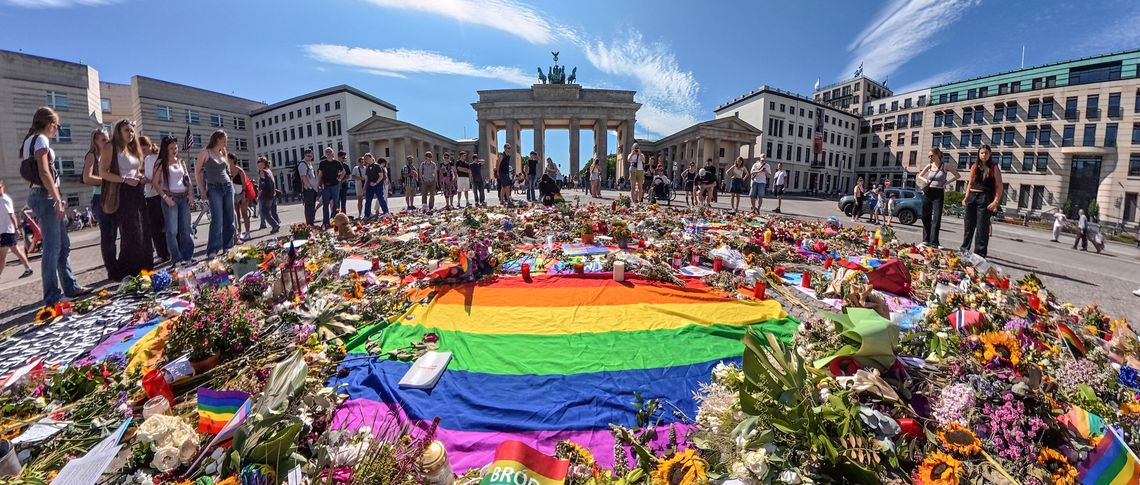
No religion is currently polarising public debate in Europe as much as Islam. The Islamist attack on Christopher Street Day in Berlin has once again intensified this controversy. It is the latest in a series of Islamist attacks in Paris, Vienna, Dresden, Mannheim and Solingen. At the same time, conflicts over mosque associations, their financial backers and the application of the Basic Law are on the rise within closed communities. These debates are becoming more heated with each passing year. One camp, however, is conspicuously holding back. It is, of all places, the political Left.
Left-wing forces have a blind spot when it comes to dealing with Islamic fundamentalism. We shy away from the debate, gloss over or downplay problems that actually exist. And when we do engage, we do so defensively. This is dangerous. Whether progressive forces take part in this debate or not — it will take place regardless. If we leave it to others, it will be dominated by nationalists and populists, on their terms and using their vocabulary. That is why this debate is long overdue. And it must be led by the Left.
Growing religious illiteracy
Still, the reasons for our reluctance run deeper than the usual accusations from the right would suggest. They relate to convictions that I, as a social democrat, share. That is precisely why we must articulate them ourselves.
Firstly, our understanding of belonging is based on shared values. Ethnicity and religion play a secondary role in this. Europe has Christian roots. Yet a society that defines itself through shared values cannot and must not exclude any religion. Millions of Muslims are an integral part of our society. Many of them do not even describe themselves as religious, yet they regard their Muslim background as an integral part of their identity. At the same time, due to ignorance, prejudice and fear, they face scepticism and even open rejection. Anyone who speaks of Islamic fundamentalism therefore inevitably also affects people who have nothing to do with it. This concern is justified. However, it must not lead us to gloss over abuses.
Those who remain silent on Islamic fundamentalism for fear of making sweeping generalisations are not protecting the vulnerable. We are turning a deaf ear to them.
Secondly, since the large-scale refugee flows of 2014 and 2015, we have taken in millions of people out of a sense of humanitarian duty, without asking about their faith. That was understandable at the time. However, this has turned into a tacit agreement to avoid discussing religiously motivated conflicts altogether. Ironically, it is precisely those who have fled Islamic fundamentalism, such as the Taliban, the so-called Islamic State or the mullah regime in Tehran, who are being forgotten. They are scarcely mentioned in our debate. Those who remain silent on Islamic fundamentalism for fear of making sweeping generalisations are not protecting the vulnerable. We are turning a deaf ear to them.
Thirdly, our society is suffering from growing religious illiteracy. For the first time since the Christianisation of what is now Germany, the two major churches together no longer represent the majority. In eastern Germany, in Berlin and in many major cities, this is now true of all religious communities. Those who know little about their own religion usually know even less about another’s. A largely secular society rubs shoulders here with people for whom religion is the central guiding principle of their lives, often linked to very conservative cultural and lifestyle values. Often, the vocabulary for a respectful yet critical engagement is simply lacking. French laïcisme shows where this can lead: Where religion is pushed out of the public sphere, a vacuum arises which Islamist ideologues exploit to radicalise young people.
Added to this is a pattern of interpretation that is more widespread in the United States than it is here, but which has long since spread to Europe as well: the division of the world into privileged oppressors and discriminated-against oppressed. Certainly, a critical examination of the colonial past is long overdue and necessary. In this oversimplified interpretation, however, Christianity appears as the religion of the oppressors and Islam, by its very nature, as the religion of the oppressed. Historically, this is untenable. Islamic colonialism did exist, and to this day there is Islam-legitimised oppression in parts of Africa and Asia. This distortion of history finds its most insidious expression in anti-Semitism directed at Israel, which portrays Jewish men and women as white colonisers.
The discussion that needs to be had
We have also underestimated where the real danger of Islamic fundamentalism lies. It stems less from terrorist attacks than from systematic infiltration. Clubs, associations and organisations – right up to and including political parties – have been infiltrated over the years and exploited for fundamentalist aims. Where this succeeds, many things that are incompatible with progressive politics are sidelined, because sections of the political left see themselves as allies of a supposedly oppressed Muslim community.
Finally, electoral arithmetic also plays a role. Some Social Democrats, Greens and members of The Left represent constituencies with a high proportion of people with a migrant background, including many Muslim voters. No party wishes to recklessly jeopardise these votes. That is understandable. The problem arises where legitimate consideration turns into political silence. Many of these voters, for example, regard the SPD as the party of social justice, yet view the socio-political modernisation – which we have played a key role in bringing about – with growing unease.
Racism refers to the discrimination and oppression of people on the basis of attributed characteristics, their skin colour or their origin. For this reason, the concept of anti-Muslim racism must be viewed critically, as it broadens the definition of racism to such an extent that it loses its precision. Incidentally, this criticism is also shared by many liberal Muslims.
Freedom of religion and criticism of religion are mutually dependent.
The left has always engaged with religion in a combative manner. The outrage over a Catholic bishop who, in the late 1980s, declared that AIDS was God’s punishment for the sin of homosexuality, shaped my political outlook. Added to this are the Protestant Church’s entanglements with National Socialism, and the fact that women have only been able to be ordained in some regional churches since the late 1960s. These were fierce social debates. No one would have thought of talking about anti-Christian racism. Freedom of religion and criticism of religion are mutually dependent. Anyone who uses the accusation of racism to nip any critical questioning in the bud undermines both.
This is particularly dangerous for social democracy. We are witnessing a culture war in which nationalist and populist forces are increasingly gaining the upper hand. If more and more citizens come to feel that we no longer wish to acknowledge their genuine concerns and experiences, we will lose their trust. If the political response to an Islamist terrorist attack consists primarily of calling for LGBTI people to be included in fundamental rights, that may be legitimate in itself. However, as a reaction to an attack, it leaves many people bewildered.
One is right to wonder why even queer people vote for conservative parties or the AfD, which have never done anything to promote their equality. The bitter answer is that many no longer feel represented by social democracy. They have the impression that progressive parties, of all places, are shielding those who verbally abuse and threaten gay men, lesbians and trans people in public spaces.
The political Left has always been a force for emancipation. Our struggles have never been solely economic struggles. They have always also been about gender equality and overcoming patriarchy. We must build on this – proactively and without shying away from our own audience. Anyone who rightly demands all this from the ‘old white man’ must also demand it from Muslim immigrants. This is neither right-wing nor Islamophobic. Social democracy must remain committed to a society in which all people can be different without fear. Precisely for this reason, it must not leave the confrontation with Islamic fundamentalism to others.