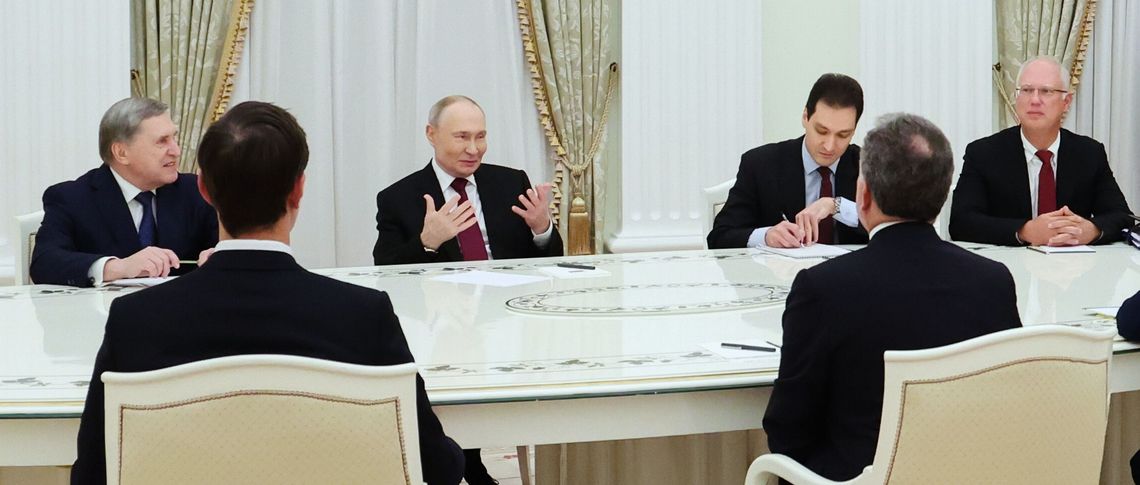
Russia’s war of aggression has been bringing death, destruction and immense suffering to Ukraine for more than four years now. Millions have been forced to flee their homes, and countless lives have been lost. Russian President Vladimir Putin made some striking remarks during the country’s Victory Day commemorations, as he suggested the war could soon come to an end, even floating former German Chancellor Gerhard Schröder as a potential negotiator.
Regardless of who could represent Europe in any talks of this kind, it is remarkable that Putin seems to be thinking of negotiating with Europe again — the first indirect sign from the Kremlin that an end to the war may be on the horizon and discussions might begin about a new security order in Europe. It also suggests that Moscow may be starting to accept a cold, hard truth: this is a war that cannot be won by military force alone. Russia has clearly failed to achieve its key objectives. Quite the opposite: Ukraine continues to fight back, NATO now has two new members in the form of Finland and Sweden, and after 16 years, Hungary’s Viktor Orbán is now out of the way. The European Union has a historic opportunity to push ahead with even more sanctions against Russia, further support packages for Ukraine and institutional reforms such as expanding majority voting on foreign policy.
Why Europe needs to be part of the negotiations
Yet none of this changes the fact that no one is happy with the situation as it is. The war in eastern Ukraine has evolved into a gruelling war of attrition, resulting in enormous human and material costs. At the same time, Europe is being shut out of talks between the United States and Russia, which is completely unacceptable given that any potential agreement between Russia and Ukraine will have direct implications for Europe’s future. What role would European troops play in securing any ceasefire? How much would Europe be expected to finance Ukraine’s reconstruction? And who would oversee a future ceasefire line? The idea that Ukraine’s territory and Europe’s security architecture could be decided by Putin’s envoys and two property moguls from Donald Trump’s circle, without Europe at the table, is simply absurd.
Most importantly, keeping Europe outside of the loop would mean losing essential leverage over Russia. Easing sanctions could only be an effective bargaining tool if Europe is part of the negotiations itself. The same is true for funding and equipping Ukraine’s armed forces in the long term, which can only serve as a credible deterrent if Europe commits to sustained support.
Europe cannot outsource its own security interests. It must represent itself, defend its values and stand up for its interests. That is why Europe needs a negotiator of its own: a figurehead who can give the continent both a voice and a face at the negotiating table. The EU, together with key partners such as the United Kingdom, Turkey and Canada, should appoint a special envoy to help Europe confidently defend its security interests. It would also be a logical continuation of Europe’s response to Russia’s aggression and the growing uncertainty surrounding the transatlantic security order under President Trump.
For Europe, this war marked a historic turning point — and that is truer now more than ever. It is arguably even more true now than at the start of the conflict, as the Trump administration seeks to act simultaneously as both Ukraine’s backer and a mediator between the warring parties.
A European envoy for peace in Ukraine would be the obvious next step — a visible demonstration of Europe’s political courage, diplomatic strength and ability to take action.
Over the past few years, Europe has demonstrated remarkable unity by pursuing three key lines of action: firstly, Europe has stood firmly by Ukraine as a political, financial, humanitarian and military partner. European countries have helped Kyiv to defend the country with weapons and substantial aid. Secondly, the EU and its partners have built an unprecedented system of sanctions against Russia, putting the Kremlin under significant economic pressure. And thirdly, European governments have made strengthening their own defence a strategic priority. Germany’s special defence fund was one of the clearest signs of how serious Europe is about rebuilding military capacity.
And Europe has gone further still. Last year, NATO members agreed to increase defence spending to 3.5 per cent of GDP, with an additional 1.5 per cent allocated to security infrastructure. These investments are designed to strengthen its deterrence against Russia, ensure long-term support for Ukraine and reduce Europe’s military dependence on the United States in the medium term.
Now Europe has to prove that it can turn this unity into political influence. A European envoy for peace in Ukraine would be the obvious next step — a visible demonstration of Europe’s political courage, diplomatic strength and ability to take action. An envoy should not only represent European interests in US-led negotiations and reinforce Ukraine’s position. They should also engage directly with Moscow to explore pathways towards lasting peace. Appointing a common representative would have an immediate internal effect as well: it would force Europe’s allies to agree on a common negotiating position. So far, the consensus has largely centred on what Europe cannot accept. A special envoy would require a mandate to also outline what Europe could accept.
A European representative could also ensure that Europe’s message reaches Moscow directly without distortion. Currently, the lack of direct communication risks leaving European policy open to Russia’s interpretation, influenced by wishful thinking or ideological assumptions. Moscow may wrongly assume that if the US reduces its support for Ukraine, then Europe will too. At the same time, Europe needs to find ways to manage the mutual distrust, prevent any escalation and avoid a direct military confrontation. The risks of any inadvertent incidents are growing, particularly in areas where Russian and European forces operate in close proximity, such as the Baltic and the Black Sea. And as it would be dangerously naïve to assume that American negotiators will automatically stand up for Europe’s interests, a European special envoy could also ensure that Europe’s position is represented seriously and consistently in Washington, too.
Europe is in a better position now to deploy a special envoy than it was just a few months ago. At the very least, it is worth giving this idea a try. It would also answer President Volodymyr Zelenskyy’s recent call in Armenia for Europe to be directly involved in the negotiations. If there is to be lasting peace in Ukraine, Europe must have a seat at the table as an equal partner. Because one uncomfortable truth must be made clear to Putin: Europe’s security cannot be decided without Europe. Any stable agreement will only succeed if Europe is actively involved.