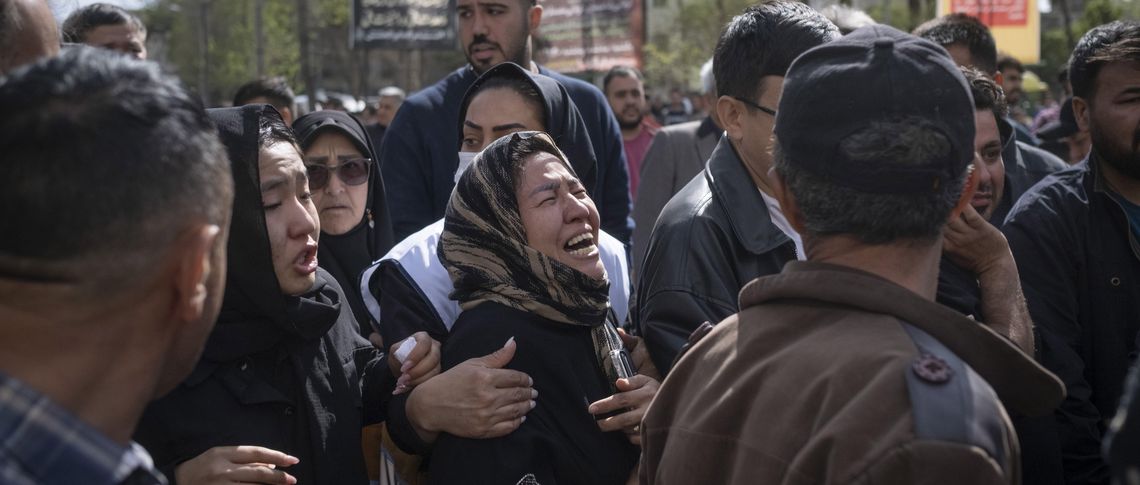
At the end of February, Israel and US missiles began to bombard Iran, killing the Supreme Leader Ali Khameini. Several weeks on and a spiralling regional crisis has led to a global energy panic as hundreds of thousands of households have been displaced within Iran.
Simultaneously, an Israeli ground invasion of Lebanon, coupled with heavy bombardment on military and civilian targets, have forced more than a million from their homes after operations began in early April. Entire villages have been cleared of inhabitants, infrastructure destroyed and families uprooted in what UN Under-Secretary-General for Emergency Relief Coordinator, Tom Fletcher, described as a ‘cycle of coercive displacement.’
Yet as the conflict continues with continued bombardments and tentative ceasefires, it has been Europe’s response to these early stages that has not been primarily humanitarian. Ten years prior, conflict within the MENA region, mainly the Syrian Civil War, had lunged a wave of migration towards the border regions of the European Union calling into question the cohesiveness and stability of the bloc itself.
The named ‘Syrian Refugee Crisis’ of 2015-2016 saw over 2.3 million irregular crossings into EU territory, which in the long-term exposed the EU’s migration mechanisms such as the Dublin System as ineffective. It also brought to prominence the political tool of migration within an electoral context, seeing many of the far-right parties in Europe heading state governments, like Italy, Croatia, Czechia and others, becoming increasingly popular in Austria, Germany and France as of the early to mid-2020s.
The political ghost of 2015-16 has haunted the politicians of the EU ever since, fearing another geopolitical crisis would call into practice the migration policy and unity of the EU.
Grimm expectations
Within days of the conflicts outbreak with Iran, Turkish officials reassured Brussels that contingency plans were already in place to avoid a repeat of the 2015-2016 migration ‘crisis’. Discussions focused on limiting onward movement, reinforcing borders and preparing buffer mechanisms. Before significant numbers of refugees had crossed international borders, the machinery of European migration control had already begun to move.
This reaction, a natural part of state security in many ways, reveals a deeper shift in European thinking. Migration is no longer treated as a humanitarian consequence of war, but framed as a pre-emptive security threat, and one that must be managed before it reaches European territory.
Already 600 000 to one million households are temporarily displaced in Iran because of the ongoing conflict, according to preliminary assessments by UNHCR.
For now, most displacement linked to the Iran conflict remains internal or regional. As with Syria over a decade ago, those fleeing are likely to seek safety in neighbouring countries first such as Turkey and Iraq. Already 600 000 to one million households are temporarily displaced in Iran because of the ongoing conflict, according to preliminary assessments by UNHCR, with a further 760 000, mostly Afghan, refugee population which could complicate matters further depending on the trajectory of the war. The imposition of a US naval blockade and the threat of wider regional disruption only deepens this instability.
Should neighbouring states restrict entry or enact oppositional policies towards asylum the pressure for onward movement towards Europe may well grow, especially with a diaspora of over half a million Iranian nationals, not including their descendants, within the EU. This is what occupies a portion of EU policy makers attentions: not immediate arrivals, but a delayed, cumulative displacement.
European leaders have been explicit about this concern.
‘We do not want to see a scenario like Syria,’ Friedrich Merz, the chancellor of Germany, told an audience in Munich, a week after the war began. In late March, Merz also urged Syrian refugees to return to their country of origin after many have been living in Germany for more than a decade.
In a post on X, EU Commission President Ursula von der Leyen posted about the Iran War on 2 March, ‘[from] migration to security, Europe must be prepared for the fall-out from recent events.’
Such language is revealing. It does not describe a response to refugees; it anticipates their arrival as a risk to be contained.
A layered system of externalised control
Over the past decade, the EU has steadily moved migration control beyond its borders. The 2016 EU – Turkey agreement established a model of containment, whereby refugees would be hosted in neighbouring countries in exchange for financial and political concessions.
Similar dynamics have since emerged elsewhere. Cooperation with Libyan authorities has enabled the interception and return of tens of thousands of migrants in the central Mediterranean, despite sustained criticism from human rights organisations. More recent arrangements with Tunisia and the Italy – Albania protocol further extend this logic, relocating asylum processing and migration management outside EU territory.
What has emerged is a layered system of externalised control. Migration is no longer managed at Europe’s borders but away from them. Neighbouring and transit countries are positioned as buffer zones, supported through funding, diplomatic agreements and security cooperation. Migration, in this framework, becomes something to be anticipated and neutralised in advance.
If migration is treated primarily as a security threat to be contained elsewhere, what happens to the principle of protection for those fleeing war?
The unfolding crises in Iran and Lebanon are now testing this system in real time. With hundreds of thousands displaced in Iran and over one million in Lebanon, the scale of regional instability is growing rapidly. Yet rather than preparing for potential asylum claims, European policymakers are already working to ensure that such movement does not reach its borders.
Turkey’s early reassurances, contingency planning for containment and discussions of capacity thresholds all point in the same direction: the EU is activating its externalised migration system before large-scale movement has even begun.
This pre-emptive logic may appear pragmatic. It reflects hard political lessons learned over the past decade and acknowledges the structural reality that large-scale displacement is likely to continue in an era of conflict, climate change and geopolitical fragmentation. But it also raises fundamental questions about the future of asylum in Europe.
If migration is treated primarily as a security threat to be contained elsewhere, what happens to the principle of protection for those fleeing war? At what point does externalisation become abdication?
The Iran war may not immediately produce large-scale refugee flows towards Europe. As in previous conflicts, displacement will likely unfold in stages, concentrated first within the region. But the European response has already been set in motion. It is not defined by reception, but by prevention.
In this sense, the EU has not simply prepared for the next migration crisis. It has redefined it. A ‘crisis’ is no longer the arrival of refugees at Europe’s borders — it is the possibility that they might arrive at all.
And in responding to that possibility, Europe risks entrenching a system in which the management of displacement takes precedence over the protection of those displaced.