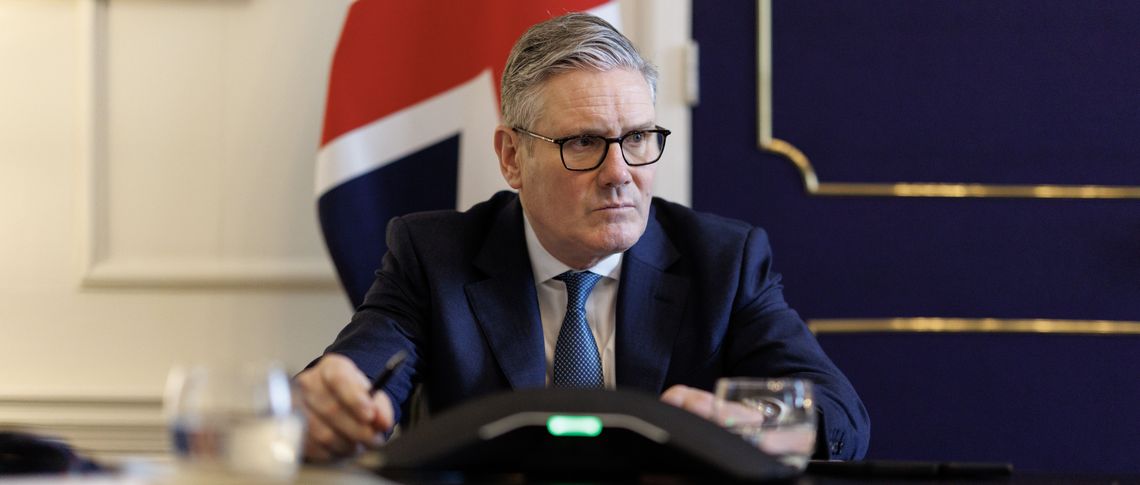
Labour suffered a historic defeat in last week’s local elections, leaving both the party and Prime Minister Keir Starmer badly weakened. In response, Starmer tried to regain the initiative with a forceful speech. Did he succeed?
He made a strong speech yesterday in making the case for why his government should be allowed to continue. It was quite personal, which is something he hasn’t always been able to do. But there are still many question marks over whether his leadership will last until the end of this Parliament, which is what he was elected to do. Principally because of concerns within his own parliamentary party following Thursday’s election results and a fairly long run-up of rumbling discontent about whether he really has the credentials to lead the country in a moment of global uncertainty and domestic difficulty. However, it remains to be seen whether it will be enough for the parliamentary party to get behind him.
Starmer insisted he would fight any leadership challenge and would not walk away from his responsibilities as prime minister. How secure is his position?
Technically, he was elected for five years, so there doesn’t have to be another election until July 2029. On paper, he is in a secure position and he’s got a big majority in Parliament. Theoretically, he should be able to get through the laws the government wants to pass.
In practice, however, his position has been weakened by these elections and by growing discontent in the country, which had already been visible in the opinion polls beforehand. The elections really confirmed what the polls have been saying for some time: like in a number of other European countries, the main centre-ground parties – both Labour and the Conservatives – are losing support to Reform UK on the right and the Green Party on the left.
And this is the first time that has really happened in the UK. I think the multi-party element of what’s happening is being overlooked. There is a lot of fixation on Keir Starmer and Labour without fully recognising that voters are abandoning the traditional centre-ground parties and moving towards what were previously minority parties. But none of those parties currently commands more than about a quarter of the electorate.
Starmer argued that the status quo is no longer an option and that ‘incremental change won’t cut it.’ What does he actually want to do differently — and is that likely to convince frustrated voters?
That is the key question. His argument was strong because he presented himself as Keir the reformer, which, as far as I’m concerned, has always been his strongest card. He argued that he had previously reformed institutions as Director of Public Prosecutions and that he reformed the Labour Party to make it more focused on the public rather than on itself.
But as prime minister, he has sometimes looked more like a manager of circumstances than a reformer genuinely championing ordinary people. That made the political pitch he made today – challenging the status quo – the right one politically.
The problem was that the specific policies he announced didn’t always obviously match that argument. For example, he committed to building a closer relationship with the European Union. Yet it wasn’t really clear what that would mean for Britain or for Europe. And I don’t think that is the ‘status quo’ he was talking about in the first part of the speech.
For some people, being part of the European Union was part of the old status quo. So the examples didn’t entirely align with the strength of the narrative he was presenting. There is certainly a debate to be had about whether moving closer to the EU – through a customs union, the single market, or even rejoining eventually – would be in Britain’s interests. But that isn’t really the same thing as challenging the status quo that people are frustrated with.
The status quo people want challenged is much more about incomes not covering living costs, companies getting away with ripping customers off, and a system where wealth is rewarded more than hard work. That’s why I don’t think the policies were fully nailed down in the way the broader narrative was. Still, we do have the King’s Speech coming up on Wednesday, which is where the government will formally set out its policy agenda, so we may see more clarity there.
Is moving closer to Europe politically the right strategy for Labour at this moment?
British public opinion has definitely shifted since the referendum 10 years ago, and there is now probably a majority that would like closer ties with the European Union. But answering a question in an opinion poll is very different from investing the political time and energy required to win a referendum and rejoin.
There are other options too, such as single market or customs union membership, which would probably be welcomed by some British businesses that have clearly been harmed by Brexit. Yet that’s not really where the voters Labour is currently losing support are politically. Many of those voters probably supported Leave and are now being attracted by Reform UK. They are not going to be persuaded by a pro-European argument.
So the question of Europe really needs to be framed as an economic question about where Britain’s future growth prospects lie. The answer should come out of a broader growth strategy. But in the short and medium term, I don’t think closer ties with Europe will deliver an immediate electoral dividend for Labour.
What struck many observers was not just Labour’s poor performance in the regional elections, but the apparent collapse of Britain’s traditional two-party logic. Britain suddenly looks like a country with five genuinely competitive parties. Are we witnessing the end of the political system that shaped British democracy for decades?
Thursday’s elections were certainly the first genuinely multi-party result we’ve had. Opinion polls since Labour’s victory in 2024 had already shown the two-party system coming under pressure, particularly because of the rise of Reform UK, which is mainly a problem for the Conservatives.
The Conservatives are actually getting much less attention right now, but they are not performing well at all. Their dilemma is whether they can continue to exist alongside Reform. It may eventually be that Reform replaces the Conservative Party altogether.
Whether we are witnessing the end of two-party politics is still unclear. There are strong forces on the right trying to push Reform and the Conservatives into some kind of electoral pact that could potentially lock Labour out of power for the long term.
It’s also unclear what the future of the Green Party will look like. The Greens now have a new leader, Zack Polanski, who is taking the party in a much more left-wing direction. Previously, the Green Party was more of an alliance of environmentally minded people from across the political spectrum. That has now changed. They are increasingly targeting the sort of left-wing vote Jeremy Corbyn once mobilised, particularly among voters energised by the Gaza conflict.
It’s still too early to know exactly where this will end. But we now have the first real evidence that Britain is moving into a multi-party era.
Both the Conservatives and Labour have lost significant public trust in recent years, while Reform UK is benefiting enormously from growing frustration with the political mainstream. Is the rise of parties like Reform less the result of ideological shifts and more a consequence of collapsing confidence in the established parties?
Yes, I think it is fundamentally about a collapse in confidence in the established parties — and more deeply, a collapse in confidence that the current economic system is working for ordinary people. People increasingly doubt that governments have the competence and capability to address the problems they face.
There isn’t necessarily a huge ideological shift to the right among the broader public. But there is a very strong feeling that all the mainstream parties are essentially the same and that none of them can deliver meaningful change, even if they want to. That pushes people towards alternative parties because they feel that things can hardly get worse than the status quo.
We saw something similar in the United States, where many people who were not enthusiastic about Donald Trump still voted for him because they felt their current situation was intolerable. And I think you see something similar in Germany with the AfD, which continues to poll strongly even as immigration declines. So this is not simply about immigration. It is, as you say, about collapsing confidence in the mainstream political, economic and governmental settlement. And that is the question that both centre-left and centre-right parties are currently failing to answer convincingly.
Is there anything that European centre-left parties, in particular, can actually learn from the British experience?
The British experience is still a work in progress, so we are not yet at the end point where clear conclusions can fully be drawn. Still, even less than two years into Labour government, there are already some lessons.
First, centre-left parties can still win working-class voters. They do not have to abandon them. In fact, any successful electoral strategy has to put ordinary working people at the centre because there are simply many more of them than there are urban liberal progressives.
Second, it is possible to unite working-class voters and urban liberals around an agenda of economic change. But Labour’s experience in government also shows that you have to be prepared to do politics differently and to communicate much more clearly where you are trying to take the country. Centre-left parties that are seen merely as managers of circumstances – or as overseeing continued cuts to the state – quickly come across as inauthentic and as failing to deliver the change people voted for.
These are already important lessons. But I would also say that this story is far from over. Labour still has a mandate for another three years, and it is by no means certain that Reform UK would win a general election tomorrow. There is still a lot to play for.
This interview was conducted by Nikolaos Gavalakis.