


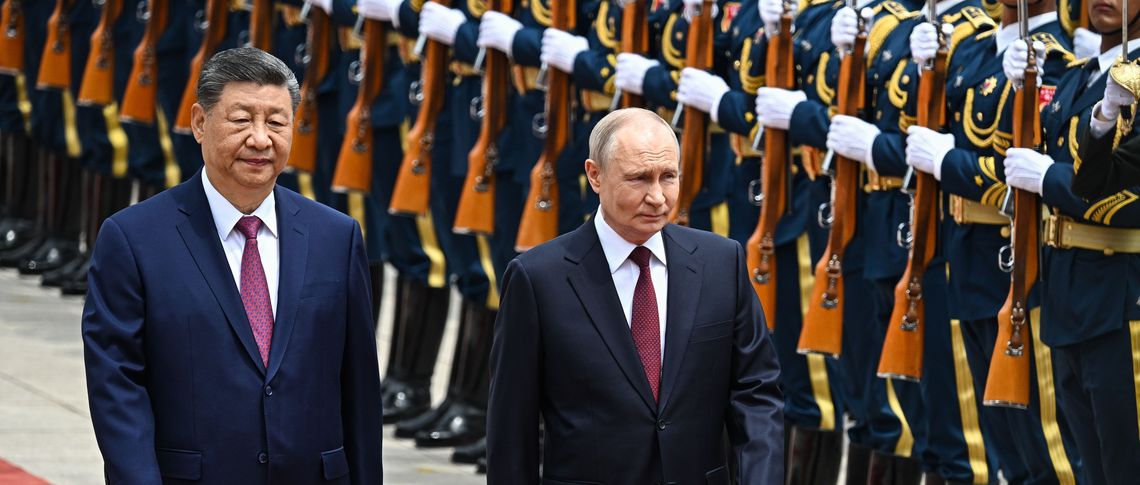
Vladimir Putin arrived in China just a few days after Donald Trump’s visit. What was the reason for such a fast turnaround?
I do not believe that this coincidence of dates was a premeditated ‘choreography’. Rather, it is down to the Chinese side’s skilful and efficient logistics.
Both Trump and Putin plan to meet Xi Jinping several more times this year, and the dates of these visits were agreed upon long ago. What is more noteworthy is that the Russian side did not reschedule Putin’s trip. Apparently, such a close proximity of dates did not bother Moscow in the slightest. On the contrary, for Putin this is a convenient opportunity to play along with the idea of the ‘big three’, where Moscow, Beijing and Washington are the key global capitals.
And here, Putin has no problem alluding to the fact that it is China that is the main pillar of this new world order. After all, Trump sees the situation differently, framing it as a ‘Big Two’ (G2) world, in which there is no place for Russia.
So, everything has worked out very well, especially given the final political declaration by the leaders of the Russian Federation and the People’s Republic of China on a multipolar world. Putin has been harping on about this for a long time. In essence, his famous speech at the 2007 Munich Conference could be read out today, in 2026, with only minor adjustments to dates and context: even then, he was seeking evidence for his theory about the end of Western hegemony.
In this sense, this sequence of visits suited absolutely everyone.
It is well known that symbols, the setting and the manner in which events are conducted are of great importance in Chinese diplomacy. How did Xi Jinping receive his Russian guest? When compared to Trump’s visit, what were the key differences?
The main difference lies in the format itself. The American visit was a state visit, whereas the Russian one was a working visit – and that is a completely different matter. Moreover, Putin meets with Xi Jinping every year, with the exception of the ‘Covid’ years. During his time in office, he has met with the Chinese leader more than 40 times – there is not a single politician in the world with whom Putin has met as often. And this year, just like with Trump, they plan to meet up to three more times.
Therefore, in terms of symbolism, I see nothing that could be interpreted as a deliberate or accidental ranking of guests by importance. Everything was predetermined by official protocol. The fact that Putin was met by the Foreign Minister on the first day is also quite standard practice; there is no intrigue here.
Did Putin attend as a partner, or as a head of state who is particularly in need of China’s support at present?
Relations between Russia and China are not merely asymmetrical – their dynamics are moving in opposite directions. China is a country on an upward trajectory: its resources, economic and political clout, and role in the international order are only growing. Russia, on the other hand, is trying to halt the ongoing loss of its status. Indeed, this is why Moscow is increasingly resorting to violence — other instruments of influence over its neighbours and the world (economic, cultural, institutional or diplomatic) simply no longer match its ambitions.
Russia’s dependence on China, given the Kremlin’s current course – including the war with Ukraine – is indeed enormous. Moreover, the Chinese factor appears to be key to understanding what place Russia will, fundamentally, occupy in the world by the middle or end of the 21st century.
That is why the two sides’ expectations of these summits are clearly different.
During the meeting, issues relating to global politics and the expansion of economic cooperation between the two countries were discussed. What exactly were they able to agree on?
Essentially, the visit’s agenda comprised two main items: the economy, specifically regarding ‘Power of Siberia 2’, and politics, namely the declaration on multipolarity. Everything else was routine Russian-Chinese diplomacy.
The main topic was, of course, the ‘Power of Siberia 2’ gas pipeline. It is intended to at least partially compensate Russia for the loss of Western markets. But China, given its systematic energy development, does not really need this project. Beijing’s additional energy needs are unlikely to arise until the mid-2030s, so there is no point in signing contracts with long-term commitments at this stage. Furthermore, China has diversified its supplies effectively: it receives a steady supply of energy resources from Qatar, Australia, Turkmenistan and (until relations deteriorated) from the United States itself.
It would have been a colossal triumph for Vladimir Putin to return home not merely with declarations that ‘Power of Siberia 2’ serves mutual interests, but with concrete timetables and, crucially, prices. But this breakthrough never materialised. Despite Dmitry Peskov and official Kremlin sources claiming last year that the parties had reached concrete agreements, this has still not happened. The difference in the degree of dependence between the two states is clear.
That said, relations between Moscow and Beijing do indeed appear robust. Throughout their four centuries of shared history, they have perhaps never been so close, and this is largely due to the personal rapport between the leaders of the two countries. Of course, useful practical steps are also being discussed at the summit: cooperation in the financial and technological sectors, supplies of microelectronics, tourism and culture. But the fact that agreements have been signed – those very notorious 40 documents – is not in itself an indicator of a real economic breakthrough. Most of them are simply memoranda of understanding, which have yet to be backed up by any economic reality.
On what issues, by contrast, do differences of opinion persist?
Differences do exist, but it is simply not customary to speak of them openly. To begin with, the Chinese concept of restoring former greatness does not in any way imply a revolutionary upheaval of the existing world order. Beijing is more interested in preserving international institutions and rules, but wants to reshape them to suit its own needs, so that they take Chinese interests and the new balance of power into account.
Furthermore, China is, in principle, not interested in rigid alliances, so it is incorrect to describe Moscow and Beijing as allies. They have no mutual defence obligations, nor do they have any joint coordinating bodies. In this sense, the Russian side’s statements about a ‘united camp challenging the West’ are only partially accurate.
There are also differences in the choice of means – particularly military ones. And the approach itself differs: Moscow wants to be united against someone, whereas Beijing is content simply to support one another on key issues.
Nor should we forget the PRC’s pragmatism. Chinese experts have repeatedly emphasised that Beijing cannot allow Russia to suffer the ‘strategic defeat’ of which so much is spoken. But this is solely because China does not need a huge northern neighbour mired in chaos and internal problems, as this would pose direct risks to the stability and prosperity of the PRC itself.
You mentioned the personal rapport between Xi Jinping and Vladimir Putin. Does this mean that Russia and China have truly become strategic partners at every level, and that this alliance is a serious and long-lasting one?
The close relationship between the leaders should not obscure the fact that Russia and China are like pyramids that touch only at their very tops. Yes, there is personal chemistry between Xi and Putin, and a shared vision of themselves as ‘great leaders’. The absence of a common ideology even works in their favour: unlike in the era of Stalin and Mao, they do not need to fight for ideological supremacy. But at the level of governments, intelligence services and the military, there is no deep trust. The memory of past border conflicts still lives on in military doctrines, and Moscow simply does not currently have the resources to assess the risks of espionage from the PRC.
In the economic sphere, up until 2022 there was no consensus whatsoever in Russia as to what level of dependence on China was acceptable. Beijing is currently helping Moscow to continue on its current course, but in geo-economic terms, the Russian Federation remains a Europe-oriented system. Restructuring the entire infrastructure towards the East is a task for generations, requiring massive investment and demand from China, neither of which exists. Moreover, the entire Russian Far East has a smaller population than a single major Chinese metropolis.
Finally, the societies of the two countries still know little about one another. Despite the visa-free regime and millions of tourists, xenophobia based on stereotypes, accumulated over generations, persists among citizens. Therefore, as soon as the leaders are replaced by new ones, these relations may face enormous risks.
This interview was conducted by Olga Vasyltsova.


