


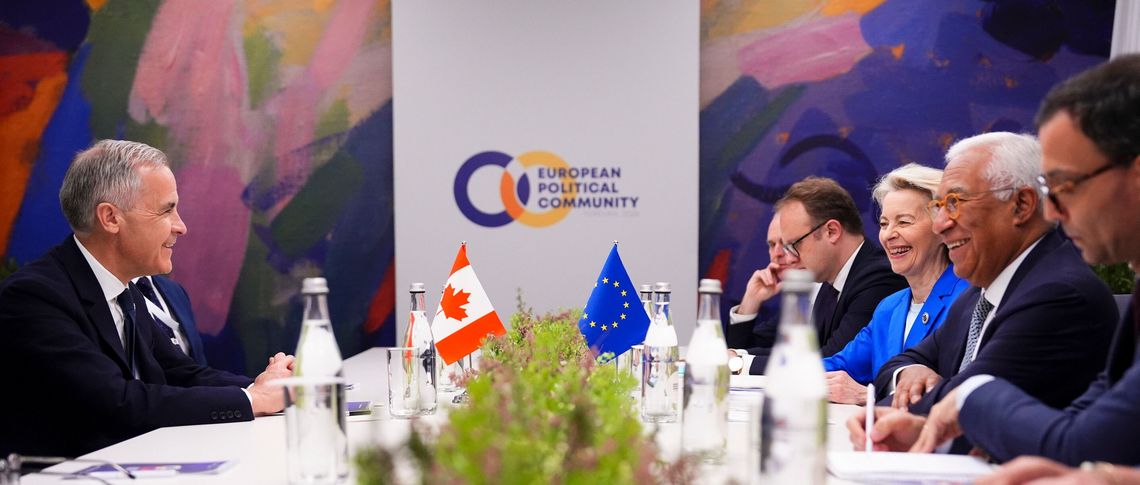
Today, the Armenian capital is hosting heads of state and government from more than 40 European countries. What is the main objective of the summit of the European Political Community (EPC)?
The 8th summit of the European Political Community is a historic event not least because this format is meeting in the South Caucasus for the first time. The overarching aim of the gathering, held under the motto ‘Building the Future: Unity and Stability in Europe’, is to deepen political dialogue beyond the borders of the EU and to strengthen Europe’s security architecture in the face of global crises. More concretely, the focus is on bolstering democratic resilience: countering hybrid threats, tackling disinformation and defining ethical frameworks for the use of artificial intelligence in security policy.
Connectivity and energy security are also on the agenda. A key point is the expansion of transport and energy routes (keyword: Middle Corridor). In this context, Armenia is increasingly being positioned as a potential bridge between Europe and Central Asia.
The summit also serves as a platform to discuss the peace process between Armenia and Azerbaijan, as well as the broader stability of the region. The presence of more than 40 heads of state and government underlines European support for Armenia’s sovereignty and constitutes a clear commitment to the peace process.
Unlike formal EU structures, the EPC offers an informal forum in which leaders can engage ‘on equal footing’ and, without the pressure of immediately binding legal decisions, forge strategic alliances. Alongside this, the first EU–Armenia summit is taking place, aimed at further advancing Armenia’s integration into the European economic and value space (CEPA agreement).
In short, it is a blend of high geopolitics and very practical networking.
This platform was created in response to Russia’s war against Ukraine. Can the EPC today present a realistic plan to end it?
That is the ‘Gretchen question’ for this format. If one expects a ready-to-sign agreement or a detailed roadmap with military security guarantees, the short answer is: no.
By design, the EPC is not a body for executive decisions or binding international treaties. Its role in a potential end to the war lies instead in its function as a ‘geopolitical incubator’.
The EPC has neither a secretariat nor a budget, nor any military structures (such as NATO). It cannot therefore guarantee peace agreements. Its real value lies in what might be called ‘strategic intimacy’. In the Armenian capital, leaders are gathering who would never sit at the same table in Brussels — including those from Ukraine, the United Kingdom, Turkey and Georgia.
Concrete solutions rarely emerge in the plenary; they are usually shaped in breakout sessions and bilateral meetings. It is there that the groundwork is laid for subsequent negotiations in more formal settings.
The most effective ‘plan’ the EPC produces today is the group photo. The fact that more than 40 leaders demonstrate unity – in a former Soviet capital like Yerevan – is a direct response to Vladimir Putin’s strategy of dividing Europe. For the Kremlin, the very existence of the EPC is a defeat, as it shows that Russia cannot carve the continent into spheres of influence.
The choice of Yerevan as the venue is no coincidence. It signals that an end to the war in Ukraine is inseparable from stability in the Caucasus. Any solution to Russian aggression must take the entire periphery into account. By backing Armenia, the EPC deprives Moscow of another lever for regional destabilisation.
Why did the President of the European Council, António Costa, describe this year’s summit as historic?
With the choice of Yerevan, the European Council has for the first time moved beyond its traditional geographical boundaries, sending a signal of the ‘Europeanisation’ of the South Caucasus. This step highlights the weakening of Russia’s dominance in the region and reflects Armenia’s strategic shift away from Moscow towards closer alignment with the European security and values framework.
In this way, the Caucasus is being elevated from an unstable periphery to an important bridge between Europe and Central Asia.
The Canadian Prime Minister Mark Carney is attending for the first time. What does this change to the format signify?
Mark Carney’s participation marks the ‘transatlanticisation’ of the EPC, transforming it from a regional neighbourhood dialogue into a global alliance of democratic heavyweights.
It signals that Europe’s security and economic resilience – particularly along sensitive flanks such as the Caucasus – are inseparably linked with North American partners. This is especially true for securing critical raw materials and jointly countering authoritarian influence. The EPC is thus moving beyond its regional roots and increasingly defining itself through shared strategic interests rather than mere geography.
And how should the absence of German Chancellor Friedrich Merz be interpreted?
Friedrich Merz’s absence is seen as a diplomatic balancing act: while representation by Emmanuel Macron underscores the strength of the Franco-German tandem, the German chancellor’s absence from the first meeting in the Caucasus leaves a political vacuum. It suggests that the German government is currently heavily preoccupied with domestic crises and coalition issues.
In Yerevan and among eastern partners, this is perceived as a dampener on European solidarity. As a result, Germany is inadvertently pushed into the second tier, while other actors such as France and the United Kingdom dominate the geopolitical stage in the South Caucasus.
Cameras captured a handshake between Georgian Prime Minister Irakli Kobakhidze and Volodymyr Zelenskyy. How would you interpret this?
The handshake between Kobakhidze and Zelenskyy is an act of diplomatic pragmatism that may signal a ‘reset’ after years of estrangement. The fact that the initiative apparently came from Kyiv underlines Zelenskyy’s strategy of not allowing Georgia – despite its ambivalent course – to drift into Russia’s sphere of influence, while strengthening regional cohesion in the Caucasus.
For Kobakhidze, the gesture sends a strong signal to European partners. At the same time, Moscow receives the message that ties between Black Sea littoral states remain intact despite ongoing tensions.
And finally, on relations between Armenia and Ukraine: in light of the first visit by a Ukrainian president to Armenia in 24 years, can we expect changes in bilateral relations?
The signs point to a profound shift in diplomatic relations, even if much will depend on the outcome of Armenia’s parliamentary elections. The fact that Zelenskyy is travelling – for the first time since the start of the war, and as the first Ukrainian president in 24 years – to a country that still hosts a significant Russian military presence indicates that Armenia is increasingly distancing itself from Moscow.
At the same time, it points to growing trust between Yerevan and Kyiv.
This interview was conducted by Olga Vasyltsova.


