
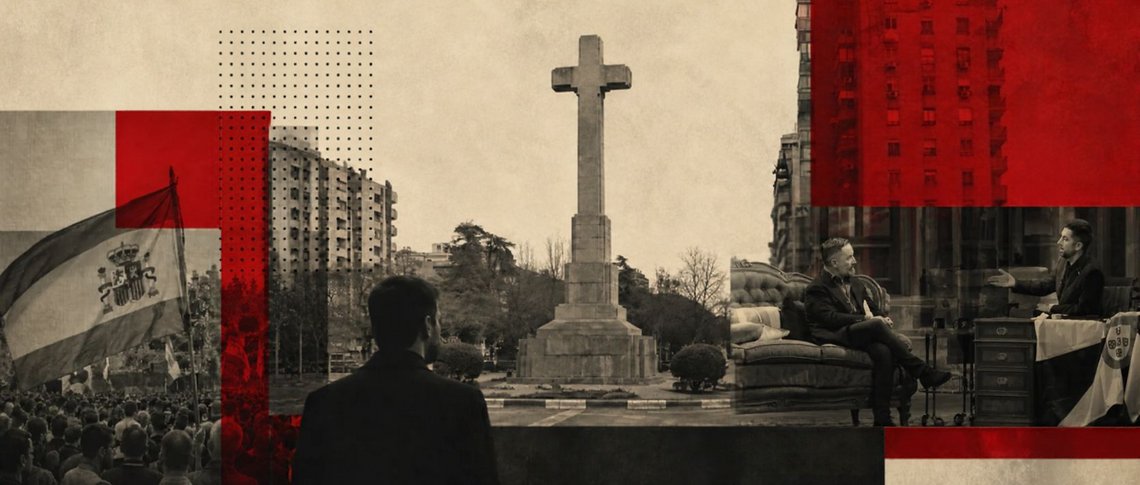
Beyond the ochre towers and Renaissance palaces of medieval Cáceres, where the old city gives way to the rather less distinguished architecture of twentieth-century Spain, traffic circulates around a squat, uninspiring granite cross. The stone, the colour of the surrounding Extremaduran countryside, rises twelve and a half metres above the asphalt.
There are no inscriptions to explain its presence. No names of the dead. Nothing to suggest why a city already generously endowed with Christian symbolism might have felt the need for quite so much more of it.
On a May morning in 1938, however, there was considerably less ambiguity. The Spanish Civil War was still raging when Pilar Primo de Rivera, sister of the founder of the far-right nationalist Falange group, arrived to inaugurate the monument. Thousands of soldiers marched past, hundreds of flags fluttered, white doves were released.
The cross is a small monument to a larger pattern.
Eighty kilometres to the south, in Badajoz, the bodies of the victims of Franco’s advancing armies had barely had time to settle into the earth. The cross celebrated the dead of one side in a war that had yet to finish. The other dead would have to make do with the ditches.
Eighty-eight years later, Spain’s central government has ordered its removal under democratic memory legislation. Extremadura’s regional government, a coalition between the conservative Partido Popular (PP) and the far-right Vox, wants it declared protected cultural heritage. The commitment appears in their coalition agreement under the heading of concordia — reconciliation. The dead in the ditches will presumably be delighted to learn that they have been reconciled.
The cross is a small monument to a larger pattern. Spain’s far right, Vox above all, disguises its ideological roots behind patriotism, cultural heritage and control of the public conversation. But perhaps the greater danger lies less in Vox itself than in how readily established conservative parties and public institutions accommodate and legitimise it.
With Spain heading into a general election on 29 November, the question is how far this willingness to accommodate will reach. If the PP needs Vox to govern in Madrid, as it already does in Extremadura, what is happening at regional level could soon become a national reality.
The art of not saying
There is a wonderfully expressive phrase in Spanish: enseñar la patita, to show one’s little paw. It comes from a German fairy tale in which the wolf disguises its paw to convince the little goats to let it into the house. And Vox’s leader Santiago Abascal has become a virtuoso at keeping his paws out of sight.
Appearing on Spanish public television this November, the man who would govern Spain displayed a touching modesty about his qualifications. Pressed on housing: ‘Well, I don’t build houses.’ On climate change: ‘I’m not a scientist.’ On military matters: ‘I’m not a military strategist.’ One begins to wonder what precisely qualifies him for the job he is applying for.
Fortunately, this humility deserts him entirely when the subject turns to immigrants, feminism or the ideological excesses of the left. On housing, arguably Spain’s most pressing domestic problem, he is religiously certain that immigration is the culprit. The young Spaniard unable to afford a flat is invited to direct his resentment not towards those who own hundreds of them, but towards those who cannot afford one either. The great conjuring trick of the radical right is to persuade people who have very little that their enemy is someone who has even less.
Meanwhile, Abascal also announced that his party had no position on Francoism.
None whatsoever.
Forgetting has a peculiar political disadvantage: eventually, someone else gets to tell you what happened.
There is something exquisite about the leader of a party claiming a monopoly on Spanish patriotism professing agnosticism about nearly 40 years of Spanish history. ‘Why should I have a position on Francoism or on any episode of our history?’ Abascal asked TV host David Broncano. A fair question from a man who had accidentally wandered into politics. Rather less so from one whose party is arranging heritage protection for the architectural residue of that history.
Abascal’s reluctance to answer questions about his politics is one thing. His party’s reluctance to let others ask them is quite another. While there was nothing objectionable about giving Abascal the same platform as Prime Minister Pedro Sánchez, what was objectionable was cancelling the audience originally booked and letting Vox organise its replacement. In an effort to facilitate an interview with a politician, public television dispensed with its public.
Days later, Abascal pulled out of The Wild Project, a popular podcast hosted by Jordi Wild, after Vox demanded more control over the recording despite Wild’s promise to broadcast it unedited. ‘We do not want to expose our discourse to any kind of risk,’ came the explanation. There was a time when the risk to one’s discourse posed by someone asking a question was known as democracy.
The trouble with the F-word
Is Vox fascist? Umberto Eco’s 14 characteristics of Ur-Fascism – the cult of tradition, fear of difference, hostility to dissent, machismo, selective populism – make uncomfortable reading beside Vox’s own rhetoric. The parallels are difficult to ignore. But perhaps the argument over the word is a distraction. Vox is not the Falange of 1936, the organised violence is still absent, and not every Vox voter is a fascist. Europe’s new authoritarians operate through elections, television studios and democratic institutions. They need not dress like Blackshirts to borrow from Mussolini’s repertoire. What is worrisome is less what Vox is than what others are prepared to do with it. When the label no longer embarrasses anyone, it is the normalisation that deserves our attention, not the vocabulary.
Spain’s transition to democracy was accompanied by the Pacto del Olvido, the Pact of Forgetting. There were understandable reasons for the arrangement. But forgetting has a peculiar political disadvantage: eventually, someone else gets to tell you what happened. Remembering has become divisive. Exhuming the dead is ideological. Removing monuments erected to celebrate a dictatorship is an assault on history. Those who opposed recovering the past have reinvented themselves as its custodians.
In 1933, as books burned in Germany, Joseph Roth warned in The Auto-da-Fé of the Mind that catastrophe was the work not only of barbarians but of those who made room for them. The barbarians have always been with us. What changes is the company they are permitted to keep.
In 2004, Cáceres’s municipal council unanimously approved moving the cross to the cemetery and redesigning the square. The mayor belonged to the PP, which enjoyed an absolute majority. Two decades later, the same party, governing Extremadura with Vox, considers protecting the cross a matter of cultural importance.
The stone has not changed.
The politics around it have.
Politics is not merely what politicians say. It is what they protect, what they dismantle, whom they exclude and what they insist we forget. Here, in a provincial city in one of Spain’s poorest regions, the evidence stands twelve and a half metres tall, in the middle of a roundabout.
The question is not only what Vox will say, but who will let it in. Whatever happens on 29 November, we will not be able to say that we did not see it coming.
It was written in stone.