


Canadian Prime Minister Mark Carney’s stock has never been higher in European capitals. His January Davos speech, delivered at the height of Trump’s threats to annex Greenland, articulated with clarity what European leaders could or would not: that the post-Cold War order had suffered ‘a rupture, not a transition’, that the old world would not return, and that middle powers could chart another path by deepening practical cooperation.
The two-time G7 central banker is an unlikely herald for middle-power resistance in a post-American global order. In the months since Davos, he has followed through by walking away from a bad trade deal, making Canada a lonely holdout against Trump’s trade war despite its profound integration with the US economy.
But while admiration for Carney within the EU is high, appetite to replicate his pushback on Trump has been markedly less so. Domestic political pressures and the fractious nature of EU governance make a similar response from Europe unlikely — yet Canada’s experience offers Europe lessons worth taking seriously.
Target since day one
What Canadians have understood is that the goal of Trump’s trade attacks is not market access, but leverage over whether Canada remains a sovereign actor at all.
Few countries have been subject to the continuous, personal presidential attacks Canada has endured in Trump’s second term. His threats began in 2024 as president-elect when he announced 25 per cent tariffs on all Canadian and Mexican goods — in violation of the trade agreement he himself signed in his first term.
From the start, he paired his threats with annexation rhetoric. Three weeks before his inauguration, asked whether he would use military force to absorb Canada, Trump replied: ‘no — economic force’. Tariffs, he said, would ‘get rid of that artificially-drawn line’ and make Canada the 51st state.
Canada has stood nearly alone in refusing US demands that compromise its sovereignty.
Despite the president’s annexation rhetoric, the talks initially still looked like they were about trade. USMCA-compliant goods were largely exempt from Trump’s initial tariffs, leaving over 85 per cent of Canada-US trade duty-free. Then in July 2026 Trump threatened a new wave of 50 per cent tariffs with no USMCA exemption, and negotiators spent the summer scrambling for relief for the auto, steel and aluminium sectors.
A deal looked possible until 21 August, when talks reportedly collapsed over last-minute American demands: concessions on language and culture policy, and limits on Canada’s freedom to sign trade deals with other countries. Washington imposed 50 per cent tariffs on about $20 billion USD of Canadian goods the next day, and Canada announced it would match them dollar for dollar. ‘You’re at war when you get attacked’, Carney told Canadians. ‘We got attacked.’
Canada is uniquely exposed in this fight. In normal times, three-quarters of its exports go to the US, worth about 19 per cent of GDP, and integration runs deep: auto parts can cross the border up to eight times before a finished vehicle rolls off the line. Yet Canada has stood nearly alone in refusing US demands that compromise its sovereignty.
How it managed that comes down to four things.
Lessons for Europe
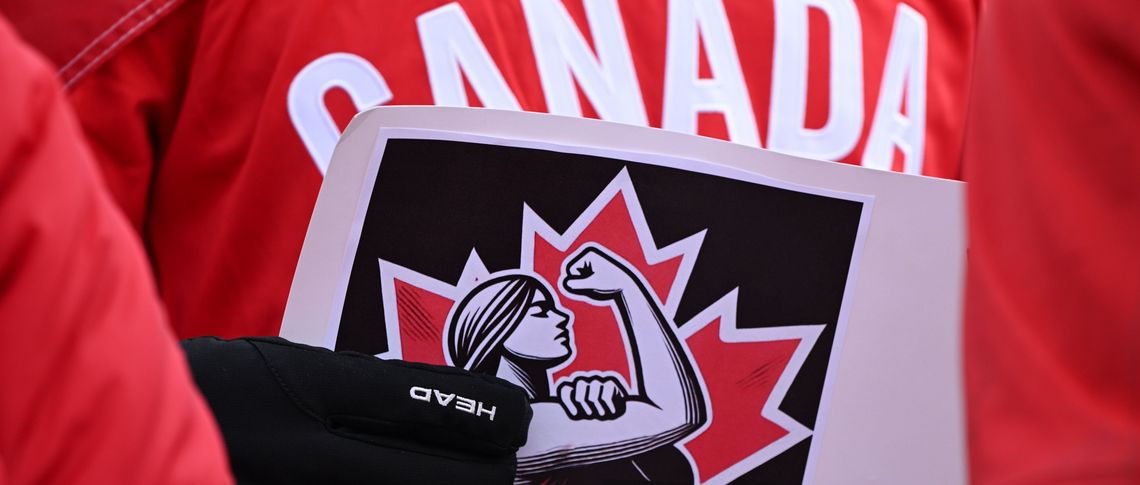
The first is Canadian public opinion. Carney’s room to manoeuvre rests on high public trust in his handling of Trump, a widely shared understanding of the risks of depending on an unstable America and a powerful desire to push back. Seventy-one per cent of Canadians support Carney walking away from the deal, across all regional and partisan lines. ‘Elbows up’, borrowed from hockey, is a national slogan. Political opinion against Trump, in fact, is so intensely negative in Canada that Carney would face bigger political repercussions if he were viewed as ‘caving’ to Trump in an unbalanced deal.
This is not an uncomplicated success story. As the trade war grinds on, there will be real economic pain in parts of the country. Canada’s support for displaced workers still trails support for business, and unions warn that recent packages leave large groups of the unemployed without help. Ottawa has also bowed to Washington on digital issues, scrapping a digital services tax on web giants and ending rules requiring Netflix and other streamers to fund Canadian content.
These inconsistencies may catch up with Carney in time. But for now, Canadians are resolved and largely united behind him.
The second lesson is that division is the strategy, not a side effect of the way Trump operates. Prime Minister Carney has had to hold together a fractious federation with deeply uneven stakes in the trade war: Ontario’s auto sector, Quebec’s dairy and British Columbia’s forestry interests are heavily exposed, while Alberta’s oil and gas sector, led by a premier more sympathetic to Trump, has been largely spared. Washington has applied tariffs in ways that deepen those divides rather than spreading the cost evenly.
There has been strong pressure to trade off tariff relief in one sector or region for concessions in another, but provincial leaders have largely hewn to a ‘Team Canada’ approach that recognises that the country is in an economic war. Maintaining relative unity is not easy for Canadian leaders, but balancing regional interests has been crucial to resisting Trump’s divide-and-conquer tactics.
Leverage and the willingness to use it
The third lesson is that dependence runs in both directions. Canada, though smaller, is not without leverage in these negotiations. It supplies 63 per cent of US oil imports, 81 per cent of imported electricity, nearly 100 per cent of imported natural gas and more than 80 per cent of imported potash, alongside critical minerals, aluminium, and a big market for US cars and digital services. Trump’s frequent statement that the US doesn’t need anything from Canada is thus patently untrue.
Leverage also comes from grassroots pushback, which has proved the most durable and effective resistance of all. Many Canadians are boycotting travel to the US, choosing to buy Canadian and leaving US alcohol on the shelves of the few provinces that still stock it. The travel downturn alone cost the US tourism industry an estimated $5.7 billion USD in 2025.
Meanwhile, Americans are absorbing real economic pain. Tariffs will cost US households more than $1,000 this year alone, and 58 per cent of Americans now oppose them outright. Trump’s popularity is cratering in the lead-up to the midterms, and some Republicans in border states are speaking out against the trade war on Canada in a bid for political survival.
Building the alternative
The fourth lesson is that diversifying trade relationships is a hedge against American instability. Even as talks continued, Ottawa has been opening up new global partnerships. In his first year in office, Carney signed more than 20 trade and security agreements across five continents.
While the approach has been broad and aspirational rather than deep, EU engagement has been a consistent theme. Canada’s accession to SAFE, the EU’s €150-billion rearmament loan fund, is a first for a non-European state, and Canada is set to open talks with Brussels this autumn on a deeper economic and security partnership.
These efforts won’t replace the immense US market next door tomorrow, but they chart a path for future cooperation and provide a counterpoint when Washington assumes Canada has nowhere else to go.
Most critically, Canada has zeroed in on the lesson that the EU and UK learned the hard way: trade agreements with Trump are not a conclusion but an opening offer, and signing one risks locking in concessions while leaving countries open to ongoing tariff threats. Trump’s signature, as Prime Minister Carney put it, is written in pencil.
Canada remains tied to the US and will keep seeking a resolution to the trade war — but it has rightly understood that there is far more than trade on the table. Trump was never seeking a negotiation over market access; he has weaponised interdependence in a quest to undermine Canada’s sovereignty.
When Carney stands in Strasbourg this month to speak before the European Parliament, the question will not be whether Europe admires him. It is whether Europe has reached the same conclusion — and if it is prepared to act on it.


