


Donald Trump’s Special Envoy for Belarus, John Cole, returned to Minsk on 15 September after a six-month hiatus. Ahead of the meeting, Alexander Lukashenko made it clear that he was expecting a substantial outcome. He spoke of his readiness for both a ‘major’ and a ‘minor’ deal with Washington, raising the issue of the $43–44 million frozen in the US-based Citibank, potash supplies, the resumption of embassy operations and even the nuclear materials remaining in Belarus.
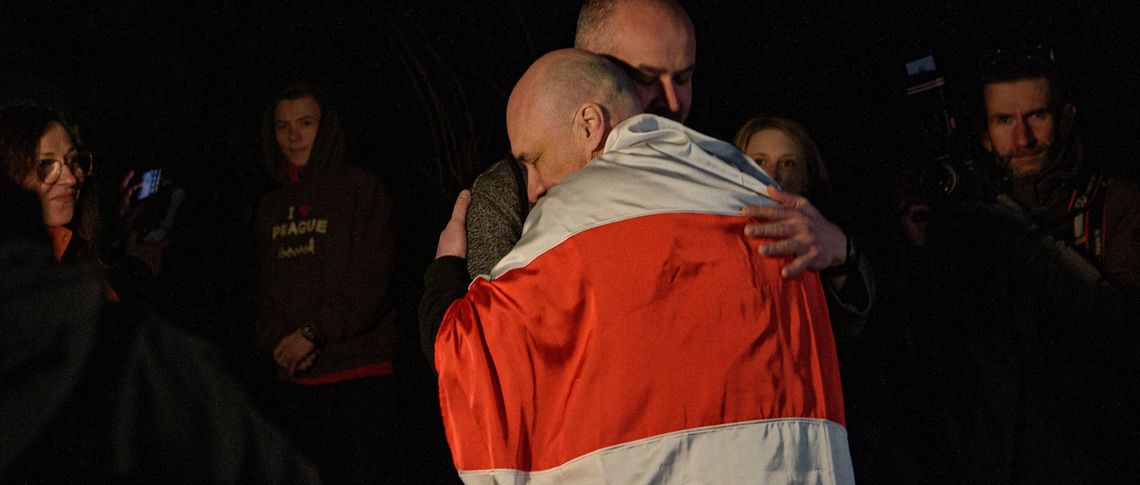
The outcome proved to be more modest than these ambitions. Lukashenko released 25 political prisoners, who were deported to Lithuania, whilst the US lifted sanctions against the ‘Lakokraska’ chemical plant and the ‘Bellesbumprom’ concern. Ahead of the meeting, sources had spoken of preparations for the release of around 200 people, and the relatives of some prisoners had even been warned to prepare to meet their loved ones at the prisons. But something went wrong, and the parties agreed on far less than expected.
Cole described the agreement reached as an interim one and stated that he expects to return to Minsk in about a month’s time. The American diplomat continues to speak of the release of hundreds of people. It appears that the parties were simply unable to agree on the entire package and have deferred the bulk of it to the next round of talks.
Adding pressure on the EU
As this happened right in the middle of the negotiations, it appears that Lukashenko has hardened his stance, deciding not to hand over all the ‘promised’ political prisoners until the US fulfils its part of the agreement. The further Minsk and Washington progress in the negotiations, the more evident it becomes that Lukashenko is dissatisfied with the meagre economic returns from the lifting of US sanctions alone. The fact is that the main economic benefits Minsk is seeking do not depend on the US, but on the European Union.
A clear example is potash fertilisers, one of Belarus’ main export commodities. The lifting of US sanctions does not restore Belarus’ short and cheap export route via the Baltic ports. This requires decisions by the EU and, above all, by Belarus’ neighbours. The same problem now arises with ‘Bellesbumprom’, which has been removed from the US sanctions list. Its products are banned from being imported into the EU, including in transit. The lifting of US restrictions may facilitate payments from buyers in third countries, but it does not solve the problem of costly logistics via Russia.
Cole raised the issue of new arrests back in the spring. But Lukashenko spoke out harshly ahead of the last meeting: there is no repression in the country, and those who break the law will continue to be imprisoned.
Washington has already attempted to resolve this issue on Minsk’s behalf. Back in the spring, the State Department asked Ukraine, Poland and Lithuania to allow Belarusian potash to pass through their territories. And now, following his meeting with Lukashenko, Cole has travelled to Vilnius and Riga for talks. However, to date, both the EU as a whole and Belarus’ neighbours have maintained a hard line.
At the same time, another problem is becoming increasingly apparent in the negotiations. Following the release of 250 political prisoners in March, more than 200 people have been added to this list, and it now contains, as it did then, almost 900 names. If this pattern continues, the Americans will have to spend years lifting sanctions in exchange for the release of people, only for Minsk to replace them with new detainees.
Cole raised the issue of new arrests back in the spring. But Lukashenko spoke out harshly ahead of the last meeting: there is no repression in the country, and those who break the law will continue to be imprisoned. Minsk clearly does not believe that the US is offering enough in return for refraining from making new political arrests. And it is already difficult for the US to offer Minsk much more without the involvement of the European Union.
Within Europe itself, these discussions are as yet barely audible. However, they are taking place actively amongst Belarusian democratic forces. There is almost no dispute there regarding US humanitarian diplomacy itself – it is welcomed by everyone, even the most principled hardliners. The differences begin with the question of whether the European Union should follow the US’ lead and join the negotiations.
Difficult balancing act
Svetlana Tikhanovskaya and groups close to her, including the United Transitional Cabinet and Pavel Latushko’s team, view this prospect negatively. Their stance is that American sanctions should secure the release of individuals, whilst European sanctions should ‘liberate the country’. The point is that the EU should maintain and escalate its sanctions to put pressure on Minsk until more significant changes are made: an end to repression, a withdrawal of support for Russian aggression against Ukraine and, ultimately, political transformation through round-table talks with the opposition.
Another approach is being championed by, amongst others, the released political prisoners Maria Kolesnikova and Viktor Babariko, as well as former members of Tikhanovskaya’s cabinet, Valery Kovalevsky and Olga Gorbunova. They are proposing that Europe engage more actively with Minsk and use sanctions to secure specific concessions – in effect, to join the US in its efforts right now.
Increased American pressure on Belarus’ western neighbours regarding potash transit will put opponents of this approach in a difficult position. They will have to persuade European governments to maintain pressure at a time when the Trump administration will link such an easing of sanctions to the release of hundreds of political prisoners – in other words, to a humanitarian mission.
If EU countries, following the US’ lead, start discussing sanctions and the gradual restoration of relations with Minsk, Lukashenko will be able to break through not only the logistical but also the diplomatic blockade.
The opposition leadership also has another interest in preventing the normalisation of relations with the Minsk regime. Since 2020, the West has ceased to regard Lukashenko as a legitimate president, whilst Tikhanovskaya and her organisations have gained direct access to European governments and international organisations as representatives of an alternative Belarus. This special status relies largely on Lukashenko’s political isolation.
If EU countries, following the US’ lead, start discussing sanctions and the gradual restoration of relations with Minsk, Lukashenko will be able to break through not only the logistical but also the diplomatic blockade. The very idea that problems in Belarus’ relations with the West can be resolved directly with Minsk will return. But if Lukashenko once again becomes an acceptable political interlocutor, the need for an alternative representative will diminish.
We are still a long way from such a turn of events, and the issue is not so much that European governments value their relations with the Belarusian democratic forces. It is difficult to change the EU’s sanctions framework simply because the US is asking for it, and there are as yet no EU countries prepared to actively lobby on behalf of Minsk’s economic interests.
Even more important is how Lukashenko himself is perceived in Europe. For Washington, he is currently a figure through whom several specific objectives can be achieved, first and foremost the release of political prisoners, and, prior to that, the sending of certain signals to Putin.
The EU as a whole, and Belarus’ neighbours in particular, view Lukashenko through a completely different lens – that of his alliance with Russia, his involvement in the war, the migration crisis and other threats to their own security. For the US, Lukashenko has become the key to resolving – albeit local – problems, whilst for Belarus’ neighbours he remains part of the problem itself.


