


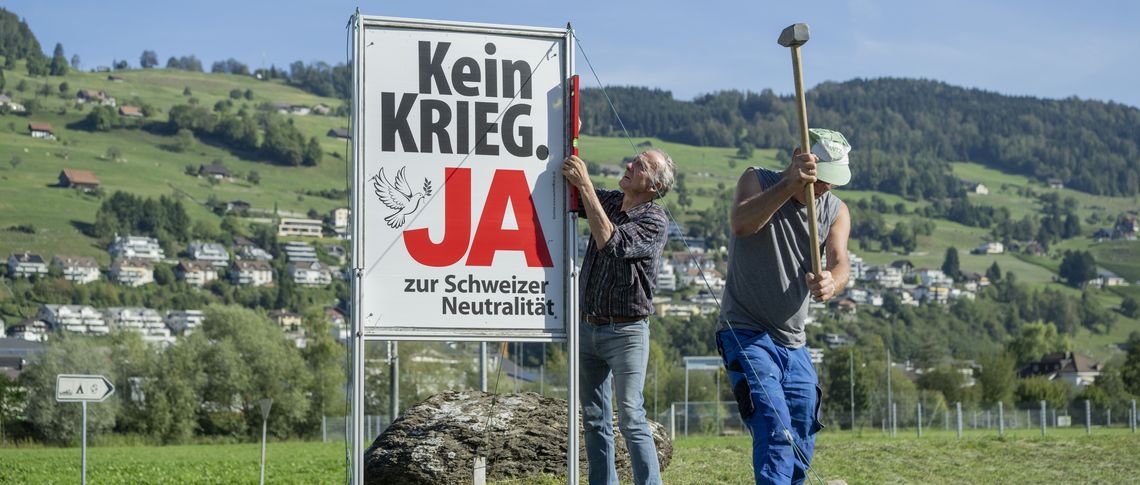
These days, anyone passing through Zurich, Geneva or Lugano cannot but notice the posters of the ‘Yes’ camp. Flyers echo John Lennon’s famous call to ‘Give Peace a Chance’. This all may seem harmless, but it is a campaign with a clear objective: to enshrine Switzerland’s understanding of neutrality in its constitution — categorically and without conditions or exceptions.
The debate centres on Switzerland’s special status, with its implications for the whole of Europe. It is often regarded as the most neutral country in the world — and it is indeed the European state that has remained neutral for the longest period. At the Congress of Vienna in 1815, the major powers recognised its perpetual neutrality, which was incorporated in its constitution in 1848.
The neutrality initiative now being put to the vote would not, however, increase Switzerland’s neutrality. It would limit its scope for action in the area of foreign and security policy, thereby weakening the very cooperation and credibility upon which Swiss neutrality is based today.
Neutrality is a narrow legal term. The Hague Convention of 1907 defines three obligations – restraint, impartiality and prevention – which, however, apply exclusively during a war between states. Arms exports and military technology must be handled identically for both sides; territorial integrity must be defended; all military support is excluded. Sanctions, economic relations, diplomacy and human rights were, on the other hand, never part of the law on neutrality. While the law on neutrality is military in nature and inflexible, a policy of neutrality is flexible and adaptable.
The initiative reduces the scope for action precisely in those areas where Switzerland needs it most.
In practice, the convention is hardly applicable today. In 1907, every state still had the right to wage war; it made more sense to treat all warring parties equally. In 1945, the UN Charter forbade wars of aggression and violence. Hybrid attacks, cyberattacks and weapons of mass destruction were unknown at the time. Yet the convention’s promise – if you stay out of it, you won’t be attacked – was regularly broken. Switzerland continued to be spared — not only because it was neutral, but because it acted as a military deterrent, remained economically useful and did business with both sides.
The myth that neutrality and security go hand in hand is nevertheless deeply rooted in political culture. For European partners, this myth certainly has its advantages: neutral states can provide meaningful assistance and can usefully complement the security regulations, particularly from the perspective of cooperative partners.
During the Cold War, Switzerland was regarded as part of the West but still maintained the narrowest understanding of neutrality anywhere in the world, not even joining the UN until 2002. Economic sanctions against Iraq followed in 1991 — and in 1993 a white paper was produced that added concepts such as ‘Security through Cooperation’ and ‘Solidarity through the promotion of Peace’ to that understanding of neutrality. At the same time, it was made clear that the Hague Convention does not call for equal treatment across the board and leaves some scope for action in economic relations. The right-wing populist Swiss People’s Party (SVP) rejected this approach but was unable to reverse it.
Neutrality is not isolation
The 2026 neutrality initiative needs to be seen in this light. In the immediate term, it represents the SVP’s response to the adoption of EU sanctions against Russia following the war of aggression in Ukraine. Its aim is to establish in Paragraph 54a of the constitution that neutrality is ‘perpetual and armed’, to limit cooperation with military and defence alliances such as NATO to an actual attack and to exclude all non-military coercive measures against states at war. Any participation in sanctions would therefore be impossible. Exceptions would only apply to existing UN obligations and to the prevention of sanction circumvention via Switzerland. The role as mediator is to be strengthened — but how this would work in practice remains open.
Whatever views people may have on the prospects of sanctions succeeding, ruling them out would seem to have little to do with a peace initiative. It is telling that the SVP veteran and co-initiator Christoph Blocher is rumoured to have economic interests in trade with Russia. The overall economic benefits of a ban on sanctions are, however, disputed and the risk is high: if Switzerland does not support sanctions in such a high-profile case, it damages its reputation with its closest trading partners. At the same time, adopting the EU sanctions was probably simply in Switzerland’s commercial interests — even if international law, the international order and security in Europe were also at stake.
The initiative reduces the scope for action precisely in those areas where Switzerland needs it most. The requirement to only work with alliances in the case of an attack does not only endanger common exercises and peacekeeping operations but also agreements relating to arms procurement and the exchange of situation reports. Anyone who only joins in once the attack is under way is acting negligently and is making itself dependent on the goodwill of friendly states. Nowadays, sovereignty does not mean that you don’t need anyone. It means that you are not dependent on others at the vital moment. That is exactly what the initiative would undermine.
Neutrality depends on trust
The strongest argument, however, is reputation. As a negotiation venue, a mediator and the headquarters of multilateral organisations, Switzerland thrives on mutual trust. Brussels is worried: a Switzerland acting as a safe haven for Russian businesspeople subject to sanctions is just as much against the EU’s interests as ending the exchange of military information; bilateral agreements with the EU are also coming under pressure. And the clear support from the Russian Foreign Ministry is not a sign of impartiality. If its closest partners are urging caution and an aggressor is celebrating, the mediator role is weakened. The Federal Council and the Parliament are rejecting the initiative. It represents the project of a single, larger party that is selling a ‘yes’ vote as a vote for neutrality — as if Switzerland would not remain neutral in the case of a ‘no’. It would remain so — and in a much more cooperative way.
For years, Swiss neutrality has been following this trajectory. Back in 2003, Foreign Minister Micheline Calmy-Rey coined the concept of ‘active neutrality’, while the current holder of this office referred in 2022 to ‘cooperative neutrality’. Switzerland is neutral, and that is exactly why it can advocate for peacekeeping, human rights and international law. Events have been moving in this direction for years — for instance, with the European Sky Shield Initiative in 2024, agreements on EU peace missions and greater defence cooperation. None of this, as the EU High Representative for Foreign Affairs Kaja Kallas made clear, contradicts Swiss neutrality.
Nobody knows which threats Europe will be confronted with in 10 or 20 years. What we do know is that Switzerland has limited options despite its important military budget. It is dependent on cooperation, international organisations and its reputation as a neutral player. From a military point of view, the sovereign approach is risky. It is all the more important that Switzerland maintains the high levels of trust that it has built up over centuries — particularly among the European neighbours upon which it is so reliant in an emergency. This trust needs to be cultivated.
Neutrality requires restraint in military matters, not indifference in political affairs.
During a war of aggression, neutrality and non-intervention are not the same. Sanctions are not a form of military support — and an embargo does not constitute participation in a war. Neutrality requires restraint in military matters, not indifference in political affairs. It is precisely this boundary that is at stake in Switzerland — and throughout Europe wherever neutral or non-aligned states are facing the same questions.
The polls are clear: most recently, only just over 30 per cent of Swiss people intended to vote ‘yes’. The debate will, however, not let up. A vote on easing restrictions on the export of weapons of war is likely to take place as early as next year — and ironically it is the SVP that wishes to make exports easier. This shows that it is business interests, not principles, that are at stake.
Of greater importance than any initiative would therefore be a clear foreign policy vision for Switzerland. Europe needs a multilateral Geneva just as much as an active neutral Switzerland providing useful assistance — now more than ever when areas free from confrontation are few and far between.
The dilemma is very real: Russia has rejected Switzerland as a negotiation venue several times and directly questioned its neutrality. However, the proposed alternative would alienate the country’s closest partners. Switzerland can offer excellent assistance if it goes along with the sanctions, as demonstrated by the trilateral meetings between the US, Ukraine and Russia in February 2026.
What ultimately counts is to maintain contact with the warring parties, take diplomatic initiatives, provide help where needed and make the most of its freedom to form alliances — while advocating clearly for international law and human rights. Neutrality is not a state of existence but a mode of active participation: it needs to be revisited every day and be credible to both sides. Anyone who turns it into a formula loses precisely the flexibility that makes it possible in the first place.


