


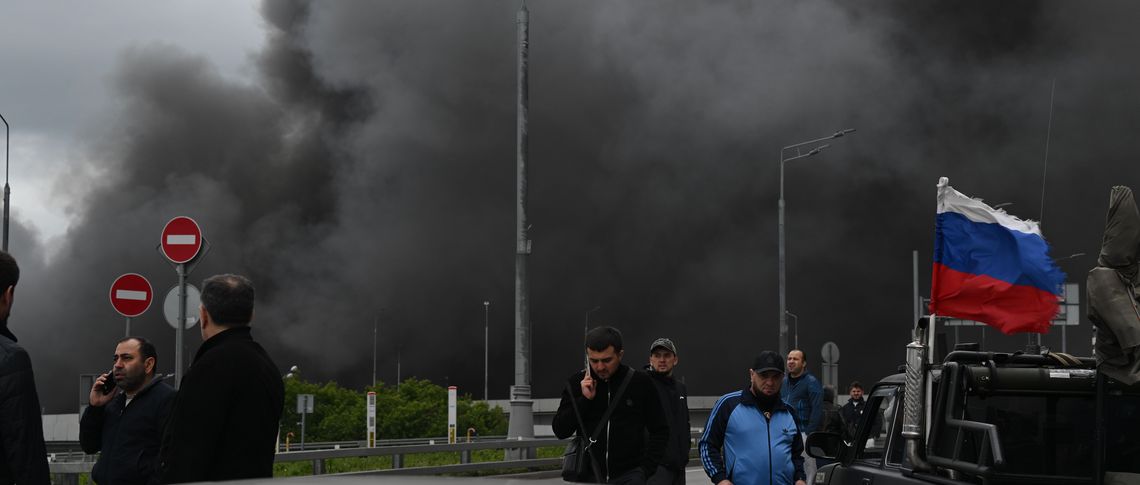
Assessing the results of the 40-day operation to coerce Russia to peace, which formally concluded on 4 August, Ukrainian President Volodymyr Zelenskyy stated that he was satisfied. Undoubtedly, strikes on the fuel and energy sectors and on logistics created serious problems for Russian logistics, while sanctions and diplomatic semi-isolation continue to force Moscow to pay an ever higher price for continuing the war, though not to end it. And yet, there are some problems here.
‘Coercion to peace’, which ultimately takes the form of an escalation of war, in reality leads to its end only in a small number of cases. Its logic is to exert such strong pressure on the adversary that it chooses to retreat. Usually, the strong coerce the weak to make peace. The term gained currency after the 2008 Russo-Georgian War, which Moscow itself described as an ‘operation to compel peace’. Such an approach presupposes coercive diktat on the condition that the opponent is incapable of offering resistance. Yet, while Ukraine destroyed more than 100 targets in Russia over the course of 40 days - oil refineries, infrastructure facilities, warehouses and so forth - it also suffered devastating strikes. The interim result was not the critical weakening of Russia, but another round of escalation.
Weighing out the odds
Expecting such a simple approach to be effective was somewhat naïve. The few wars in which coercion to peace did work were characterised by additional conditions. For example, when escalation sharply altered the balance of forces or led to the termination of external support for one of the parties. It was clearly unrealistic to expect anything similar in our case.
The political circumstances are even more complicated. Coercion to peace works when there is a parallel political dialogue, effective mediators, and an acceptable exit from the war for the parties involved, together with guarantees for the future. None of this exists at the current stage of the Russo-Ukrainian War — nor is it likely to in the near future.
The result is predictable: under such conditions, escalation does not coerce peace. It merely increases the costs for both sides without altering the fundamental calculations that determine the value of continuing or ending the war. And when peace does not arrive, a new round of violence begins, the stakes are raised, and the determination to fight until final victory is strengthened. The chances of ending the war diminish.
For the Kremlin, the war has become a source of regime legitimacy, a mechanism for domestic mobilisation, and a way of explaining a wide range of problems.
It has now become clear that forcing Russia to make peace is far more difficult than many believed in 2022. Russia has suffered enormous human and material losses, come under unprecedented sanctions pressure, and become far more dependent on China, yet it has not abandoned its objectives in the war. The huge Russian losses that the General Staff reports to us every day have not caused it to stop — it is unlikely that the loss of Wildberries warehouses or Ukrainian strikes on oil refineries will do so.
For further ‘coercion’, the key question is no longer how to make the war even more costly for Russia, but under what conditions the Kremlin might conclude that ending the war is more advantageous than continuing it.
But Putin has no urgent need to end the war simply because it has become too expensive. For the Kremlin, it has become a source of regime legitimacy, a mechanism for domestic mobilisation, and a way of explaining a wide range of problems. Bringing it to an end, especially as a result of a publicly announced campaign of ‘coercion’, was clearly never among Moscow’s intentions.
In the modern world, states generally do not end wars simply because the costs become too high.
Incidentally, announcing a deadline under such circumstances clearly reduced the chances that the war would actually end, even if the pressure had been far stronger. Politicians cannot afford to demonstrate a lack of resolve or a willingness to yield, especially during wartime and all the more so in authoritarian Russia. Was the Ukrainian president aware of this when he made such public statements? Presumably, future attempts to compel Russia to peace will need to be conducted more quietly.
The continuation, and even escalation, of the war means not only that the pressure proved insufficient. In the modern world, states generally do not end wars simply because the costs become too high. They may, however, end a war if they come to understand that continuing it will not deliver a better political outcome. Russia appears to be no exception: the Kremlin understands the challenges and does not ignore its own losses. But the belief that the Russian economy will outlast the Ukrainian one; that Ukraine will eventually lose Western support; and that overwhelming superiority in resources will sooner or later prove decisive, outweighs the arguments in favour of ending the war.
Making war futile
Ukraine should rethink the logic of coercion to peace. The simple version - we strike, and the enemy retreats - does not work. The more complex version focuses not on making the war as costly as possible, but on making it futile. Such a strategy requires the fulfilment of several important tasks.
First, Russia should ideally be deprived of the ability to achieve strategic successes on the battlefield. This is not about rapidly liberating occupied territories or drinking coffee in Yalta, but about ensuring that the Kremlin can no longer regard its slow advance as guaranteed.
A clearer post-war vision is needed. This should concern not reconstruction conferences, but how to make renewed aggression against Ukraine futile.
Second, it is necessary to create and demonstrate to Moscow a model of Ukraine’s successful long-term functioning. The ability to defend itself, including securing the necessary resources and partners, gradual integration with European security structures, domestic weapons production, and a democratic political system should convince Moscow that waiting for the collapse of Ukrainian statehood is not a viable strategy.
Third, a clearer post-war vision is needed. This should concern not reconstruction conferences, but how to make renewed aggression against Ukraine futile. Coercion is most difficult here because, at some stage, it will be necessary to negotiate and encourage compliance with any agreements that are reached.
Ukraine’s experience of attempting to compel Russia to peace has shown that increasing losses, new sanctions packages, including those involving long-range measures, and expectations of regime or economic collapse are unreliable and insufficient. Moscow chooses war despite understanding its high cost — and this is not the first time it has done so. Greater emphasis on the dead end into which the war has led the Kremlin may prove more effective.


