‘Checkmate in Iran’ — few have captured it as succinctly as Robert Kagan, an icon of American neoconservatism. And he has a point: the failed war against Iran marks a watershed for the Middle East. The decline of American hegemony could now lead in one of two directions: the final collapse of any semblance of order through the entrenchment of a situation that is neither war nor peace, or the tentative emergence of a self-sustaining regional security architecture in which the region’s major powers become security guarantors in their own right for the first time.
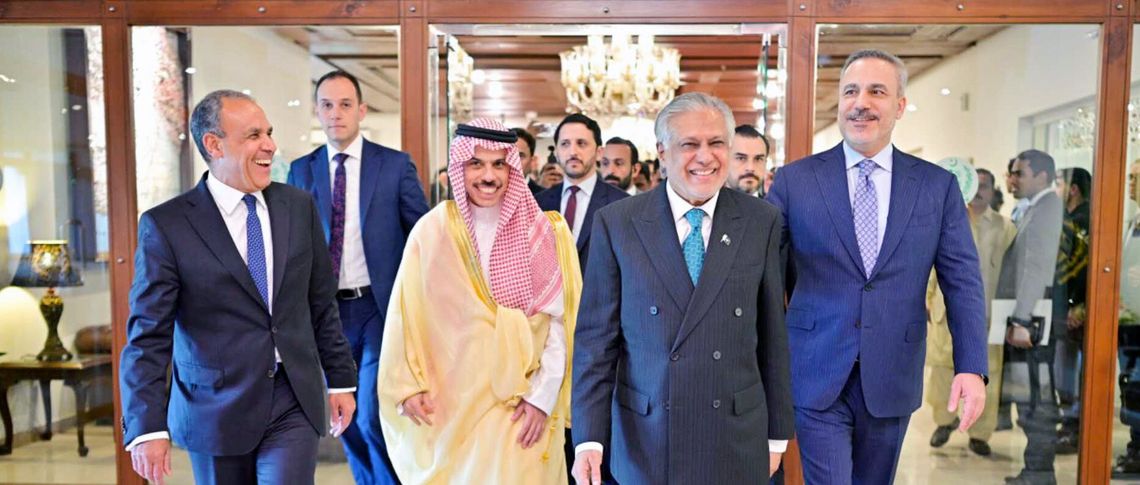
On 21 June, overshadowed in the media by the start of US-Iran consultations in Switzerland, the foreign ministers of the four major Sunni Muslim regional powers met in Cairo: Saudi Arabia, Turkey, Pakistan and Egypt. It was already the fourth high-level meeting in this format in the space of just three months, and for the first time the institutionalisation of the grouping was also on the agenda. What is taking shape here could well become the nucleus of an independent regional order.
‘Share the region’
Even before the latest escalation, the members of this quartet had lobbied in Washington against the decision to go to war. Unlike the sorcerer’s apprentices in America and Israel, the region foresaw the ensuing disaster. ‘Had the Israeli plan to ignite war between us and Iran succeeded, the region would have been plunged into ruin and destruction’, said Prince Turki al-Faisal, the former intelligence chief and long-standing semi-official voice of the Saudi establishment. Rather than using Iran’s retaliatory strikes to fuel further escalation, it was the Big Four, together with their smaller brother state Qatar, that made the most determined efforts to bring the catastrophic war to an end.
Cooperation between the four countries and Qatar is all the more remarkable given that many of them were openly at odds with one another only a few years ago. The upheavals of the Arab Spring, with their proxy wars and state collapse, triggered a regional hegemonic crisis that made any understanding impossible for years. Riyadh and Ankara, in particular, long stood at opposite ends of the ideological spectrum. Turkey was the beacon for Islamist revolutionaries, while the Kingdom positioned itself as the bastion of counter-revolutionary monarchical stability. Egypt and Qatar became arenas for this rivalry, which at times was almost as intense as the antagonism between Saudi Arabia and Iran, the third state competing for pan-Islamic influence.
Hubris gave way to disillusionment. Turkey needed money, Saudi Arabia needed stability, and even Tehran recognised the limits of its confrontational approach. Regional rapprochement therefore began well before 7 October. The Saudi-Iranian rapprochement brokered by Beijing has survived even the most recent war. In Syria, Saudi-Turkish détente achieved its greatest success, with the two countries jointly bringing the country out of regional isolation after the overthrow of the regime — under none other than the rule of a former al-Qaeda commander.
When it comes to the strengthened regime in Tehran, the strategy of the Middle East Four is one of maximum engagement.
‘Share the region’, President Obama once advised the region’s strongmen. He was well ahead of his time, but years later the message has finally sunk in. The realisation has dawned that no regional power can impose its claim to dominance on its own, and that proxy wars and ideological hostility taken to extremes ultimately harm everyone. There is also a growing recognition that American global power can only be harnessed for one’s own interests to a limited extent. No matter how many billions are spent, no one can outcompete Israel in Washington.
The formula of the new Middle East quartet is straightforward: at least partially replace America as the region’s security guarantor, integrate Iran and thereby contain it, while pushing Israel back. Israeli expansionism in the West Bank, Syria and Lebanon, together with the country’s increasingly unconstrained concept of security, is now regarded as just as great a challenge as the revitalised regime in Tehran, which, having been completely cornered, has found its ‘nuclear option’ in the Strait of Hormuz — holding not only the region but the entire global economy at knifepoint.
The Persian-Israeli antagonism is now widely seen as the greatest threat to lasting peace and stability in the region. Containing and defusing it is the central geopolitical objective of the quartet led by Riyadh and Ankara. The aim is to prevent both a new, polarising round of Abraham Accords, of the kind Tel Aviv now seeks to impose on Syria and Lebanon, and the emergence of a Pax Iranica in the Gulf.
There is little confidence that the erratic Americans will play a constructive role in this joint endeavour. Trump, seemingly losing interest, is already leaving the field to his two Diadochi, Vance and Rubio, each of whom poses a risk in his own way. The Vice President, who finds the region so distasteful that he may simply abandon it to face the Iranians alone. And Secretary of State Rubio, who, despite his MAGA disguise, remains an ‘Israel Firster’ of the old neoconservative school. How America’s struggle with itself will end remains uncertain.
The road to peace runs through Ramallah
When it comes to the strengthened regime in Tehran, the strategy of the Middle East Four is one of maximum engagement. An arms race in the Gulf is clearly inevitable, but deterrence alone will not suffice. Using the Strait of Hormuz as leverage is almost criminally cheap. All it takes is for a Revolutionary Guardsman to cough, and the entire global economy catches the flu. The overtures have long since been made: if Iran cannot be defeated, it must be integrated. Even the United Arab Emirates, long known for its scepticism towards Iran, appears to have realised that it is wiser to reach an accommodation with Tehran than to place itself in the crosshairs. The regime may be more aggressive than before, but perhaps also less ideologically rigid. In Riyadh, meanwhile, the Beijing-brokered rapprochement is still regarded as a success, one that many would like to expand into a fully-fledged non-aggression pact.
The need to treat Iran with caution despite all the mistrust also stems from the regime’s newly acquired popularity. It is an open secret that large sections of the Muslim world were rooting for Tehran. At last, here was a country willing to stand up to Israeli-American arrogance. The danger, however, is that the Islamic Republic may become intoxicated by its unexpected successes, overplay its hand and once again plunge the region into chaos.
The quartet’s relationship with Israel is even more complicated. Contrary to claims by Israeli propagandists, there is no fundamentally anti-Israeli agenda. Nor is Turkey ‘the new Iran’. All four powers support what was originally a Saudi initiative: the Arab Peace Initiative, offering full normalisation in exchange for a two-state solution based on the 1967 borders. The hand remains extended towards an Israel that wants peace. The problem is that such an Israel scarcely exists at present.
For lasting peace, an Israel willing to come to its senses would be more than welcome.
Netanyahu’s vision of a Pax Judaica is intended to make Israel the Middle East’s sole ‘superpower’. The entire region is to be transformed into a maximally weakened, sovereignty-free space in which the Israeli military can operate at will. It is the exact opposite of the state-centred order the new Middle East quartet seeks to build. By remarkably similar means, the Jewish state, like its arch-nemesis Iran, relies on fragmentation, ethno-sectarian division, separatism and proxies. Hubris still has a home in Tel Aviv.
That extraordinary overconfidence is, however, reaching its natural limits. ‘You’re a country of nine million people. You can’t simply kill your way out of every security problem’, JD Vance reportedly told what was once America’s closest ally, which is now encountering a much chillier mood in Washington than it has for years. The region is listening closely. It has long recognised the shifting tectonic plates of geopolitics. Without unconditional US backing, the Jewish state risks becoming Icarus.
For lasting peace, an Israel willing to come to its senses would be more than welcome. The Iranian-Israeli antagonism feeds on the unresolved Palestinian question. The extremists on both sides resemble two drunks propping each other up while wrecking the entire pub. That is why the foreign ministers of the Big Four are clear: the road to peace runs through Ramallah. Ignoring this simple truth made 7 October and the wars that followed possible in the first place. That must not be allowed to happen again.
This is precisely where common ground exists with Europeans, who are sinking into splendid irrelevance. We, too, have learnt that leaving the Middle East conflict unresolved comes at a cost — one measured not only in war, extremism and migration, but also at the petrol pump. It is time for more than the usual lip service. The new Middle East quartet offers an opportunity. We should seize it.