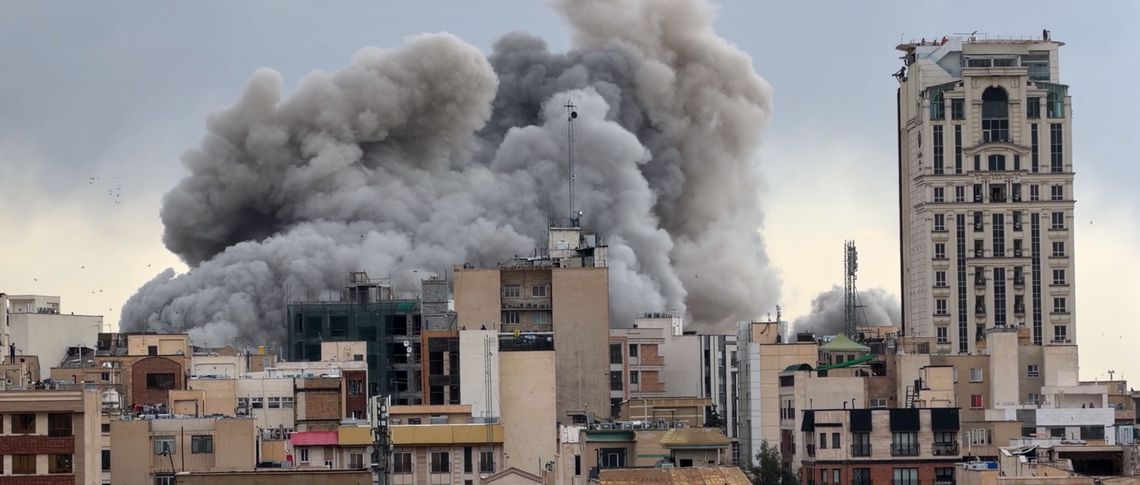
The political dimension of the recent US–Israeli bombardment of Iran can scarcely be overstated. While in many European capitals a potential regime change is being applauded, the historical significance of these attacks remains largely obscured from public view.
The current escalation marks a rupture. The hostile parties are now pursuing the goal of mutual destruction with renewed determination. The Iranian head of state has been killed, along with leading diplomats and military officials of a middle power of 90 million people — a state whose legitimacy will remain indispensable to any stable order in the Middle East in the long term. What was successfully prevented in the war in Ukraine – namely limiting the conflict both horizontally and vertically – has failed in the case of Iran. The threshold has been crossed. The consequences will be enormous, including for Europe.
Every regional order rests on the legitimacy of its most powerful actors. Alongside Turkey, Iran is the most significant middle power in the Middle East, with a millennia-old imperial history and a corresponding self-conception. An aerial bombardment is highly unlikely to bring about regime change. And even if it were to succeed and Iran were a flourishing democracy tomorrow, why, after all it has endured, would this power not do everything in its capacity to become militarily strong enough never to be humiliated again?
Historical experience is unequivocal: order does not emerge from morality, but from balance.
What we are witnessing – the liquidation of a political leadership – is not the resolution of the conflict. It is its overture, not the grand finale. How this country is to be persuaded over the coming decades to help sustain a stable order is more than doubtful. Order requires trust, and that trust has been destroyed. However many regime changes may follow, no future government will place trust in this order or believe in its reliability.
One might object that revisionist actors cannot, in principle, be permanently integrated. Their aim, it could be argued, is not the stabilisation but the overcoming of the existing order. Equally, one could contend that balance-of-power politics has always been a historical interlude: temporary, fragile, never an order for the long term. Added to this is the fact that through its network of proxies, Iran has in effect maintained a permanent state of war, in asymmetrical and elusive form.
This gives rise to the strategic core question: does one settle for an unstable stability? Does one keep conflicts contained as long as neither side openly challenges the balance — as was essentially the case prior to the bombardment? Or does one seek deliberately to break Iran’s military power in order to create an order that no longer needs to take it into account?
Historical experience is unequivocal: order does not emerge from morality, but from balance. Every order has had to be secured militarily if necessary — or at least by a credible threat. Functioning orders were not characterised by the absence of violence, but by its limitation. Diplomacy prevented the use or escalation of military confrontation; conflicts remained contained. Balance was never the opposite of order. It was its precondition.
The true objective was the elimination of Iran as a counterweight altogether, to gain a free hand in reshaping the Middle East.
One can argue that the United States, Israel, together with most other Middle Eastern states, and Iran found themselves for decades in precisely such a balance. This order had no moral foundation; it was based solely on the balance of military power. From this caution emerged a certain diplomatic modus vivendi. The order was fragile, but it functioned in its own way. There were at least minimal rules in this raw balancing act. They have now fallen.
What did the balance look like shortly before the bombardment? De facto, the United States, Israel and their Arab partners had fully balanced Iran. Economically, technologically and militarily, Western superiority was overwhelming. Hamas had been crushed, Hezbollah weakened. Iran was diplomatically isolated, economically crippled, domestically under mounting pressure, and a nuclear agreement appeared within reach. It would have been enough to maintain this pressure. The regime would, sooner or later, have been forced into a phase of consolidation. Instead, the temptation of the moment prevailed, creating chaos where previously, however brittle, order had existed.
For it was not the balance that drove the West — it had long since tilted decisively in its favour. The true objective was the elimination of Iran as a counterweight altogether, to gain a free hand in reshaping the Middle East. The bombardment is the logical culmination of this approach, and for that reason it is so alarming.
Presented with faits accomplis
Iran will not settle down. Anyone who existentially threatens its political leadership produces lasting instability. That instability will not strike America first, but Europe. For decades, Europe has absorbed the collateral damage of other great powers’ games in the Middle East. The refugee movements of 2015 were a stark warning. Little has been learned.
Europe is a constellation of small and middle powers. Prosperity, security, the entire social model — all depend on a stable international order. Europe is not powerful enough to impose itself militarily like the great powers. But if rules no longer apply, why should anyone still take Europe’s interests into consideration?
One need only imagine if Napoleon or Bismarck had, after their campaigns, simply executed every enemy monarch, general or diplomat. Instability would have been universal; not for sentimental reasons, but out of sober calculation. After the devastation of the Thirty Years’ War, the European powers enshrined a minimum of principles of international law in the Peace of Westphalia of 1648 for good reason: no diplomatic intercourse without the protection of envoys, no negotiation without the premise that yesterday’s enemy may be tomorrow’s interlocutor. These rules were not naïveté. They were strategic reason. They were the precondition for adversaries to be able to speak to one another at all.
Those who renounce this minimum and elevate lawlessness to a principle should not be surprised when others do the same. And respond in kind at the next opportune moment. It will end as it must: in chaos. What does Europe stand to gain from chaos in the Middle East? Nothing. Only problems — and paying the price for games others have played. The last thing Europeans should do is applaud it. Yet the deeper strategic error lies elsewhere: Europe lacks the power to shape the balance in the Middle East actively. It reacts; it does not shape. And although Europe’s interests in the region are greater than those of the great powers, it allows itself to be presented with faits accomplis.