


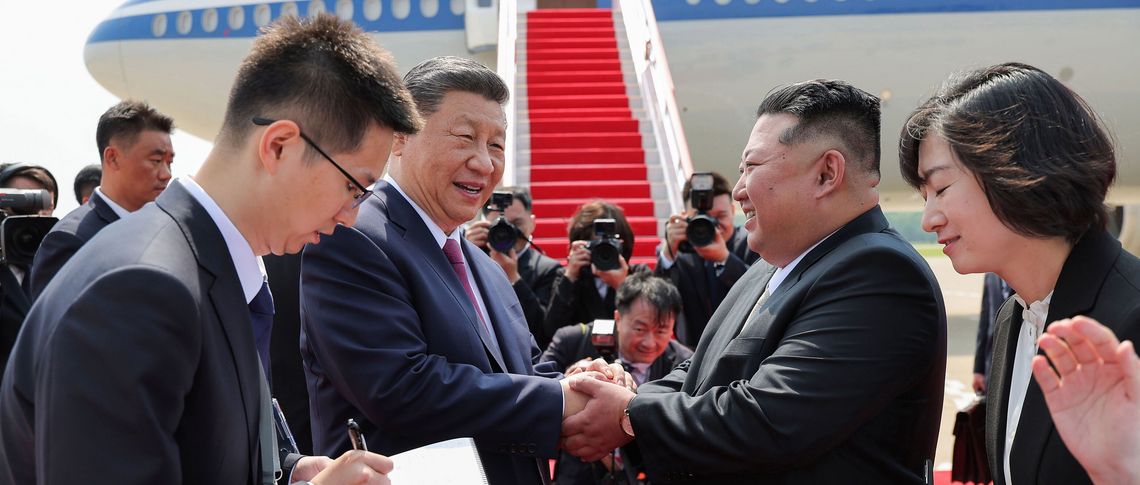
Xi Jinping’s visit to North Korea is not a nostalgic nod to the traditional friendship between the two countries. Rather, it demonstrates just how much the balance of power in North-East Asia has shifted. North Korea, of all places, long regarded as China’s isolated junior partner, now has greater scope for manoeuvre in foreign policy. Pyongyang is increasingly exploiting the rivalry between China, Russia and the US to its own advantage.
This is precisely why it is worth taking a closer look behind the official statements. Chinese media cited the 65th anniversary of the Sino-North Korean cooperation treaty as the reason for the visit. Xi himself invoked the ‘unshakeable friendship’ between the two states and spoke of a ‘new era’ in relations. But the real significance of the visit lies less in the past than in the geopolitical shifts of the present.
There can only be one
Since Xi’s last state visit in 2019, both the geopolitical landscape and North Korea’s strategic position have changed significantly. Accordingly, the visit is far more than a symbolic gesture for Xi. Rather, China linked concrete strategic interests to the visit. Beijing’s central objective was undoubtedly to cement its own role as North Korea’s most important strategic partner – officially its only ally. The summit thus also sent a geopolitical signal to Moscow. Regardless of the increasingly close relations between Russia and North Korea, the symbolic message of the visit was that these would not challenge China’s traditional primacy. The visit was therefore intended to refute the impression that the rapprochement between Russia and North Korea had weakened Beijing’s traditional influence over Pyongyang.
For Kim Jong Un, the visit was a huge symbolic and strategic success. The fact that Xi, one of the world’s most powerful leaders, chose to make his first overseas trip of 2026 to North Korea – following visits to Beijing by Donald Trump and Vladimir Putin – represented a significant boost to North Korea’s prestige. The visit reinforced the image of Kim Jong Un, deliberately cultivated by North Korea, as a leader who operates on an equal footing with the leaders of the major powers.
Going beyond its symbolic significance, the summit underscores North Korea’s growing strategic and political importance, thereby also signalling that the country is by no means isolated in terms of foreign policy. The visit also sends an important signal to the US and its allies: North Korea continues to enjoy China’s political backing. Even if Beijing does not support every North Korean position, China has no interest in Pyongyang’s international isolation. On the contrary: North Korea’s room for manoeuvre has gradually expanded in recent years, particularly as a result of its rapprochement with Russia. The more China fears losing influence to Russia, the greater Pyongyang’s opportunities become to negotiate political and economic concessions. This creates a situation for Kim Jong Un that North Korea already exploited effectively during the Cold War under Kim Il Sung – the prospect of playing major powers off against one another whilst expanding its own scope for action. By drawing closer to Russia, North Korea has also sought to reduce, at least in certain areas, its unilateral dependence on China – and it will attempt to derive the greatest possible benefits from both relationships.
The more China comes to terms with the status quo, the less pressure there is on Kim Jong Un to make substantial concessions on the nuclear issue.
It is also worth noting what was apparently not discussed – or at least not in the Chinese and North Korean reports on the summit: the nuclear issue. For many years, China officially emphasised the goal of a nuclear-free Korean Peninsula and, in the past, also supported international sanctions against North Korea. As recently as his last state visit to North Korea in 2019, Xi stated that China remained committed to the denuclearisation of the Korean Peninsula. There is no mention of this today. It is no coincidence that Kim Jong Un visited a new uranium enrichment plant shortly before Xi’s visit, whilst Kim Yo Jong, Kim Jong Un’s sister, described North Korea’s nuclear armament as an ‘irreversible reality’ on the eve of the summit. The fact that the nuclear issue was not mentioned in the public statements of either state once again highlights China’s priorities regarding North Korea. Stability and influence are considered more important than denuclearisation. This, too, suits North Korea. The more China comes to terms with the status quo, the less pressure there is on Kim Jong Un to make substantial concessions on the nuclear issue.
In the run-up to the summit, there was much speculation as to whether Xi’s visit might provide fresh impetus for the resumption of dialogue between the US and North Korea. Even before the first summit between Donald Trump and Kim Jong Un in 2018, Xi Jinping and Kim Jong Un had met on several occasions to exchange strategic views and coordinate their policies. In fact, Donald Trump had repeatedly reaffirmed his willingness to meet the North Korean leader again. Against this backdrop, and following the recent summit between Trump and Xi in Beijing, Xi’s visit has fuelled speculation as to whether China could broker new contacts between Washington and Pyongyang. Whilst direct contacts between Trump and Kim cannot be ruled out, it is highly doubtful that North Korea would engage in dialogue with the US aimed at denuclearisation. This is because North Korea has now directly linked its own survival to the possession of nuclear weapons – and the fates of Nicolás Maduro and Ayatollah Ali Khamenei have further strengthened Kim Jong Un’s resolve in this stance.
China wants to prevent North Korea from drifting too far away from Beijing. North Korea, for its part, is exploiting Chinese concerns to expand its own strategic autonomy.
Xi Jinping’s visit to North Korea reflects a changing geopolitical landscape. China is seeking to secure its influence over a strategically important neighbour, counterbalance Russian ambitions and respond to the US’ increasingly alliance-oriented policy. Kim Jong Un, on the other hand, is gaining international legitimacy, increasing his room for manoeuvre in foreign policy, improving his position vis-à-vis China and Russia, and hoping to secure additional economic and security options. The real significance of the visit therefore lies in the fact that both sides need it for different reasons. China wants to prevent North Korea from drifting too far away from Beijing. North Korea, for its part, is exploiting Chinese concerns to expand its own strategic autonomy.
North Korea has achieved a major symbolic and strategic success. Whilst Beijing is keen to avoid losing influence, Kim Jong Un is, for the first time in decades, able to play off several strategic partners against one another. Xi Jinping’s visit makes it clear that Pyongyang is no longer merely the object of great power politics, but is increasingly shaping it itself. North Korea has once again become an independent player whose geopolitical value rises as the rivalry between China, Russia and the US intensifies.


