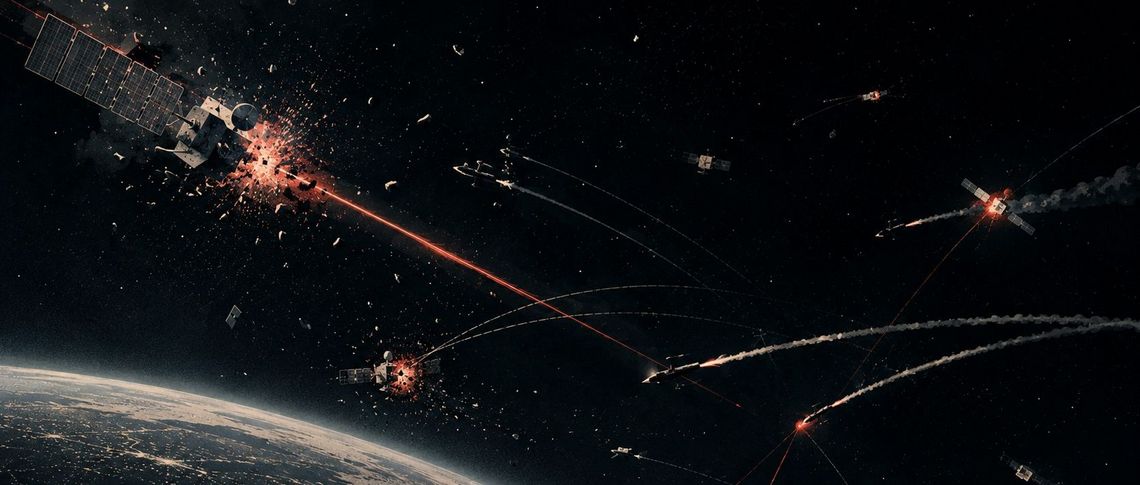
In the first half of June, Elon Musk is planning to float SpaceX on the stock exchange. With an expected valuation of up to two trillion US dollars, the IPO could make Musk’s space-exploration company one of the most valuable businesses in the world. In addition, rumours are growing about a possible subsequent fusion with Tesla, which could create a corporate empire of hitherto unknown proportions.
This Wall Street extravaganza represents the last nail in the coffin for a romantic illusion: space, long a peaceful domain of science, research and the pursuit of humankind’s ‘grand dream’, has now become an arena of economic, technological and geopolitical power plays in the fight to establish a new global order.
A new world disorder
Washington is currently showing the world just how it thinks this order should be forged in the 21st century – not, as in the past, via long, drawn-out negotiations at international organisation level, but via a national-level alliance of unfettered tech capitalism and military might – and the uncompromising deployment thereof in order to further one’s own ends. In its rivalry with China, the US is deliberately using corporations to assert its geopolitical supremacy, tasking them with the creation of, among other things, an orbital infrastructure that it regards as the backbone of a modern state’s logistics, IT and military capabilities. We are thus facing a ‘new world disorder’, one in which the unipolarity of recent decades is increasingly giving way to a loose multipolarity.
In the meantime, Europe is caught on the horns of a structural dilemma. Though it has recognised the strategic importance of the orbital realm, it lacks the political and industrial capabilities to turn that into action. They may share the same objectives, but Brussels, Berlin and Paris are blithely pursuing their own agendas. While they conduct debates and produce prose, others are creating facts on the ground (and in space).
Europe is struggling to comprehend space not just as a realm with economic uses (communication, navigation and geo-information services) and a cultural function (science, research and education), but also as a ‘theatre’ for political power games and military stratagems. When the International Space Station is taken out of orbit at the end of this decade, the last form of peaceful cooperation between the US and Russia will also come to an end. Rather than collaboration, the space race of tomorrow will be defined by merciless competition, strategic rivalry and orbital congestion.
The dependence of modern economies on this orbital infrastructure is so complete that its failure could trigger a rapid return to pre-industrial conditions.
Nonetheless, space will continue to be the cornerstone (and Achilles’ heel) of every modern society. Fundamental to the growth of global telecommunications, satellite systems are used to coordinate international payment transactions, manage supply chains and synchronise electricity grids. The dependence of modern economies on this orbital infrastructure is so complete that its failure could trigger a rapid return to pre-industrial conditions. Given the increasing upheaval in the international order, such a scenario now feels less like a dystopian vision and more like a genuine possibility.
Consequently, states have begun treating their orbital systems as critical infrastructure, not least due to such systems’ massively increased military importance — without space-based communication, reconnaissance and navigation, today’s armed forces would be flying blind. Those who control the orbital realm thus also dictate how we live – and die – on Earth.
The structure of this new world order, including the added dimension of space, is the subject of intense theoretical debate. One trend identified here is the move towards a loose multipolarity, with other gravitational centres existing alongside the two key systemic rivals, China and the US. Via a combination of highly precise, remarkably low-cost home-grown technology and tried-and-tested anti-satellite capabilities, India, for instance, has become an orbital heavyweight and will not be content to simply serve as a junior partner to other global powers. At the same time, the Gulf states and Brazil are also pushing into space and bypassing the traditional Chinese-American duopoly. Space is thus already a contested front in the battle for technological, political and military leadership.
Nowhere is this more apparent than in the rivalry between China and the US. Washington and Beijing are not only competing for market share and regional influence, but they are also increasingly facing off in this new theatre, with each seeking technological and political dominance. That competition spans everything from anti-satellite weapons and huge satellite constellations in low Earth orbit to strategic infrastructure and resources in space.
The economic and diplomatic dimensions of space power are also often underestimated. China, in particular, is deliberately using the export of space infrastructure for geopolitical ends, be it satellite systems for Nigeria, ground stations for other African states or launch facilities for partner countries. It’s all part of Beijing’s strategy of creating long-term technological, financial and operational dependency. These relationships could pay dividends at a later date, when it comes to votes in international organisations, for instance, or agreements on global standards. Space technology is thus not just about military objectives; it’s also increasingly about economic and political influence.
Europe’s predicament
These developments throw the European position into sharp relief. Thanks to the gulf between its strategic aspirations and its real-world dependency, Europe finds itself in a structural dilemma. There has been no shortage of strategies and policy papers from both the European Union and the European Space Agency. The problem has been putting them into practice.
While the US is relentlessly pushing the aforementioned alliance between the Pentagon and tech billionaires and China is pursuing its space strategies with planned-economy rigour, Europe is cultivating institutional fragmentation. Among the consequences of this sectionalism is the absence of reliable, permanent space-launch facilities. Thanks to crises of its own making, Europe has at times been embarrassingly dependent on American private operators such as SpaceX, the very operators whose monopoly power its politicians have railed against in stump speeches.
The issue of economic sovereignty goes far beyond the procurement of particular microchips.
Europe’s predicament goes even deeper, however, being not so much a question of resources as one of mentality. European governments avoid risk, regulate embryonic technologies and can only look on in wonder as, elsewhere, innovations manage to make it into industrial mass production. Europe possesses high-level technological know-how but lacks the drive required to rapidly turn it into robust, market-ready and, above all, security-relevant systems. As a result, Europe remains stuck in its accustomed role — acting as the moralising rulemaker while lacking the ability to put plans into action and see them through.
Brussels seems to have at least belatedly woken up to the significance of this issue. In June 2025, the European Commission outlined the basic elements of an actual policy on strategic autonomy. Its central insight was that there can be no sovereignty in space without absolute sovereignty on Earth. Resilient supply chains, industrial capacity, independent manufacturing capabilities and flexible funding structures — these are the rather banal preconditions that need to be in place before a space infrastructure programme with European security standards can even get off the ground.
In this context, the Commission has identified a range of critical space technologies where serious geopolitical risks and supply chain dependencies exist. These include microelectronics, semiconductors and special materials, much of which has to be imported from the US or Asia. The debate around this issue underlines the fact that technological dependency in the space domain is not just a theoretical economic issue; it’s a basic question of European security.
The issue of economic sovereignty, meanwhile, goes far beyond the procurement of particular microchips. What matters is control over the platforms, data streams and architectures of global value chains. Those who command these invisible networks in space will not only hold sway over technological systems; they will also control access to markets and dictate the terms of tomorrow’s economic dependencies.
The space race isn’t just about technological and military supremacy; it’s also deeply intertwined with systemic norms.
Moreover, recent experience has taught us that it’s not enough to have control over such systems. You need to be able to ensure their secure and robust operation too. In addition to independent access to technologies, strategic autonomy thus also means being able to keep them functioning in times of crisis or conflict.
The space race isn’t just about technological and military supremacy; it’s also deeply intertwined with systemic norms. The US is exporting a model of private enterprise-led infrastructure, while China is pushing an array of state-controlled digital space tech. To date, Europe has had very little success in translating its own values – transparency, rule of law and institutional dependability, for instance – into a convincing global offering. This results in a credibility problem; after all, if you’re constantly moralising about ‘strategic autonomy’ but can’t achieve it yourself, you’ll earn pity rather than respect on the geopolitical stage.
If it wants to have geopolitical leverage, Europe clearly can’t respond by isolating itself from other powers. Strategic autonomy is not a rejection of the transatlantic partnership but a necessary material complement to it. As long as Europe has to regularly go begging to Washington or to private tech giants to meet its reconnaissance and communications needs, or to defend its own vital economic arteries, then it can’t act as an equal partner. In such a situation, it is a useful vassal rather than a genuine ally.
Europe’s ability to overcome its own institutional fragmentation, rather than the content of its next strategy paper, will thus be the litmus test for what’s left of its credibility. Strategic autonomy is not about words. It’s about possessing the ability to independently develop, fund and manufacture critical systems — and having the means to defend them in the event of conflict. It’s this that will determine Europe’s future status as a strategic actor.