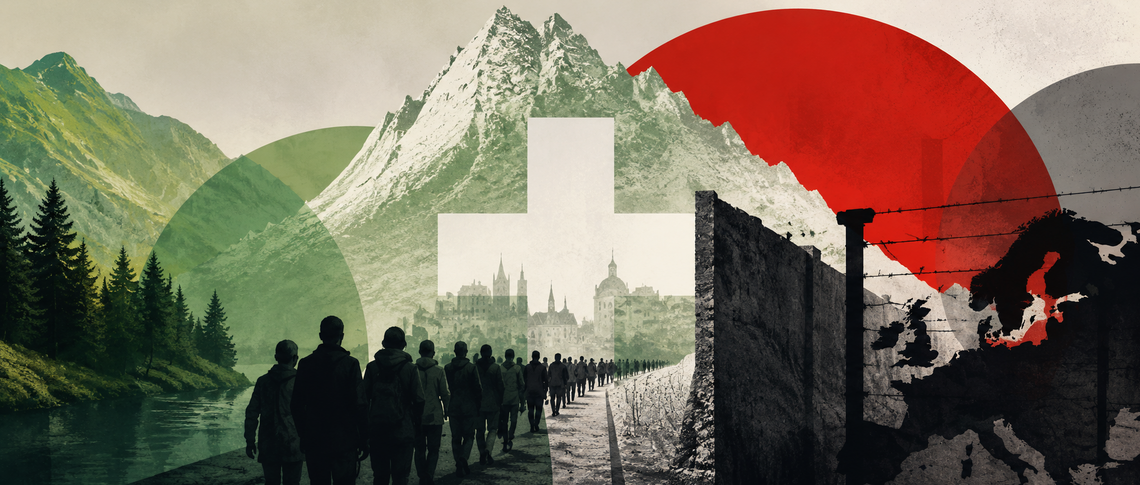
As the world’s first country, Switzerland might introduce a 10-million population cap, hard-wired in its constitution after a referendum on Sunday. What happens when that goal is reached? The government would have to withdraw from all ‘population-driving’ international agreements, the referendum’s initiators demand.
That means Switzerland would leave the European Convention on Human Rights, the Refugee Convention and the UN Convention on the Rights of the Child. Most importantly, it would have to quit its free-movement agreement with the EU, which contributes greatly to the country’s wealth (that, and... being a tax haven). The EU is the country’s largest trading partner, accounting for 60 per cent of its trade — imagine tariffs and border controls on that. The initiative would thus severely damage Switzerland’s economy and international legal commitments, especially its ties with the EU.
Despite these costs, the strategy of the referendum’s far-right initiators has proven politically viable. By repackaging anti-immigration politics as environmental protection and demographic sustainability, the Swiss far right goes far beyond traditional immigration policy, pioneering a form of ‘econationalism’ that could soon be copied across Europe.
There’s a lot at stake
This would not happen in some distant future: Switzerland already has a population of 9.1 million, and according to its statistics office, the 10 million mark could be reached as early as 2040.
The country’s population growth has been remarkably fast: Since 2000, it grew by 26 per cent, compared to only two per cent in Germany. The country has Europe’s third-highest share of foreigners (behind Luxembourg and Liechtenstein), with just under a third of its population not holding Swiss citizenship (over half of them come from EU countries).
But Switzerland’s wealth also grew massively in the same period. GDP per capita increased by a fifth, median income by a fourth, and median wealth by one and a half. It’s mostly the agreements with the rest of Europe and foreigners’ work – as managers, architects, biologists, construction workers, nurses, artists, musicians – that helped boost the Swiss economy and culture.
If successful and implemented, this measure would tank the so-successful Swiss economy and kill its culture.
If you think: ‘This is insane. Swiss people would never want to crash their own economy.’ Sadly, you’re wrong. It’s actually quite a close call: according to the latest polls, 45 per cent of Swiss people would vote yes, while 52 per cent would vote no.
But there is another issue at stake here, beyond Switzerland’s economy and relationship with its neighbours. Regardless of whether this initiative passes, this is a new way for the far-right to mobilise — and parties around Europe will learn from it.
A bellwether for Europe
The Swiss People’s Party (SVP), which is behind the initiative, used a particularly nasty strategy. They labelled it a ‘sustainability initiative’, linking ecological concerns about density stress with nationalist policy. This econationalism is the far-right’s dangerously simplified response to the climate crisis: blame the migrants instead of Big Fossil. Instead of now addressing the climate crisis and trying to mitigate what we still can, the far-right is choosing the cheap way out: claiming migrants cause Switzerland to build too much and therefore destroy the country’s hailed nature.
Econationalism itself is not a new concept — coined by Jane Dawson in the 1990s, it turns ecological grievances into vehicles for nationalist mobilisation. Today Europe’s far-right uses this framing: France’s Rassemblement national (RN) defends national terroir and landscapes against globalisation, Germany’s Alternative für Deutschland (AfD) wraps conservation in Heimat rhetoric, and Spain’s Vox casts rural land and hunting traditions as national heritage under threat — nature recast as ethnic patrimony rather than a shared global concern.
And it’s set to get much worse. Water scarcity, extreme weather and sea-level rise due to the climate crisis will inevitably cause more migration to Europe in the future — something no population cap can prevent. When migration inevitably increases, it’s not too difficult to imagine AfD or RN demanding similar population caps.
When migration inevitably increases, it’s not too difficult to imagine AfD or RN demanding similar population caps.
At the end of May, representatives of the European far right met in Portugal for a ‘remigration summit’, where they openly discussed how to expel big parts of Europe’s population because they aren’t ‘European enough’. By linking this with concerns about biodiversity loss and density stress, they’re opening up to potential new voters.
Switzerland is a political bellwether for Europe. The SVP became dominant much earlier than its European counterparts: Since the 1990s, it has been the largest party in the national parliament, with around a third of the votes. The proposal is reaching the ballot thanks to one of Switzerland’s direct democracy tools: the popular initiative. If campaigners collect 10 000 signatures, it triggers a vote on constitutional change.
The Swiss far-right has been very good at using this tool to push for ideas that other countries’ far-right would pick up later: Already in the 1970s, its ideological predecessor pushed for an initiative which would have introduced a 10 per cent foreigner cap in every single canton (except Geneva) — which would have led to the expulsion of up to 400 000 people. It was narrowly rejected.
Successful was the SVP in 2009, when Swiss voters approved a ban on the construction of new minarets. In 2010, Swiss voters approved the automatic revocation of residence permits for convicted foreigners — a topic which became big in other countries only in recent years. In 2014, Switzerland voted to reintroduce immigration quotas, which tested EU-Swiss relations. And in 2021, it successfully campaigned to ban burqas — even though there are no women wearing burqas and only around 30 wear niqab in Switzerland.
Their next initiative is already loading: they want to introduce an annual cap of 5 000 refugees that the government can accept — which once again breaches international human rights law.
Whether the far-right’s econationalism will actually become Europe’s policy is open. But if the debate around this initiative and migration around the continent is anything to go by, we are headed for a dark, nativist future.