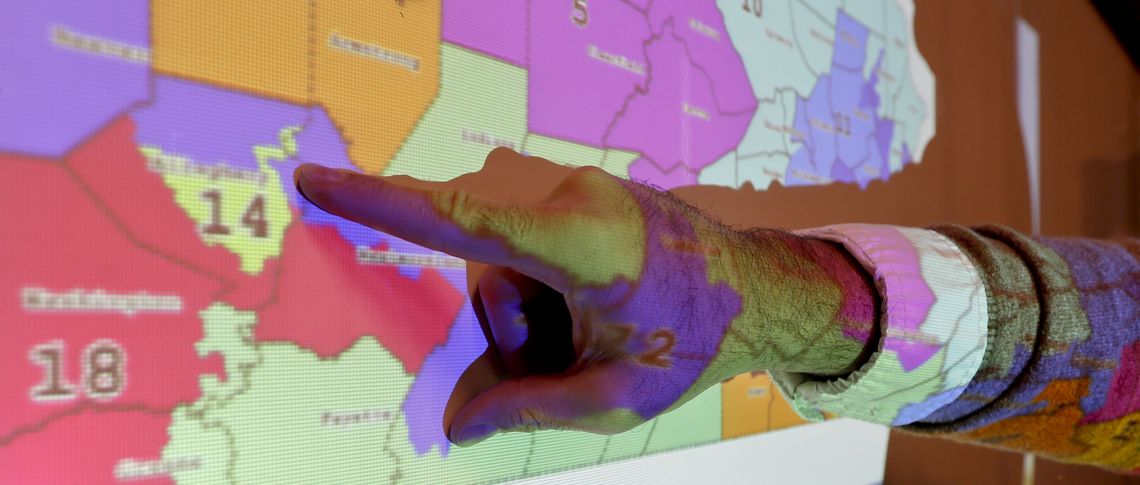
It looks as though the Republicans are winning the race to redraw constituency boundaries in the US, a process now referred to as the ‘gerrymandering war’. At President Donald Trump’s behest, his party has managed to carve out the potential for up to 16 additional seats in the House of Representatives since last year. On the Democratic side, there are so far only six potential new seats. It therefore looks very much as though Trump is once again imposing his will with full force.
But whether this supposed advantage will actually pay off is far from certain. Because this desperate attempt to retain majorities in Congress despite record-low approval ratings is not a Republican masterplan, but a risky move with an uncertain outcome.
Fighting fire with fire
In the US, electoral districts are usually redrawn roughly every ten years following the national census. The last one was carried out in 2020. The parties are then permitted to divide the constituencies to their own advantage based on the census data. Americans call this process ‘gerrymandering’, ever since Governor Elbridge Gerry had a constituency in the state of Massachusetts redrawn in 1812 in such an abstruse manner that it resembled the shape of a salamander on the map. Gerry and salamander became ‘Gerrymander’. This tactical redrawing of constituencies has a long tradition in the US. What is unusual now is that Republicans – and, in response, Democrats too – are ‘gerrymandering’ in the middle of the decade, and on an unprecedented scale.
Trump claims that he is simply entitled to more Republican representatives from certain states because a corresponding number of people there voted for him in 2024. This is not only wrong in terms of democratic theory and, in most cases, mathematically incorrect, nor is it the real reason.
The President is desperate to prevent the Republicans from losing their majority in the House of Representatives. ‘You have to win the mid-term elections. If we don’t win the mid-term elections, I will be impeached,’ he said at a party event in January. This is because a Democratic majority in the House of Representatives could initiate impeachment proceedings. However, an actual impeachment would subsequently require a two-thirds majority in the Senate.
Another factor currently working in the Republicans’ favour is that, in most of the states they control, state legislatures and governments can simply approve new electoral maps.
That is why, since the summer of 2025, Trump has been pressing Republican-governed states to give him an advantage outside the ten-year cycle through partisan gerrymandering. This is not the sovereign exercise of power, but an act of desperation. For he and his loyalists have realised that, given their policies – which are disappointing even to their own voters – they have little other option if they are to retain even a semblance of a majority.
So far, the Republicans are well ahead in the battle for constituencies. However, that could change. Driven by desperation, they are now largely exploiting their potential ahead of the mid-term elections. Only in a few states, such as Indiana and South Carolina, have the Republicans so far held back. In seven other states, however, the gerrymandering war is in full swing. The Supreme Court ruling, which at the end of April 2026 declared a provision of the Voting Rights Act against racially discriminatory constituency boundaries to be unconstitutional, paved the way for long-planned new electoral districts, particularly in conservative Southern states.
Another factor currently working in the Republicans’ favour is that, in most of the states they control, state legislatures and governments can simply approve new electoral maps. In most Democrat-governed states, by contrast, political and legislative barriers have been put in place in recent years to prevent partisan gerrymandering.
The Democrats must now not only make a 180-degree turn in their political arguments, but also circumvent recently enacted rules, for example through costly referendums.
Barack Obama campaigned against the practice for years because, in his view, it was undemocratic and exacerbated polarisation in the country. States such as California and Virginia set up independent commissions for impartial redistricting for the same reasons. The Democrats must now not only make a 180-degree turn in their political arguments, but also circumvent recently enacted rules, for example through costly referendums. As a result, they have so far been unable to come close to realising their potential for rapidly changing constituency boundaries.
California’s Governor, Gavin Newsom, was the first Democrat to decide last year to ‘fight fire with fire’ after the Republicans in Texas had carved out five additional seats for themselves. Newsom put a new Californian electoral map to a public vote, which is intended to give the Democrats five extra seats in turn.
The risk of dummymande
Although other Democratic states subsequently declared themselves ready to fight, they have so far failed to overcome the hurdles they set for themselves. Only in Utah have Democrats managed to win an additional seat. In Virginia, the new electoral map, which, as in California, had been approved by citizens in a referendum, is being held up by the state constitutional court on ‘procedural grounds’. That does not mean, however, that the map cannot be approved at a later date.
In New York and Colorado, the constitutions would even have to be amended to allow partisan gerrymandering once again. This is no longer possible before the mid-term elections, but it certainly is by 2028. New York is already preparing for this. So far, the Democrats have been unable to keep up in this race. But it is only a matter of time before they catch up.
Yet even regardless of how strongly the Democrats fight back, it is by no means certain that the Republican gerrymandering campaign will pay off.
There is a short-term risk for the Republicans that the newly drawn constituencies are no guarantee of success. The new electoral districts are based on the 2020 census data. The information on the composition of the population is therefore already several years old. Anyone wishing to tailor constituencies as precisely as possible to the expected electorate is therefore working with an increasingly unreliable data set.
The Republicans are also basing their calculations on voter groups whose support is by no means guaranteed. Despite low poll ratings, they expect to continue receiving strong support from Latinos, even in the newly drawn constituencies in Texas and Florida. Latinos traditionally tend to vote Democrat, but have recently been increasingly backing Donald Trump.
The Republicans are increasingly focused on serving their president above all else, and are willing to take risks to achieve this.
However, current polls show just how much support the President is losing among Latinos during his second term. In February 2025, 36 per cent supported him; now, only 22 per cent do. Among Latinos who actually voted for Trump in 2024, approval ratings fell from 93 to 66 per cent over the same period. Although the president is not up for election this November, this dissatisfaction will also be reflected in the election results regarding seats in the House of Representatives. The Republicans cannot, therefore, really rely on the Latino vote in Texas and Florida.
Accurate knowledge of the electorate’s composition and its expected voting behaviour would be particularly important, especially in the face of such excessive gerrymandering. After all, the more a party spreads its potential voters across as many constituencies as possible, the more competitive the elections in those areas are likely to become. There is a specific term for this. Political scientist Thomas Brunell calls this hasty and greedy approach, which can even harm a party, ‘dummymander’.
However, the Republicans under Trump are not taking these risks because they are ‘stupid’ and know nothing about figures or constituency boundaries. The party is increasingly focused on serving its president above all else, and is willing to take risks to achieve this. Trump’s priority is to secure his power and to be able to govern with as little oversight as possible over the next two years.
At present, it is not even certain whether the gerrymandering war will pay off in the mid-term elections, even if the Republicans were to win all the new constituencies. Given the administration’s dismal performance and widespread aversion to the president, the Democrats stand a good chance of gaining more seats in the House of Representatives than the Republicans can secure through new constituency boundaries. The Republicans may currently be ahead in the gerrymandering war. Whether they will ultimately win it is far from decided.