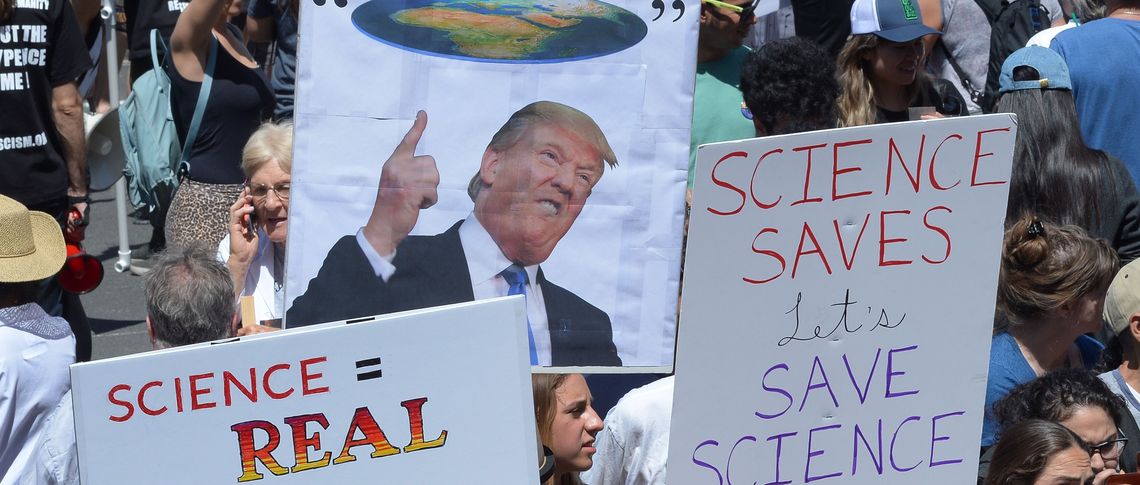
Far-right actors across the world are actively advancing their ‘war on science’ — from denying structural inequalities to questioning so-called gender ideologies by opposing gender mainstreaming, marriage equality, LGBTQIA+ rights and state-supported birth control. As part of this campaign, scholars, students and academic institutions are increasingly under attack. While many progressives often dismiss these attacks as just another chapter in the culture wars – noisy, polarising, but ultimately symbolic – they are better understood as a strategic bid for discursive dominance and, ultimately, political and societal control.
From the United States to Europe, far-right movements are not merely criticising ‘wokeness’. They are constructing parallel knowledge systems, systematically discrediting research that challenges their narratives and preparing loyal elites to replace critical scholars within universities, think tanks and public institutions. What is at stake is the authority of science itself — the power to decide what counts as evidence, whose expertise is legitimate, which questions may be asked and whether knowledge production serves to challenge power or to advance ideological agendas.
Redefining reality, one day at a time
In The Handmaid’s Tale, Margaret Atwood writes: ‘in a gradually heating bathtub you’d be boiled to death before you knew it.’ This image of slow, almost imperceptible transformation reflects far-right tactics today, gradually monopolising key areas of public knowledge creation and contestation.
Many traditionalist and patriotic parties have already shifted from the periphery to the political mainstream. And in both the United States and across the European Union, attacks on scientific institutions – and the knowledge they produce – have been increasing when such knowledge challenges or undermines their ideologies. Their strategy, described by researchers as counter-knowledge, involves manufacturing alternative realities by mimicking academic legitimacy in order to reshape and redefine reality itself. It thus goes far beyond merely opposing what they label ‘woke indoctrination’ but serves to erase pluralistic perspectives from wider academic and public discourse and establish discursive dominance.
Attacks targeting feminism and reproductive rights, in particular, serve as ‘symbolic glue’, enabling these actors to mobilise broader political support by framing social change and equality as threats to traditional norms and national identity. Diverse societal and political actors – religious authorities, right-wing politicians, public intellectuals, journalists – form alliances around shared anti-gender agendas to oppose feminism and policies promoting gender or sexual equality. These transnational networks have grown much stronger in the past decade, not only through ideological alignment but also thanks to substantial financial backing from conservative donors, who heavily invest in digital media platforms and content.
By framing gender studies as having been captured and instrumentalised by the political left, these actors reinforce their narrative through appeals to what is described as ‘real science’, particularly biology, which is presented as having definitively established the existence of only two genders. This position is deliberately set in opposition to gender studies, seeking to delegitimise an entire academic field and, in turn, undermine critical interpretations of gender and the broader feminist struggle grounded in this scholarship. This strategy is not accidental. The critical interpretation of social reality has a long history of exposing injustices, with universities playing a central role in questioning and examining the status quo.
Unsurprisingly, the normalisation of anti-science discourse in the US has led many in the public to gradually accept the attacks on universities, legitimising efforts to restrict academic freedom and reshape knowledge production.
These continuous attacks on academia – aimed at delegitimising entire academic fields such as gender studies – are accompanied by coordinated disinformation and targeted campaigns across digital media platforms, including Facebook, X, Instagram, TikTok, Telegram and YouTube. These new forms of content and socialisation spaces have emerged as an alternative media system that adopts the techniques of brand influencers not only to attract audiences, but to reshape reality itself. Thus, extending their reach, shaping public perception and reinforcing their ideological narratives, effectively merging academic assault with online propaganda.
For example, by framing scholarship such as gender studies as a threat to free speech, new media personas flood digital platforms with ideological content designed to permeate public conversations. Simultaneously, ‘filter bubbles’, in which counterarguments are conspicuously absent, help to popularise this messaging. In doing so, these actors replicate the almost imperceptible process Atwood describes — gradually reshaping norms and perceptions until their ideological goals are normalised.
Since the mid-2010s, podcasts, in particular, have grown rapidly as a medium for communication, discussion and entertainment. This provides a stage for figures like Jordan Peterson, Ben Shapiro, Charlie Kirk and Matt Walsh on issues such as racism, feminism, cancel culture, political correctness and ‘wokeness’, with ‘critical theory’ being the main target for their attacks.
The popularity of these media platforms can partly be explained by their accessibility, which allows anyone with a microphone and internet access to broadcast ideas to a global audience. However, the scale of anti-science attacks is not driven solely by individual actors or content. It is also shaped by whole media infrastructures increasingly owned and controlled by a small group of powerful individuals, through which content is strategically produced, curated and algorithmically amplified to advance broader ideological agendas and play a key role in the far right’s ‘radicalisation pipeline’.
Unsurprisingly, the normalisation of anti-science discourse in the US has led many in the public to gradually accept the attacks on universities, legitimising efforts to restrict academic freedom and reshape knowledge production. Already during its first term, the Trump administration undertook a series of anti-science actions, including censorship, budget cuts, personnel changes, interference in university research, and the banning of books on sexual and racial identity in public schools (including Atwood’s The Handmaid’s Tale).
Following the re-election of Donald Trump, federal pressure has intensified, particularly through the withdrawal of funding from universities and research programmes considered inconsistent with MAGA policy agenda, including work related to diversity and climate change. This has been accompanied by continuous efforts to influence university admissions, hiring practices, research priorities, teaching content and disciplinary procedures. As of February 2026, several US public universities, including Texas A&M University, have closed down their women’s and gender studies programmes, changed the syllabuses of hundreds of courses and cancelled six classes as part of a new policy that limits how professors can discuss some race and gender topics.
Not just a US problem
While many experts continue to believe that the public commitment to protecting and promoting academic freedom remains strong in Europe, a 2025 Council of Europe report identifies many emerging trends and warning signs. These include the growing scrutiny of academic freedom through reduced institutional autonomy, cuts to research funding and increased political oversight of fields of study described as ‘undesirable’. It is worrying for many reasons, as the development in the EU follows the same strategy as intervention online, with media platforms disseminating knowledge and spreading misinformation directly to a much broader audience, reaching people beyond academic spaces.
These alliances and networks were perfectly mapped out in a report published by the European Parliamentary Forum for Sexual and Reproductive Rights in 2025, which analyses the rise and strategies of anti‑gender, anti‑rights and religious extremist movements in Europe and makes a deliberate link to anti-science. The scale of these interventions is already substantial, ranging from supporting think tanks, charities and political foundations that undermine progressive fields of study to establishing so-called ‘higher knowledge institutes’ deliberately modelled on universities, such as the Institut de sciences sociales, économiques et politiques (ISSEP), active in France and Spain. The objective is clear and deeply troubling: ‘to create a new cadre of educated, anti-rights elites to fill positions in political parties and, eventually, public administrations’.
The value of science is rarely self-evident in everyday experience; it must be continuously demonstrated and communicated in ways that reach diverse audiences beyond academic circles.
Addressing these coordinated alliances and networks requires clarity about what is at stake. For progressives in Europe, this means recognising the struggle over knowledge production and academic institutions as a central political battleground, rather than dismissing it as merely another episode in the culture wars.
The defence of academic freedom and critical inquiry cannot remain a fragmented or narrowly professional concern left to universities alone. It demands coordinated engagement from political actors, academics, NGOs and trade unions to confront proactively the strategies through which these movements seek to reshape the production and legitimacy of knowledge. At the same time, scientists themselves must move beyond the traditional boundaries of the ‘ivory tower’ and engage more visibly in public life. By communicating their research in an accessible language and participating more actively in public debates, including on digital media platforms, they can help rebuild trust in scientific expertise and counter the spread of misinformation.
The value of science is rarely self-evident in everyday experience; it must be continuously demonstrated and communicated in ways that reach diverse audiences beyond academic circles. Strengthening science communication, fostering dialogue between researchers and wider society, and improving access to knowledge are therefore essential steps in reinforcing public confidence in evidence-based inquiry.
Ultimately, defending the integrity and authority of knowledge in Europe must become a broader political project. Efforts to disrupt how knowledge is produced, validated and used are inseparable from defending democratic institutions.