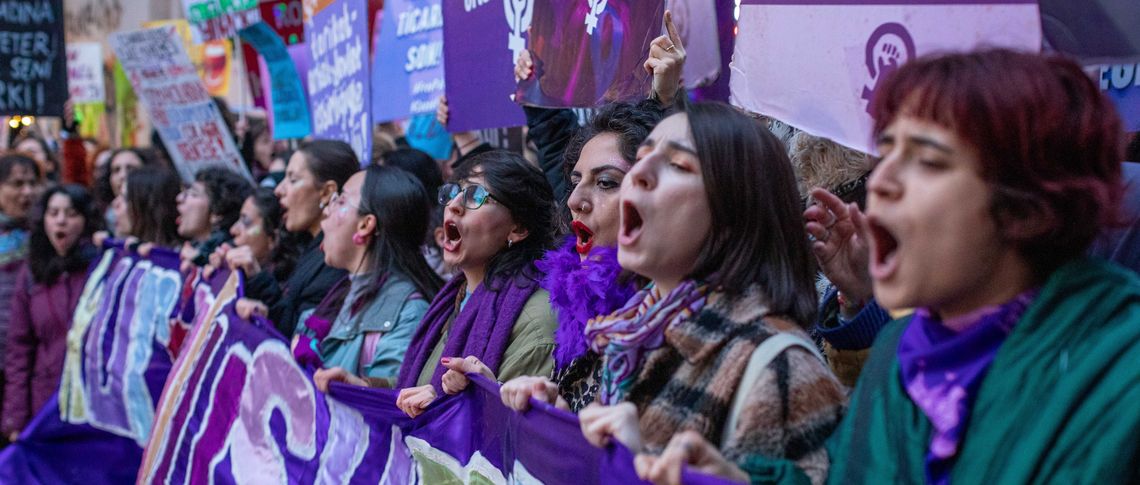
Over the past two decades, Turkey has undergone a profound authoritarian transformation. Under AKP rule (in power since 2002), the space for political opposition has steadily contracted: press freedom has been gutted, civil society organisations shut down or co-opted, and the legal and electoral frameworks increasingly bent toward the consolidation of power. The tools of this transformation are by now familiar. Which is not limited to outright repression, but a more systematic effort to delegitimise the opposition by fragmenting it, discrediting its leadership, and making organised dissent appear either dangerous or futile. In this context, sustaining any form of political opposition is genuinely difficult.
Yet that is precisely what the feminist movement in Turkey has done. The feminist movement has remained a consistent, visible, and expanding political force, capable of bringing tens of thousands of women onto the streets and articulating demands that cross deep political divides. The feminist movement in Turkey has built an alternative political possibility: a living demonstration that politics can be practiced differently, that opposition need not mirror the power it resists. And that collective action organised around shared experience rather than ideological uniformity can hold ground even as authoritarian pressure mounts. In a political landscape where the question of how opposition survives is increasingly urgent, what the feminist movement in Turkey has built is not merely a local story. It is a case study in political possibility.
Anger uniting all
The feminist movement in Turkey began to organise in the 1980s. Largely driven by women from leftist movements, it developed its unity through the struggle against patriarchy with a comprehensive feminist perspective. This also meant that their understanding of feminism positioned itself against multiple systems of oppression, including racism, nationalism and capitalism. The movement adopted a campaign-based mode of organising, which enabled it to remain decentralised. This decentralised structure was not designed as a counter-strategy to authoritarian pressure; it reflects the political logic of feminism. But in the Turkish context, it has produced an unintended structural advantage: a movement with no single centre cannot be dismantled by targeting its centre. And thus, this movement is able to organise quickly under today’s challenging conditions and to come together around specific issues as separate groups. This resilience also weakens the effectiveness of the AKP’s strategy of delegitimisation, which aims to fragment and discredit social movements by targeting centralised structures and visible leadership.
From the outset, the AKP’s conservative agenda targeting women has provoked a lot of anger. As a direct response, during moments of broader political repression, when social freedoms were curtailed and opposition intensified, women intervened with distinctly feminist responses. Feminism’s reach extends beyond anti-AKP opposition precisely because it does not limit its critique to state policy. It names a system of male domination that predates the AKP, cuts across political lines, and shapes women’s lives regardless of their political affiliation. Women do not turn to feminism despite this broader critique, they turn to it because of it.
Even state-sanctioned alternatives could not remain insulated from the political energy feminism had generated.
Over the years, especially in the late 2010s, the AKP has adopted an increasingly authoritarian approach. Freedoms, particularly of expression and assembly, have been curtailed, and civic space has steadily narrowed. Within this context, the feminist movement’s ability to maintain a strong oppositional stance, stems from the rebellion women have accumulated in their own lives against male domination. The AKP has relied on discrediting the opposition, feeding off and reinforcing deep polarisation. Feminists, too, have been subject to efforts of marginalisation and delegitimisation. Yet the language of feminism - one that speaks to all women, recognises both differences and commonalities, and articulates demands and a mode of opposition that can be broadly embraced - is not susceptible to this. What distinguishes feminist language from other forms of oppositional discourse is not that it appeals to all women strategically, but through naming a system that produces different but related forms of harm across women’s lives, regardless of class, political affiliation, or region. Women do not find themselves in feminist politics despite their differences, they find each other through them.
The attacks on women’s rights and gender equality, made concrete through the AKP’s withdrawal from the Istanbul Convention, have affected women’s lives in multiple ways. The prevalence of violence against women, femicides and the impunity enjoyed by male perpetrators persist alongside state policies that define women primarily through the family and place the burden of care squarely on their shoulders. As if this were not enough, the reopening of debates on issues such as alimony, abortion and inheritance further fuels women’s anger. This response is not limited to women in opposition to the AKP, but also comes from those aligned with it politically. The emergence of GONGOs (government-organised non-governmental organisation) as an attempt to channel women’s organised presence, rather than suppress it, itself testifies to the strength of that demand. Even state-sanctioned alternatives could not remain insulated from the political energy feminism had generated. Even women’s organisations established as GONGOs, intended to promote the AKP’s gender ideology, one that replaces equality with the notion of ‘fitrat,’ a religiously grounded idea of gender difference, have at times taken positions critical of the policies they are meant to support.
Women in different local contexts and everyday realities circulate feminist claims, permeate other political movements, and find in that shared articulation something that organised politics rarely offers: the recognition that what felt personal was structural all along.
The feminist movement in Turkey does something that few other opposition formations currently can: it converts the accumulated weight of patriarchal experience in everyday life into collective political language and action. Women in different local contexts and everyday realities circulate feminist claims, permeate other political movements, and find in that shared articulation something that organised politics rarely offers: the recognition that what felt personal was structural all along.
The feminist movement’s trajectory over the past two decades offers something beyond a Turkey specific case study. In a political landscape where authoritarian consolidation has become a global pattern, it poses a concrete question to opposition movements elsewhere: what forms of organising can hold ground not despite repression, but through it?