


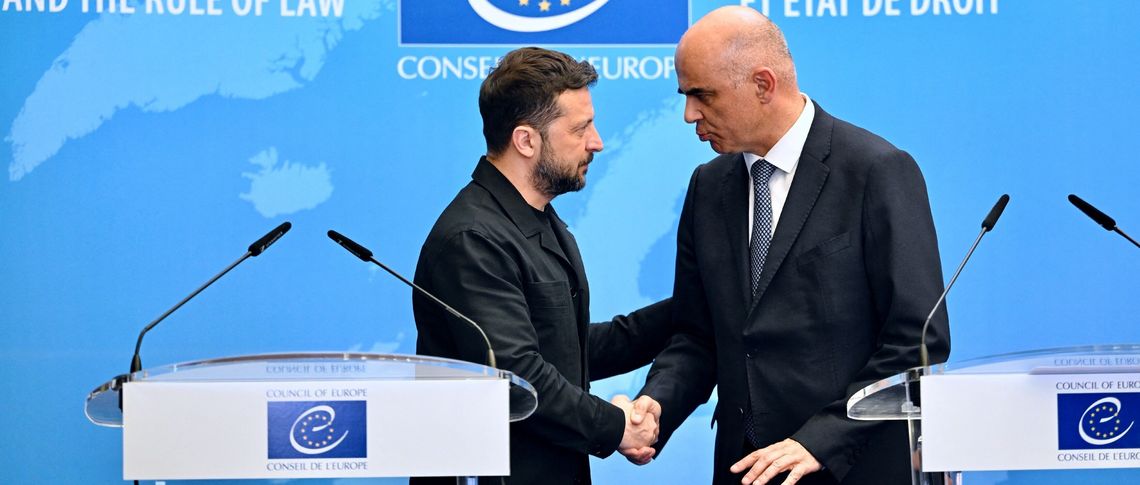
The Council of Europe rarely voices its opinions loudly. Its decisions are taken far from the limelight, despite the fact that it comprises 46 member states with a combined population of nearly 700 million. And still, it is in Strasbourg that the guidelines are drawn upon which the human rights framework and the protection of democracy and the rule of law in Europe are based.
Here, responsibility arises not from public attention, but from the voluntary commitment of the member states. And therein also lies the risk. Governments are happy to commit to legal obligations as long as they are politically convenient. But the decisive factor is whether they stick to them even when it comes at a political cost. If this pressure is absent, recognition becomes a mere gesture and implementation an exception. The result is not an open breach of the law, but insidious erosion and a loss of authority. This question takes on particular urgency in the context of Russia’s war of aggression against Ukraine: it will show whether the Council of Europe’s quiet order holds up in turbulent times.
Where external coercion is absent, voluntary commitment ensures the binding nature of norms without undermining the sovereignty of member states. Anchored in conventions, this commitment determines the actual validity of common norms and standards. But it can erode even without treaties being terminated. This is particularly evident at the European Court of Human Rights: if judgments are recognised but implemented only selectively or with delay, the commitment effectively loses its force.
The importance of self-commitment
In May 2025, these problems came to light. Nine governments – led by Denmark and Italy – called for a ‘new dialogue’ in an open letter. They were referring to the Court’s interpretation of the Convention on Human Rights, particularly in relation to migration policy. At its core, this was less about individual judgments than about the question of power: who ultimately determines the extent to which human rights obligations extend into areas of domestic policy that are politically sensitive? The Court’s interpretation itself thus became a test case: do the Court’s judgments set limits on state action – or is its authority, when in doubt, up for debate? The dividing line therefore, lies less in the interpretation than in the implementation by member states, right at the heart of everyday political business.
In the day-to-day work of the Committee of Ministers of the Council of Europe, the permanent representatives of the member states use national action plans, reports and deadlines to check whether judgments are being implemented and at what pace. This opens up room for manoeuvre: whether through prioritisation or through a generous interpretation of what ultimately counts as compliance.
The ‘Seehofer Deal’ continued to allow for accelerated returns without individual assessment. Ultimately, human rights standards were noticeably weakened.
It is precisely within these spheres that self-commitment is either upheld or undermined. If delays are tolerated and partial implementation is deemed sufficient, the pressure to comply and the Court’s authority diminish. Only if the Committee of Ministers uses its supervisory role to exert political pressure, thereby increasing the costs of non-compliance, can the Council of Europe’s intricate mechanisms take effect. The case of the imprisoned human rights activist Osman Kavala shows that enforcing judgments remains difficult even then. In May 2020, the Court issued a final judgment against Turkey and ordered his release. This has not yet happened – even after infringement proceedings were initiated as a last resort in February 2022.
This weak point is most starkly revealed where the state’s desire for control and human rights obligations collide directly: in migration policy. This is evident in the enforcement of a judgment against Germany from October 2024 — the Court criticised the immediate return of an asylum seeker to Greece via a bilateral return route, which had taken place without basic procedural safeguards. Yet the ‘Seehofer Deal’ continued to allow for accelerated returns without individual assessment. Ultimately, human rights standards were noticeably weakened.
A similar logic of erosion can be observed in the so-called Venice Commission. As one of the Council of Europe’s most discreet advisory bodies, it advises its 61 member states on legislation, constitutional reforms and adherence to democratic standards – rarely visible, but influential. If its opinions are politically gutted, for instance through disregard or public delegitimization, these standards remain only on paper. A current example is provided by the US’ announced withdrawal from the Commission in January 2026, which speaks more to its continuing political influence. Yet where exactly the limit of what is tolerable lies, without undermining the credibility of the organisation as a whole, remains open for the time being.
Measuring order
This uncertainty is no marginal issue. Unlike the OSCE, the Council of Europe does not act as a direct crisis actor. It acts as a guardian of human rights standards, curbs arbitrariness and upholds binding standards – even where military logic dominates. In this respect, the Palace of Europe in Strasbourg is not a command centre for current crises but rather, order is measured here, whilst elsewhere it comes under pressure.
Where standards under international law are contested, the Council of Europe sometimes draws firm lines. By expelling Russia in March 2022, it sent a clear signal. This bolstered its relevance, but at the same time limited its scope. For Ukraine, this fragile architecture is becoming a trial by fire; it will be the test of whether effective accountability can arise from a commitment to self-regulation.
In December 2025, this claim became a political litmus test — 35 countries, including the EU, signed a Council of Europe convention to establish an International Compensation Commission for Ukraine. For the time being, this is neither a judgement nor a guarantee of compensation. Rather, Europe’s self-imposed commitment is removed from the daily rhythm of political crisis and given a form that makes future reparations negotiable in the first place. The convention will come into force once at least 25 contracting parties have ratified it and start-up funding has been secured.
In Ukraine, as in other contexts of conflict, it is less a question of visibility than of reliability – of the ability to uphold commitments despite fluctuating political attention and limited capacity for enforcement.
This building block fits into a multi-tiered architecture of European accountability that forms the framework for a future post-war order. As early as May 2023, the Council of Europe laid the foundations for this in Reykjavík with the Register of Damage, documenting destruction and human rights violations resulting from Russia’s war of aggression. Over 100 000 claims have now been submitted – each one documenting an injustice. The register does not pass judgement, set sums or order payments. It is precisely in this limitation that its strength lies, it documents and preserves claims for compensation before they become politically enforceable.
Separately, the criminal prosecution of the crime of aggression is proceeding through a special tribunal outside the International Criminal Court. The Council of Europe and Ukraine agreed on this in June 2025. This decoupling is intended to prevent the question of Russian responsibility from being worn down in day-to-day politics. Simultaneously, the temptation is growing to offload the dispute into routines and procedures – because decisions can be quietly defused or postponed there. What is intended as an instrument of self-commitment can thus itself become mere administration of responsibility. The human rights order then does not collapse openly, but gradually loses its effectiveness.
2026 will be a stress test for the Council of Europe. Under the leadership of Secretary General Alain Berset, it will be decided whether he can effectively assert his claim as a guardian of order without overstretching it. In Ukraine, as in other contexts of conflict, it is less a question of visibility than of reliability – of the ability to uphold commitments despite fluctuating political attention and limited capacity for enforcement.
The financial conditions for this are extremely tight. The Council of Europe has less than half a per cent of the EU budget at its disposal each year. This makes a closely integrated division of labour with the EU and other international organisations all the more urgent; not as competition, but as a lever to bind member states permanently to their obligations and to strengthen trust in the organisation’s normative power in everyday life, particularly in times of a changing world order.
There are three key tests for 2026: first, whether the Compensation Convention is ratified and funded; second, whether the Committee of Ministers consistently drives forward the implementation of judgments; and third, whether the division of labour with the EU proves effective in day-to-day political business. This is where the real challenge lies. It is not in a state of emergency, but in the regular procedure that reveals whether self-commitment takes hold. Not in the mere existence of conventions, but in their consistent implementation. Especially when they become unwelcome or politically untenable. If this fails, the result is not disorder, but an order without effect – arguably the most deceptive form of stability.


