


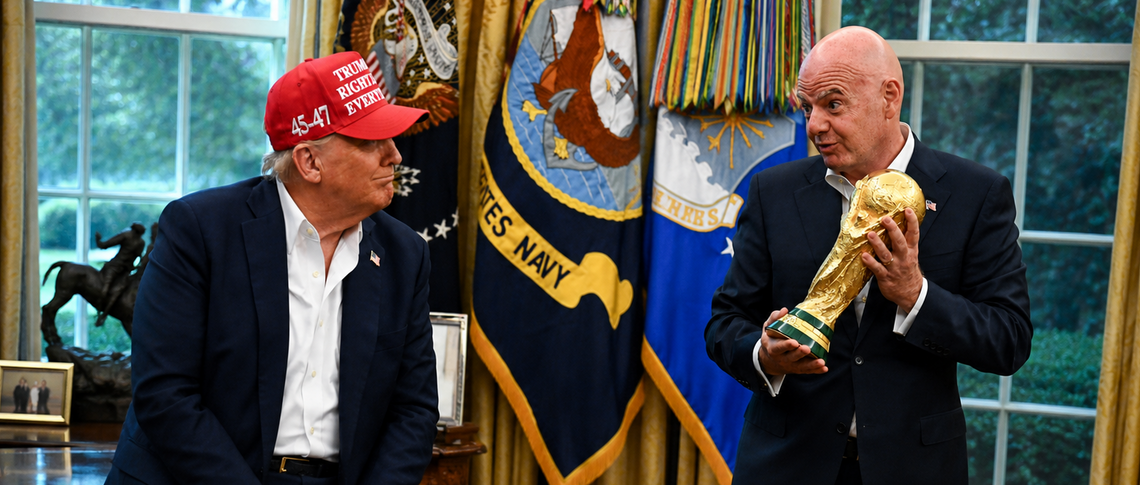
A video from a US sports channel paints a picture of a new summer fairy tale: The US versus Brazil, last minute, the US boys score, and the country becomes the world champions. A rather unlikely football miracle — but one that Donald Trump, in particular, is likely to be dreaming of. For Trump, the World Cup offers a chance to divert attention from his own failures. His popularity at home has hit rock bottom, particularly due to the recent war with Iran, with approval ratings now standing at just 37 per cent. The Republicans face the threat of a debacle in the mid-term congressional elections this autumn.
When the US submitted its World Cup bid in 2017, a certain Barack Obama was still president, and the US was a country that claimed to be a global role model for human rights. Admittedly, even back then, that self-image was of dubious credibility. But even Trump had not yet completely cast it aside during his first term. And he lobbied hard himself to bring the multi-billion-dollar spectacle of the World Cup to the US, together with co-hosts Canada and Mexico. At the time, he had already signed a free trade agreement with both countries.
Overshadowed by current issues — or is it?
Since then, the world has changed — significantly due to Trump’s disruptive policies in his second term, which have massively undermined international law and human rights both domestically and abroad. Europe has also lost a great deal of credibility because it has barely commented on the US’ breaches of the law and has done little to challenge them, for fear of upsetting Donald Trump. This is also evident in the run-up to the World Cup. With the tournament about to begin, things are surprisingly quiet: hardly any talk of boycotts, no international appeals to President Trump — just the smooth talk of the incumbent FIFA President Gianni Infantino, who fantasises about the ‘most inclusive World Cup’.
Not a word on the domestic and foreign policy situation under Trump. Yet FIFA’s list of concerns must be enormously long. On the one hand, there is Trump’s brutal and racist immigration policy. Up to half a million people have already been deported since he took office. He has transformed the immigration police, ICE, into a unit of masked and ruthless men who spread fear and terror, act without judicial basis and, in many cases, use disproportionate force, often with fatal consequences.
In less than a month, the World Cup is set to begin in a country separated from the continuation of a war against another World Cup participant by nothing more than a fragile ceasefire.
On the other hand, we see an aggressive and interventionist foreign policy. At the start of the year, Venezuela’s head of state, Maduro, was abducted by the US; Trump is currently stepping up his threats against Cuba. And on 28 February, Trump, who as recently as December 2025 was honoured with the FIFA Peace Prize, created especially for him, launched his war against Iran alongside Israel. The war is clearly classified as a violation of international law and has so far claimed over 3300 civilian deaths, 26 000 injuries and caused severe destruction. The Iranian regime has survived the attack and is now responding with maximum repression at home and demonstrations of power abroad. At the same time, Tehran has declared its intention to take part in the World Cup. After all, Iran was the first team from the Asian group to qualify for the World Cup.
Naturally, the Iranian leadership would be keen to exploit the World Cup for its own propaganda purposes. It is likely to try to prevent protests by its own players – who, for example, have refused to sing the national anthem in the past – by threatening severe sanctions. At the same time, large-scale protests are to be expected during the World Cup itself: Iran is scheduled to play two matches in Los Angeles. With up to 700 000 members, the city is home to the largest Iranian diaspora in the world and is also known as ‘Teherangeles’ among Iranian exiles. It therefore seems unlikely that Trump will be able to use the World Cup to make the war with Iran fade from memory. The issue will catch up with the tournament just as much as the brutal US immigration policy. This has created a grotesque situation: in less than a month, the World Cup is set to begin in a country separated from the continuation of a war against another World Cup participant by nothing more than a fragile ceasefire.
According to FIFA’s statutes, world football is supposed to be ‘apolitical’ — a notion that is a far cry from reality. The World Cup in Russia was already a source of controversy: the country was able to use the tournament to break out of its isolation following the occupation of Crimea in 2014, which violated international law. There was also massive criticism of the working conditions of foreign labourers, particularly those from North Korea. The criticism was even harsher in the run-up to the World Cup in Qatar. In the small desert state, two million migrants were working on World Cup construction sites under conditions that were, in some cases, appalling. And Qatar was just as uninterested in values such as diversity and human rights as the Russian organisers had been four years earlier. Numerous football fans turned their backs on the event, and fan groups actively supported calls for a boycott — whilst the DFB and UEFA, under pressure from FIFA, decided not to contradict the myth of the ‘apolitical World Cup’.
Rarely has a World Cup been as political as this one.
In light of the upcoming World Cup, the major human rights organisations that have joined forces in the Sport and Rights Alliance are raising the alarm. They are calling for fans, staff and journalists to be protected from repression, surveillance and discriminatory entry rules. Consequently, there is widespread concern among fans worldwide – and also among the governments of their home countries – about what might happen if they travel to the World Cup in the US. New regulations requiring the disclosure of social media activity from the past five years upon entry are not yet in force. However, individual travellers have reportedly already been turned away due to their critical stance. Citizens of various countries have for some time had virtually no chance of obtaining visitor visas for the US. Since the start of the year, this has also applied to four countries taking part in the World Cup: partial restrictions apply to Senegal and the Ivory Coast, whilst there is a complete entry ban on Haiti — and Iran.
All of this, however, stands in direct contradiction to the human rights obligations that, according to FIFA statutes, hosts of a World Cup must undertake. The World Cup in the US was actually supposed to be the first in which all host cities were required to submit a ‘human rights action plan’. With a few exceptions, this has not happened in the US. Instead, we face the prospect of yet another World Cup marred by serious human rights violations.
Rarely has a World Cup been as political as this one. The EU must, at the very least, press for fans from all over the world to be able to enter the country without hindrance and for freedom of expression to be respected. It should also use the sporting event to persuade Trump to abandon his threats and aggression towards other states. Without appropriate guarantees that freedom of expression, the right to demonstrate and freedom of movement will be respected, European fans too could soon find themselves caught in the crossfire of US immigration policy. And Europe’s already severely damaged credibility is likely to suffer further if we once again pretend that there is such a thing as an ‘apolitical’ World Cup.


